Prostitution and Illicit Sex in Baltimore, Commercialized Vice
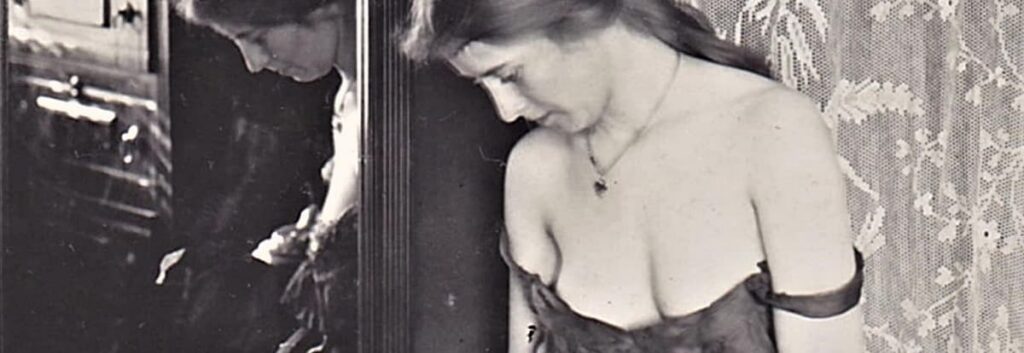
I first came across the Maryland Vice Commission reports on prostitution in Baltimore while researching my novel Into the Suffering City, set in the city in 1909. The Maryland Department of the Enoch Pratt Free Library holds the only extant copies, which exist on typescript pages. Contemporary Baltimore City officials suppressed the reports and most of the findings were never published.
The five reports are full of detail about every aspect of the sex trade — hundreds of interviews with sex workers, tabulated data on earnings and disease, and substantial evidence of complicity by businesses, the police, and the wider municipal establishment.
Prostitution was thriving, widespread, and deeply entrenched in Baltimore, according to the five reports. Much the same was true of other big American cities.
Prostitution in Baltimore: What the Investigators Found
 The Maryland Vice Commission did not trade in rumor. Its operatives worked undercover across the city, sitting down with madams, clients, and hundreds of the women themselves, then organizing what they learned with the still-new methods of sociology and public health. The result read less like a sermon than a ledger. Investigators set the money a woman could make in a bordello against the wages she had earned as a salesgirl or servant, recorded how many of those examined carried syphilis or gonorrhea, and traced the paths by which new recruits were drawn in from department-store counters, dance halls, and amusement parks. One tabulation followed 220 streetwalkers.
The reports also laid bare the economics that kept women in place: madams and cooperating merchants marked up clothing and daily necessities so steeply that a worker’s debts never quite closed. Threaded through the statistics were the women’s own accounts of how they had arrived — one explained simply that she had gone indoors because the streets were cold — testimony that gives the documents their staying power as a record of lives the official city preferred to forget.
Why Baltimore Buried the Reports
Of the five reports the commission delivered in early 1916, only the study of the trade in unwanted infants ever reached print. The other four were locked away, a striking act of concealment when more than thirty other cities and towns across North America were releasing vice findings of their own. Mayor James Harry Preston brushed the work aside as “a scandalous libel on life in Baltimore,” and the Society for the Suppression of Vice announced that the city had seldom been cleaner.
The resistance was not only rhetorical: a grand jury hauled in the commission’s chairman, the Johns Hopkins surgeon Dr. George Walker, and demanded the names of everyone his investigators had interviewed so they might be prosecuted. Walker refused, absorbing threats of a contempt charge rather than surrender his sources. A few voices broke the silence—the physician-reformer Dr. Howard A. Kelly answered with a pamphlet, “The Double Shame of Baltimore,” insisting that the real disgrace lay not in the vice but in the city’s resolve to look away. The furor cooled within months, and the buried reports slid into library typescript, where they waited the better part of a century for someone to read them.
The Enoch Pratt Free Library holds the original typescripts — the set Dr. George Walker gave it — and has digitized all five volumes, each with a keyed transcript, in its Maryland Vice Commission Reports collection at Digital Maryland.
- Volume 1: Prostitution (Digital Maryland) — the organized trade: the houses, the madams, the money, and the women’s own accounts of how they arrived.
- Volume 2: Industrial Conditions, Clandestine Prostitution, Abortions, Etc. (Digital Maryland) — industrial conditions and the wages of working women, clandestine prostitution, and abortion.
- Volume 3: Furnished Rooms, Saloons, Theatres, Dance Halls, Etc. (Digital Maryland) — the commercial spaces where solicitation was done: rooming houses, hotels, restaurants, moving picture theatres, dance halls.
- Volume 4: Prostitution in Baltimore County, Anne Arundel County, and the Cities of Hagerstown, Frederick and Cumberland (Digital Maryland) — the same inquiry carried past the city line.
- Volume 5: Investigation of the Traffic in Babies (Digital Maryland) — what became of infants born to unmarried mothers, documented through interviews with one institution’s superintendent, midwives, nurses, physicians and hospital officials.
Digital Maryland shows each volume as page images in a viewer and pairs it with a transcript keyed from the original — steadier ground for close reading and citation than machine-read text.
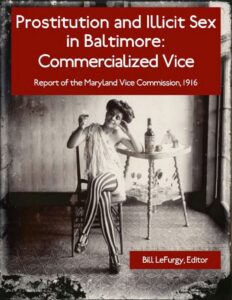
I have also published the first volume on its own as a fully searchable PDF, with an introduction: Prostitution and Illicit Sex in Baltimore: Commercialized Vice, Report of the Maryland Vice Commission, 1916 (pdf, 463 pages; ISBN 978-1-7345678-5-4). It is the same document Digital Maryland catalogues as Volume 1, with a text layer added throughout; download the whole report and search all 463 pages, offline and by word or phrase.
The One Report That Reached Print
The traffic in babies is the single part of the Commission’s work that saw publication in its own time, and it got there because Walker published it himself. In 1918 the Norman, Remington Company of Baltimore issued The Traffic in Babies: An Analysis of the Conditions Discovered During an Investigation Conducted in the Year 1914 under his name. It is free to read at the Internet Archive.
The book and the typescript above are not the same document.
Walker’s book is the wider of the two. The typescript covers a single institution — the Commission called it Institution No. 1 — and ends with its notes on the death and burial of infants. The book carries all of that and then keeps going: a second institution, interviews with physicians, clergymen, nurses, midwives and social workers on the separating of mother and child, investigations of hospitals and of boarding homes for children, the results of an experiment in advertising a home for a very young infant, and an appendix printing the Maryland law the investigation produced.
For the ground the two share, though, the typescript runs about three times longer. Walker cut heavily for print, and the manuscript preserves what he left out. He anonymized more thoroughly once he was publishing, too, replacing names with a formal key — P1 and P2 for physicians, M1 and M2 for midwives, Hospital 1 and Hospital 2 — where the typescript makes do with looser initials.
Set side by side, the two show a Progressive-era investigator deciding, three years after the fact, how much of what he had found the public should be permitted to see.