
Mary Miles Minter on William Desmond Taylor: Full Transcription of Three 1923 Newspaper Accounts
Originally published in the Los Angeles Examiner, August 14, 1923, Section 1, pages 1 and 4; the Los Angeles Evening Herald, August 14, 1923, pages 1 and A—15; and the Los Angeles Times, August 15, 1923, Part II, pages 1–2.
About Mary Miles Minter
Mary Miles Minter (1902–1984) was an American silent-film star. William Desmond Taylor directed several of her films before he was murdered in his Los Angeles bungalow in 1922. Affectionate letters attributed to Minter were found among Taylor’s possessions, drawing her into one of Hollywood’s most enduring scandals. Her final film, The Trail of the Lonesome Pine, was released in 1923.
About these accounts
Eighteen months after Taylor was murdered, and in the middle of a public quarrel with her mother over her film earnings, Minter gave three accounts of her relationship with him to three Los Angeles papers within about thirty hours. Documents A and B are features written by reporters who quote her; Document C is a statement published under her own name. They do not agree. The first two report her saying she and Taylor were engaged to marry at the time of his death; the third, printed the next morning, says he never proposed and that marriage was her private hope. The two features also end the morning of the murder in incompatible ways.
Each is transcribed here in full from the original pages, with the papers’ own headlines, subheads and errors preserved. Why she spoke when she did, and what the surrounding week shows, are discussed separately in Why Did Mary Miles Minter Talk About William Desmond Taylor?.
Minter’s career and what became of her are sketched in 16 Forgotten Silent Film Stars. This edition belongs to a series of silent film and Jazz Age primary sources transcribed here in full.
Contents
- Document A — Los Angeles Examiner, August 14, 1923
- Document B — Los Angeles Evening Herald, August 14, 1923
- Document C — Los Angeles Times, August 15, 1923
- Textual notes
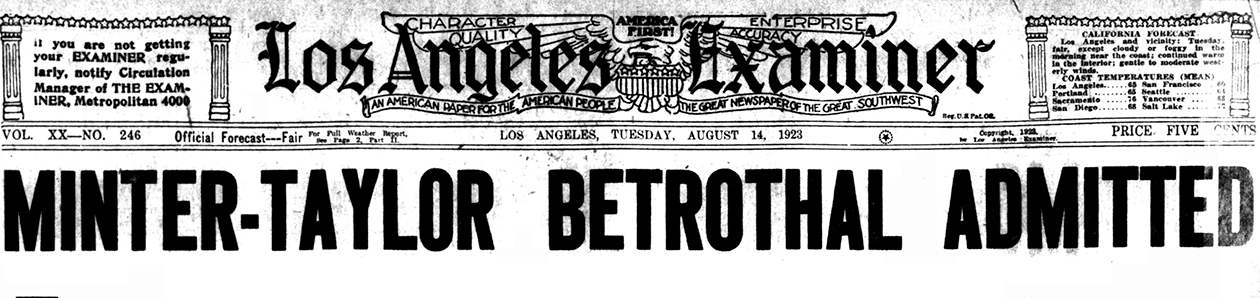
Document A — Los Angeles Examiner, August 14, 1923
Morning edition, Tuesday, August 14, 1923, Section 1, pages 1 and 4. By R. D. Knickerbocker.
Page 1
Banner across the page:
MINTER-TAYLOR BETROTHAL ADMITTED
Headline:
Screen Star Declares Mother Hushed Story
Actress Explains Silence Regarding Engagement
BY R. D. KNICKERBOCKER
ADMITTING that she was engaged to William Desmond Taylor, noted film director, at the time of his death, Mary Miles Minter yesterday for the first time bared the details of her romance with the slain man.
With her controversy with her mother, Mrs. Charlotte Shelby, over $1,300,000 salary rapidly reaching the point of legal action, the little film star decided that the time had come to reveal the true relationship that existed.
The statement that she would soon have been the wife of Taylor had he not been slain casts an entirely new light upon what is conceded to have been the most baffling murder that ever confronted the Los Angeles police.
“For more than a year and a half I have kept secret that which was the sweetest and holiest thing in my life — my love for William Taylor,” she said.
“Any girl could have been proud to have been engaged to him, and I longed to tell the truth to the whole world. There was nothing to be ashamed of in my love, but on the advice of my mother I kept silent.
“Oh, if I had only been allowed to talk much of the terrible ordeal that I underwent might have been spared me. I wanted everyone to know that I loved Mr. Taylor with the pure, wholesome love of a young girl.”
But, according to her story, the influence which her mother then possessed over her prevented her from making this fact public at the time of Taylor’s death. While co-operating with the police in every
Photograph spanning both columns. Minter at left, Taylor at right. Caption: “Mary Miles Minter and William Desmond Taylor, photographed as they greeted each other when both attended a meeting of the San Francisco Advertising Club in December, 1919.—International Newsreel photo.”
Page 4
MARY MINTER TELLS ENGAGEMENT STORY
way to solve the mysterious shooting, and spending many hours in conference with former District Attorney Thomas Lee Woolwine, she was not allowed to make this important fact public.
Yesterday, acting upon the advice of her friends, she went into full details of what she described as “the great romance of my life.”
“I love Mr. Taylor the first moment I saw him.” [sic] she declared in telling of the inception of her love. “And today, nearly two years after his death, my love for him is stronger than ever. I realize that is something I must place behind me, but it was a part of my life that I shall always treasure.
One Man in World
“I knew but little of Mr. Taylor’s past life, but I knew that he was an honorable gentleman in all the word implies [sic]. He was a man’s man, yet withal a man of gentleness and kindliness. He was cultured, but yet not immune to the human feelings of mankind.
“I cared not who or what he was, for when he put his arms around me and said, ‘Mary, I love you,’ I knew that he was the one man in the whole world for me. And when I think that if it had not been for the continual bitter opposition to our engagement I would have been his wife it is almost more than I can bear. No wonder I am bitter.
“My whole life was wrapped up in him. When I would come home from the studio I would dream of the home in which William Taylor and I would spend the balance of our lives.
“But, no, he was too old, I was told. He was not an old man. I would not even let him tell me so. William — possibly you think it strange that I call him William or Mr. Taylor, but I so worshipped him that I could not think of calling him Bill — used to tell me that he would not allow me to sacrifice myself on a man his age.
Questioned Self
“‘I wonder if I am doing the right thing?’ he would often ask me. ‘You have brought me the greatest happiness of my life, but you have come at the time of the Setting Sun, while you are in the glory of your youth.’
“But I would not have it so. I knew that the years I spent with him, no matter how short, would be the happiest of my life, and we often discussed the little home we were going to build up in the Hollywood hills. As soon as I was 18, our marriage was to take place.
“Then came his death. It was like a bolt from a clear sky. I was simply stunned. With my soul starved for love by the life I had led at home, his tenderness and kindness seemed doubly sweet.
“It was at this time that all the pressure possible was brought to bear by those under whose influence I was at the time to see that my engagement with Mr. Taylor was kept secret.
“I mustn’t talk; it would hurt my career; it was the same old story of hushing and shushing. The public must never know that I was engaged. I must be a little girl with golden curls. It would never do for the world to know that I was a human being instead of a doll-faced automaton.
Career ‘Threatened’
“My mother and other advisers told me that it would ruin me if it became known that I was engaged to Mr. Taylor. As if being engaged to him ocould [sic] have hurt any girl.”
While Taylor was known to number among his friends many of the most beautiful stars of filmdom, it was not thought that he centered his affections upon any particular one.
A series of affectionate letters, written by Miss Minter while in Paris, were found in the dead man’s rooms by the police. An immediate investigation was started on the theory that the slaying might have been done by some one inflamed by jealousy.
At that time it was denied that Taylor and Mary were anything more than friends. It was explained that the letters were merely those of an impulsive child, written to a man whose many accomplishments had aroused her admiration.
The belief, expressed by the police that the recent alleged attempt upon her life might have come from the same sources as those responsible for the death of Taylor, is not shared by Miss Minter.
According to friends of the latter, the attempt to kill her was made on the night of June 10, shortly after she had turned over her bungalow, located at 2183 Argyle avenue, to Miss Sigrid Holmquist, Famous Players-Lasky star.
Miss Minter rented the Argyle street house shortly after she had left the home of her mother, Mrs. Charlotte Shelby. With Mr. and Mrs. Ewart Adamson, she occupied the house until she moved to Pasadena, where she is now residing. When she left her bungalow she sublet it to Miss Holmquist.
On June 10 she called at the house during the afternoon and left by a rear entrance. During the dinner hour a shot, fired from a clump of bushes, narrowly missed Miss Holmqust [sic] and struck one of the guests.
The two stars greatly resemble each other in appearance and it is the belief of the police that Miss Holmquist was mistaken for Miss Minter by whoever fired the shot. The latter, however, has an entirely different theory regarding the incident.
“There were many strange happenings while I occupied that house,” she said yesterday. “In fact, it was on account of the mysterious occurrences that I left.
“Night after night we would hear men tramping through the shrubbery, but when anyone looked out all sounds would immediately cease. It got so bad that I became nervous and secured permission to carry a revolver.
“I don’t believe that these occurrences had anything to do with the killing of Mr. Taylor. I am positive that I was being shadowed and that these affairs were caused by people hired to intimidate me.
“At one time two men rushed into the house, announcing they were detectives. This occurred immediately after I had left the house. But if anyone thinks I can be scared into giving up my present plan of action they are mistaken.”
There has been no meeting between Miss Minter and her mother since the latter left the Good Samaritan Hospital Saturday afternoon. However, it is quite certain that an attempt to settle the ownership of he [sic] $1,300,000 earned by the screen actress during the past three years will be made during the next few days. Mrs. Shelby still believes that a reconciliation will be effected between herself and Mary.
“I am glad to be home. These quiet rooms will enable me to recover more rapidly so that I can consider the many problems that have confronted me during the past few days,” said Mrs. Shelby yesterday.
“But of one thing I am convinced: Mary may have made the statement that she does not love her mother, but I know she did not realize its full portent.”
Document B — Los Angeles Evening Herald, August 14, 1923
Night edition, Tuesday, August 14, 1923, pages 1 and A—15. By Helen Roberts.
Page 1
Diary Bares Mary Minter Romance
STAR’S LOVE FOR TAYLOR REVEALED
By HELEN ROBERTS
The silent leaves of Mary Miles Minter’s love diary spoke today and told for the first time their heart-throbbing story of a tragic romance which has extended beyond the grave.
With the passion and pathos of a literary classic they voiced of the thrill and thraldom of the deep and enduring affection of the beautiful young picture star for a man more than twice her age. And it is this affection—which the long silent diary traces back beyond the tragic days of the notorious Taylor murder—that may place in the hands of the authorities a belated clew to unravel the baffling mystery which has remained impenetrable—the mystery of who shot William Desmond Taylor.
The diary is bound in scarlet moire silk, as scarlet as the life-blood of William Desmond Taylor that stained the floor of his home on that memorable night he met death at the hand of an assassin, and in it Mary Miles Minter has recorded the yearnings and longings for her lost love.
The first entry in the book was made two weeks after the death of Taylor.
“Oh, my beloved, where are you?” the heartbroken girl wrote.
Then she described her longing for the man whose arms would no longer embrace her.
“You were to have been mine. Had I known you were to have been taken from me no power on earth could have kept us apart.”
It was night. In the distance music was playing. She recorded memories of happier times when music, which Taylor loved, had been a part of their lives. She told of her hours of anguish and bitter weeping for the man who was gone.
“Where? I do not know, my beloved. But you are near, somewhere, of that I am certain. You could not leave me so utterly hopeless, alone and forlorn.”
Nine days later she again makes an entry of her grief and loss in the little book. This time “Chummy,”
Page A—15
Banner across the top of the page:
LOVE DIARY OF MARY MINTER IS BARED
Tiny Book Tells Affection of Actress for Slain Director
Column-one head:
SAYS MURDERED MAN DEEPLY LOVED HER
Film Star Blames Mother for Intervention Which Kept Couple Apart
the dog Taylor gave her, was stolen. “They have even taken away what you have given me,” she wrote. “How a dog can understand! Better than most humans.”
Then in Honolulu, in June. Again the gay dancing throng of that playground of the Pacific recalled happier days with the man she had loved and lost. But she believed Taylor was not far way [sic]. She felt his presence and the little diary carried a message not of a hopeless death, but to one who had “gone away for a little time and would return again.”
“It is night again, dearest, our time of peace and surcease from the stress of life that grows so weary at times. Morning will come all too soon; and with its coming will begin again the weary task of life Life without you, dearest, is weary. Our love was like a great white star that burns its way across the heavens. They are dancing down below. I can see them from the window. The lovely gowns look like bright colored balloons against the dark background.
“Oh, Desmond, my love, where are you? Surely not so far away but that I will find you somehow, somewhere?”
STILL SEEKS LOVER
It was June again, in California. A year has rolled by since the last entry in the little diary. But the heart-hungry girl is still seeking her lost one. She is a woman now and realizes more fully her loss.
“How long, my love, how long until you clasp me again in your dear arms?”
That is the love of Mary Miles Minter for William Desmond Taylor, who rests under the golden sunshine in “God’s Acre,” where sleep the dead of this and other generations.
Supplementing the written avowal of her love as contained in the diary, Miss Minter told of her great passion for William Desmond Taylor, who, she says, declared she had come to him as a “glorious ray of light in the sunset of life.”
Only the heart story of the great tragedienne, Eleonore Duse, and her love for Gabriel D’Annunzzio, has equaled in simplicity and straightforwardness the love story of Mary Miles Minter as she told it exclusively to The Evening Herald.
Here are some of her statements:
“I loved William Desmond Taylor with an all-consuming passion. He was my god, my ideal, the great love of my lifefi [sic] and if I live to be 1000 [sic] years old I will love him as faithfully and as devotedly as I did before the hand of an assassin struck him down and took him from me.
KNOWS HEARTACHE
“The world will say, ‘What does a young girl know of love?’
“What do I care what the world says? I know my own heart. I know the bitterness and heartache, the longing, the loneliness, the searching, searching, searching—into what? Into the realm, beyond the borderland whence none return, but where my soul has wandered since my love has been taken from me.
“If it had not been for my mother I would have known the full fruition of that love I bore William Desmond Taylor.
“But no. She wanted him herself.
“So, because he loved me, she intervened and she forbade me to see him, even to telephone him. When I wanted to see him I must slip away, as if our love were some unclean thing that could not be avowed publicly.
“And William Desmond Taylor loved me. I have the proof of it.
“I had had school girl affairs that seemed serious to me at the time, but were only passing fancies.
“I was 17 years of age when I first met William Desmond Taylor. I loved him the first time I saw him. ‘This is God,’ my heart sang when I looked into his face.”
Miss Minter’s eyes were tear-dimmed as she went on.
“I know the world will think that a very immature age and a very foolish conclusion for one so young. But you must remember that while for the last three years of my life my mother has tried to keep me a ‘little girl’ with curls down my back, had made me appear and act older than I was.
YOUTHFUL TRAINING
“When I was 8 years old I was passed off for 16, twice my age, and dressed as a midget, with high heels and long skirts, so that I could play the stellar role of ‘The Littlest Rebel’ at the Chicago Opera house. That was because the state law of Illinois prohibited children under 16 years of age from appearing as professional performers.
“Those things have an effect upon a child that all the training and coaching in the world cannot eliminate. When I went into the movies it was different. Then mother wished to undue [sic] all the training of maturity she had imposed upon me and have me appear unsophisticated and simple, childlike and trustful. It was paradoxical. But I matured very quickly in this glorious sunshine and gorgeous setting of California.
ATTRACTIVE TO MEN
“With the passing of the adolescent period, it became very evident to mother that men were attracted to me. I liked the company of men. They were jolly, good companions, splendid comrades and were not forever saying, ‘Don’t do this,’ or ‘Don’t do that.’
“It worried mother because I was popular with them. The few with whom I came in contact were not attracted to Margaret. This was a bitter pill to both her and mother. Margaret is older than I and mother thought she should be given preference. But if a girl does not naturally attract men, all her efforts will fail.
“That was the status of things when I first met William Desmond Taylor. I knew when I laid eyes on him that he was the one man in the world for me, and that he reciprocated my love. I wish I could make you understand with what tenderness and understanding. He used to call at our house. But soon mother noticed his preference for me. She put a stop to it. Until she knew of my love for Mr. Taylor she had only words of praise for him.
CALLS MOTHER RIVAL
“Then, suddenly, she turned against him. Why? Because I soon discovered that she cared for him herself. It seems hard for a daughter to say things of this sort against her mother, I suppose. But I have suffered untold agony since he—went away.
Mr. Taylor and I became engaged. I told mother of it. She was furious. I told Mr. Taylor of her attitude.
“‘Your mother knows best, Mary. I am an old man,’ he would say.
“Then I would kiss the words away. I did not know Mr. Taylor’s age, but he was not old in spirit or understanding and that was all that mattered to me. He was mine. I wanted him, to be his wife, to be able to do the thousand and one little things for him that only a wife can do. I would have married him then and there, but he said we must wait.
“‘Wait a while, Mary dear,’ he would caution. ‘Ah, do not think I don’t want you, child. It is not that. But because of my great love for you I would shield you from the unkindness of the world. And the world would never forgive me for blighting your career. We must wait.’
“But I did not want to wait. Perhaps many women would be ashamed to admit what I have admitted. But I am not ashamed. Our love was a glorious thing. ‘Why should we wait?’ I would protest. As long as we had each other what else counted. Then I wrote letters, passionate, impulsive letters. Some of them were published. I also wrote some very simple, polite ones. They were not published. But what does it matter, now that he is gone? Many of those letters were written two years before—he died. And he kept them. That was my one thought at the time. He kept them.
WENT TO EUROPE
“Surely he must have loved me deeply, sincerely, to have kept them for so long. I did everything I could to make him break his resolve and marry at once. Not to wait until I was older.
“Then mother took me to Europe. She told me of the lovely things we would buy over there. Things that were to be for my home, she said. Where are they today? Mother has them, if you please, and tells me they are not mine but hers.
“Mr. Taylor went to Europe, too. But I did not get to see him. Mother saw to that. I pleaded with her to let me see him but she always insisted that she would not permit me to throw myself at Mr. Taylor’s head. So we tramped all over Europe, always careful to keep a safe distance between me and the man I loved. But in Venice I had my one ray of happiness. One night we were talking to a very distinguished officer of the World war on the piazza of one of the great hotels. Our conversation drifted to heroic deeds of the great conflict. Captain Oliver, that was his name, remarked that there was one man for whom he would lay down his life if ever the time came.
STORY OF WORLD WAR
“‘And I shall do it gladly, willingly,’ he declared. It bore promise of a good story which we prevailed upon him to tell. It was a tale of No Man’s Land in France. Of a brother officer who had risked his life to carry the captain safe behind the lines when Captain Oliver lay wounded in those stinking mud holes of the battlefield.
“‘Just as he reached the lines with me over his shoulder, he encountered a string of barbed wire in the awful blackness of the night. It ripped him open right across the middle,’ the captain continued, ‘But he was a game fellow and crawled, torn and bleeding as he was, for help. He could no longer carry me. But he brought help and I was carried to safety. He lay for many weary weeks in the hospital. They gave him the croix de guerre for it and I gave him my horse. It was my dearest possession and a beautiful blacq [sic] charger. It was the best I could give him.’
TAYLOR THE HERO
“We paused, overcome with the tale of bravery.
“Then I asked: Who was the man, Captain, you have not told his name.
“William Desmond Taylor, he replied. And I believe he is in California today, somewhere out there, so I am told.”
“How my heart leaped. It was my beloved. I felt that my faith in him had been justified. He was a real man, brave, strong, courageous. Only a woman who loves as I loved him can understand the gladness of my spirit on that memorable night.
“Eventually we came home. Mother and Margaret stopped over in Chicago and I came on west, home. I sent Mr. Taylor a message and he met me with flowers and a lovelight in his eyes that told me his affection for me had not diminished during my absence.
FEW DAYS OF LOVE
“I had a few days of delightful comradeship with him before mother returned for my grandmother understood our great love and did not offer any interference.
“But when mother came home again Mr. Taylor was forbidden the house.
“Then grandmother fell ill. It took a great deal of our time. I spent all the time that I could with her, for I love her dearly.
“Whenever I could I would slip away with Mr. Taylor, but the times seemed so far apart. All too seldom.
“Then, one morning, as I was dressing to keep an appointment to purchase some gowns, mother came running up the stairs. She was living at the New Hampshire street house while I was at the Hobart boulevard house. A man from the district attorney’s office had a room there to sort of protect her from danger at night because she had many valuable things there and it really wasn’t safe for her to be alone in the great place at night.
BEATS ON DOOR
“This morning she beat furiously on my door.
“‘Who is it?’ I demanded.
“‘Open this door quickly and no nonsense about it,’ was her reply.
“‘But I am not dressed,’ I protested. I had on nothing but a chemise, and mother always scolded me if I appeared before her even in a neglige.
“‘Open the door,’ mother again insisted.
“I opened the door and mother came in.
“‘What do you think has happened?’ she said.
HEARS OF MURDER
“I looked at her, for she seemed greatly excited. ‘William Desmond Taylor has just been found murdered in his bed.’ She added some more words which were not altogether complimentary to Mr. Taylor.
“I was dumbfounded. I crawled up on my bed and began drawing on my stockings. Mother talked on in a most excited manner. I can’t remember what she said—all of it—but it was something about this would teach me a lesson and how to behave myself in the future.
“Then mother said, ‘Well, why don’t you say something?’
“I couldn’t. I was too hurt. I got up and started to put on my dress.
“‘Where are you going?’ mother demanded.
KEPT INDOORS
“‘I am going to him, of course,’ I said.
“‘Oh, no you’re not,’ mother declared. ‘You’ll not leave this room. I’m going to lock you in and here you’ll stay until I say you can come out.’
“I pleaded with her.
“‘You’ve kept me from the man I love in life and you can’t keep me from him in death. I’ll scream and raise the neighborhood, I told her. But it did no good. Mother had her way. I was not permitted to say anything more or to go to him.
ONE GREAT LOVE
“But since then, God alone knows what I have suffered.
“Mother and the attorney did the talking for me. They told of my childlike affection for an old man. How I trusted and loved him as a father. But I tell you here and now it was no childlike affection. It was a full grown woman’s love for her mate. For William Desmond Taylor is the one great love of my life and always will be.”
The boxed diary extracts (page A—15, columns 2–3)
Set in a wavy-ruled box across the top of columns 2 and 3, in bold and italic sans-serif type:
Diary Tells Love for Taylor
Here are some of the burning phrases in which Mary Miles Minter inscribed in her diary her great love for William Desmond Taylor, slain motion picture director:
“It is night again, dearest—our time of peace and surcease from the stress of life that grows so weary at times. Morning will come all too soon and with its coming will begin again the weary task of life.
“Life without you, dearest, is weary. Our love was like a great, white star that burns its way across the heavens.
“Oh Desmond, my love, where are you? Surely not so far away but that I will find you somehow—somewhere.
“How long, my love, how long, until you clasp me again in your dear arms?”
The first entry in Miss Minter’s diary was written two weeks after Taylor had been slain.
Related story on page A—15 (columns 4–5, above the rule)
Reproduced here for context, this news item is not part of the Roberts feature. It appears under its own headline, with a rule in each column separating it from the feature below.
MISS MINTER TO REVEAL TAYLOR MURDER MOTIVE
A strong motive for the mysterious murder of William Desmond Taylor, which was the point that baffled detectives who investigated the case, was expected to be disclosed today by Mary Miles Minter following her admission that she and Taylor were engaged to be married at the time he was slain.
Jealousy aroused by the love Miss Minter bore Taylor, which found full requitement, loomed as the motive for the murder and tended to divert suspicion from Edward Sands, Taylor’s valet-secretary, sought as the slayer.
LENGTHY STATEMENT
At the time the murder was under investigation Miss Minter made a lengthy statement to the district attorney’s office and co-operated in every way with the authorities in their efforts to solve the crime.
Now, after a year and a half of silence, it was learned that new information she is able to furnish will undoubtedly provide a strong motive for another person to have committed the murder.
This person, according to the information Miss Minter is finally able to give, was in a position to have been aroused to a murderous frency [sic] through jealousy over the love that existed between Miss Minter and Taylor at the time he was murdered. She is, however, reluctant to believe that the person her new information casts suspicion upon could be guilty of the murder.
STILL LOVES TAYLOR
Miss Minter asserted that her love for Taylor was the “sweetest and holiest” thing in her life.
“I loved Mr. Taylor from the first moment I met him. Today my love for him is stronger than ever. He was the one man in all the world for me. If it had not have been for continual bitter opposition I would have been his wife. They kept telling me he was too old and I was too young, but when he told me that he loved me I didn’t care.”
Miss Minter said that her engagement was kept secret at the urgent request of her mother, Mrs. Charlotte Shelby, whom she is about to sue for an accounting of $1,300,000 she earned as a motion picture star.
Document C — Los Angeles Times, August 15, 1923
Wednesday, August 15, 1923, Part II, pages 1–2. Published under the byline “By Mary Miles Minter.”
Part II, page 1
MARY MINTER BARES
TAYLOR LOVE AFFAIRWrites Story of Relations With
Slain Director for “Times;”
Through With Mother
Mary Miles Minter will have no further conferences with her mother to settle the differences that have arisen between the two over an accounting over Mary’s earnings as a picture star. A definite decision to this end was reached yesterday between the girl, who has won international fame as “The Dresden China Doll,” and Neil McCarthy, her attorney. The conference was at a place other than the attorney’s office and after it was over Mary said, simply:
“I shall not see mother again to settle this trouble. It must be settled by the attorneys or in court. That is all that I can say.”
Miss Minter yesterday gave exclusively to The Times the first signed statement which she has ever made in reference to the Taylor murder and the incidents of her affection for the late motion picture director. In this statement she reveals that, contrary to report, she was not formally engaged to marry Mr. Taylor and that she hoped some day, when she had earned sufficient money to care for her mother and sister in comfort, they might marry.
With the return of Miss Minter’s attorney, who has been absent from the city since the news of her contemplated suit for accounting against her mother became public, plans for pressing the case went forward. Early in the day Miss Minter telephoned Mr. McCarthy from the Pasadena bungalow where she has lived in semi-seclusion until the past week and made an appointment to meet him at a place other than his office.
“NOT AT HOME”
“Miss Minter is not at home. I don’t know when she will be back,” was the answer that came over the telephone from the Pasadena residence last night.
Inquiry at the New Hampshire-street address where her mother is recovering from her illness, incident to her recent operation, met with the response that Mrs. Shelby would not receive anyone. The daughter, Miss Margaret Shelby, had gone to bed—early.
BY MARY MILES MINTER
It has happened! For months and months I have been hoping and praying that my differences with my mother might not bring up again the dreadful incidents of the murder of William Desmond Taylor. I have tried and tried to make no references to it in my statements concerning my effort to secure an accounting from my mother, but newspaper reporter after newspaper reporter has hounded me day and night and always with questions, questions, questions about Mr. Taylor. The Times is the only newspaper which has not done this and because of this fact I am now giving the first statement that I have ever given under my own name.
William Desmond Taylor came into my life when I was 17 years of age. He was the first man ever to call me Miss Minter.
“How do you do, Miss Minter?” he said to me when first we were introduced, and then he smiled.
MADE IMPRESSION
Always before I had been called Mary and treated like a child by men and women alike, but Mr. Taylor called me “Miss Minter,” which at that age, heart hungry as I was, made an instant impression. From that moment he fascinated me. It was not long afterward that we were in New England making a picture. My mother, my grandmother and sister were with the company.
I used to listen for his footsteps as he came into the door of
Part II, page 2
MARY MINTER
TELLS STORYFirst Signed Statement is
Given to “Times”Relates Her Affections for
William TaylorFormal Engagement to Dead
Director Deniedthe little hotel where we stayed. I recognized them as they went up the stairway and into his room, which was just over the little parlor where we all sat.
One time, it was my seventeeth [sic] birthday, we all went into Boston for a dinner party for me. He rode in the automobile between my grandmother and me. The road was rough and bumpy, his arms were spread across the rear of the back seat in which we rode. One bump threw grandmother against him and he said, “I guess I will have to hold you.” But his arm did not embrace me.
THRILLED BY ACT
“Dare I? Dare I?” I said to myself. I dared and I reached up and tugged at his coat sleeve and he dropped his arm about my waist. And coming home he did the same thing again.
The thrill of that innocent act thrilled me for days and days. We spent what little time we could together, which was not much because mother always watched and every night after I had gone to bed she used to sit in the little parlor with him just as much as he would let her while he was working on his script.
One day it rained dreadfully. We were out somewhere and he wrapped his coat about me and took me to the hotel. There stood mother, fairly raging. She accused Mr. Taylor before the entire company of taking me out, humiliating him most shamefully.
For two days I hardly spoke to him and then I apologized for mother’s action.
“Your mother is right, Mary,” he said. “She is right and you must always obey her.”
That was the beginning of quarrels between mother and I. He soon left and came to California. Grandmother and I came later, while mother and sister remained in the East. Sister Margaret had a sort of beaked nose and she had it operated on to straighten it out. That kept them in the East.
We had a glorious reunion when we came west. Grandmother and I went riding with him, to dinner, to the theater. Then mother came and I was forbidden to see Mr. Taylor, to speak with him alone. Mother forbade his coming to the house. It was then I started to write him little notes.
I loved him, oh, so sincerely and he loved me. He told me so many, many times.
We were never engaged in the sense that he had asked me to marry him and I had promised. I had always hoped that sometime we would be married. But I had planned in my own mind—never with Mr. Taylor—that as soon as I had made enough money so that mother and sister could be assured of a comfortable income for the rest of their lives—that perhaps we would be married. But not engaged in the sense of wearing a ring, or of telling one’s friends of an intention to marry or of telling my mother. Marrying Mr. Taylor was just my dream—a dream which, voiced to him, always met with the answer that it was impossible.
HEARS NOTHING
Finally he told me I must not write him any more and must not call him up, that he would telephone to me. I waited a week, two weeks, three weeks and he did not call. I swallowed my humiliation and called him. His butler answered and told me he was ill. He was too ill to talk with me. I gave the butler instructions of what to make him eat, to see that he was well covered during the night. For five days he did not eat a thing and during it all I suffered more than I can express.
We went to Europe, mother, sister and I. I think mother meant to take me as far away as she could. It was on this trip while on a boat one time that a Maj. Oliver was telling of some deeds of heroism that he had noted during the war. He told of how one man, a captain, had saved his life. This man had crawled through the lines, amidst the hail of shells and in the glare of flares and picked up Maj. Oliver and carried him back to the English lines. In the trip this man had run into some barbed wire entanglements that cut into the muscles of his stomach, but despite this dangerous wound he kept on and on.
“Who was this man?” I asked the major.
“He is in America now, in Hollywood I believe, a picture director. William Desmond Taylor is his name.”
My heart came into my mouth. I could have screamed for joy. It was my beloved.
MARY HEARTBROKEN
When we came back to America I was so proud of him. He had never told me of those things, never would talk about the war, excepting now and then to tell some funny story. I made him put on his uniform and go and have some pictures taken. Those pictures, with little messages of love written on them, are my most precious possession.
Early in the December before he was shot I had telephoned him and told him that I must see him. We had not talked with each other for weeks. We would pass on the lot and he would smile so sweetly, but in his eyes was the love-light that none but I could see. He made an appointment for me to come to his house in two weeks. Grandmother and I went. The house was dark. I was heartbroken. In the keyhole I twisted one of the little golden hairpins that I wear so that he would know I was there.
No word from him, no telephone call. On December 23 I was down town buying some Christmas presents—one for him that I never got to give him. I have it still. There in the store opposite me in another aisle he stood. He smiled so sweetly, bowed and was gone. The clerk came and brought some samples of something and I told her to wrap it up. I don’t even know what it was, I was so dazed. My maid grasped me by the arm thinking I was going to faint. He went away.
A few nights afterward I could not sleep. Everyone had gone to bed. I tiptoed to my grandmother’s room and told her I must go to him. She tried to dissuade me, offered to go with me, but I told her no, that this was something I must do alone.
GOOD-BY NOTE
I gathered up his pictures and a little golden mesh bag he had given me and stopped to write him a note. It said:
“Dear William Desmond Taylor: This is good-by. I want you to know that I will always love you. Mary.”
I got out my car myself and went to his house. There was a light shining behind the blind. I rang the bell. All was silence. My heart stopped. I was afraid that perhaps he had gone out and that he had left the lights burning. But then I heard the rattle of a newspaper, the door opened and there he stood.
“Why, Mary,” he said. “It’s quite late, isn’t it?”
“Yes, it is, nearly 12 o’clock,” I answered. “But I must see you,” and I pushed past him into the room.
I noticed things were changed. That the furniture was moved, but on the wall there still hung my pictures, two of them and one of Mabel Normand.
“Mary you should not have come here,” he said. He was trembling, seemed to grow old standing before me. Perspiration covered his brow.
“Here, read it. It’s good-by,” I said, handing him the note I had written. He read it and without a word turned to his desk, fumbled about and then handed me a note.
“I thought you had gotten this two weeks ago,” he said. I started to open it.
“No, no,” he cried. “Not here.”
“But I must,” I said. “I must. Maybe there is something in it I must answer.”
“No, I beg of you, I entreat you. I cannot stand it if you do. Don’t!”
LOVE IS SWORN
“Then tell me that you love me,” I said.
He put his arms about me and kissed me.
“I love you Mary, better than anything in this world, more than God,” he answered.
He led me to my car, helped me in. I reached out and squeezed his hand. In the house he had clenched his teeth, his face was drawn, his finger nails had been gripped so hard that he brought blood when the nails cut the skin. He had used a silk handkerchief he had tucked in his upper coat pocket to wipe away the blood. As we stood by the car door I pulled this handkerchief from his pocket and took it, handing him mine. He kissed it and slowly walked back into the house. I drove home.
That was the last time I ever saw him alone. After that a few times I met him on the lot. Again he smiled and spoke, but that was all.
HEARS OF DEATH
In February one morning I was dressing. It was about 11 o’clock. I was standing in my undergarments before the mirror fixing my hair. I heard my mother’s footsteps coming, pat, pat, pat down the hall. I knew something was wrong from the way she was walking.
She pounded on the door. “Let me in,” she said.
I told her I was not dressed. “Let me in,” she fairly shouted. “Let me in or I shall break down the door.” All this time she was pounding.
I told her she must wait until I got into a dress and then I opened the door.
“William Desmond Taylor has been murdered. He was found dead in bed this morning,” she said.
“Where were you last night.”
“I was here, of course,” I said, hardly realizing what she was saying.
I grabbed a hat, a wrap and then began to look through my pocket book, through the drawers of the dresser. I was hunting for the keys to my car. I thought I would go frantic in the few moments that it took.
GOES TO HOUSE
“Where are you going,” mother asked.
“To him, of course,” I replied.
“You cannot, you cannot. I shall not let you,” she said and stood before the door to stop me.
“I am going to him if I have to throttle you to get past,” I cried. And she stepped aside.
I drove to his home in a daze. Newspaper reporters, officers and other people were before the house. They were carrying out books and papers.
“Who are you and what are you doing here?” they asked me.
“I am Mary Miles Minter and I have come to see Mr. Taylor,” I answered.
“But he is not here. They have taken him to the undertakers,” they said.
I got in my car and drove downtown to the undertakers. I drove and drove, round and round that block until finally I found the place. I went in. I asked to see him and they told me I could not, that they were trying to find the bullet.
“I must see him. I must see him,” I told the man.
“You cannot see him until after the inquest,” I was told. “It is against the law for me to let you see him before.”
Finally he promised me that I could see him the next day at noon and I went away.
Then I drove to Mabel Normand’s home. I was frantic. Without ringing the bell I went in. There were reporters in the parlor waiting for her. I rushed upstairs. She was dressing.
I grasped her by the shoulders, shook her and looked straight into her eyes.
“What do you know about it?” I asked.
“Nothing,” she answered simply. “Not a thing but what they have told me.”
And I believed her and still believe her.
VIEWS HIS BODY
The next day I went to the undertakers and they let me in all alone with him. I pulled back the sheet and looked at him. But he was not the same. His skin was waxen. I leaned down and put my arms about him, my cheek to his.
His face was cold, so cold, but not a cold like ice.
“Do you love me, Desmond,” I said.
He answered me. I could hear his voice.
“I love you, Mary; I shall love you always,” he whispered. I kissed him and put a red rose in his hand from some I had brought with me.
The door opened. The undertaker was there. I went away.
Textual notes
Document A — layout
On page 1, the story occupies the first of its two columns; the second contains the Minter-and-Taylor photograph above the fold and an unrelated story below it. The story continues in the third column of page 4, matching the paper’s own column numbering.
On page 4, the story runs in two columns: the first (x 1795–2610 in the source image) from the top of the story to “…it was not thought that he cen-“; the second (x 2615–3440) from “tered his affections upon any particular one.” to Mrs. Shelby’s statement.
The three subheads — One Man in World, Questioned Self, Career ‘Threatened’ — are set inside double-ruled boxes, a heavier treatment than either of the other papers gives its subheads.
Document A — readings preserved
- “ocould” for could, under Career ‘Threatened’. The sentence ends with a period, not an exclamation mark.
- “of he $1,300,000” for of the.
- “Miss Holmqust”. The other three occurrences on the page read Holmquist; this is an isolated misspelling.
- “in all the word implies” — as printed; the that is not there. CDNC’s optical transcription supplies it and is wrong.
- “I love Mr. Taylor the first moment I saw him.” she declared — two anomalies in one sentence, both as printed: the present-tense love where the sense wants the past, and a period closing the quotation before a lowercase she, where the sentence needs a comma. Earlier drafts of this edition silently set a comma; the period is what the page prints.
- “2183 Argyle avenue” in one paragraph and “the Argyle street house” in the next. The paper is inconsistent with itself within column two; neither reading is emended.
- “nearly two years after his death” — Taylor was killed on February 1, 1922, eighteen months before this interview.
Document B — layout
Five column-runs on page A—15 carry two texts. The feature runs: column 1, “the dog Taylor gave her” to “who rests under the golden”; column 2, “sunshine in ‘God’s Acre,’” to “as if our love were some”; column 3, “unclean thing that could not be” to “it became very evi-“; column 4, “dent to mother that men were” to “the croix de guerre for it”; column 5, “and I gave him my horse” to “and always will be.”
The separate story occupies the upper part of columns 4 and 5, above a rule in each.
Document B — readings preserved
“lifefi” (column 2): “the great love of my lifefi and if I live.” Examined at three times magnification, the marks following life read as a stray fi ligature rather than punctuation or damage.
“1000 years old” (column 2) is not an error for 100. The image is unambiguous; a transcriber correcting by sense rather than by sight would emend the figure incorrectly.
“frency” for frenzy (column 5, separate story). “blacq” for black (column 5). “undue” for undo (column 3). “not far way” for not far away (column 1). “If it had not have been” (column 5, separate story).
“Eleonore Duse” and “Gabriel D’Annunzzio” (column 2) appear for Eleonora Duse and Gabriele D’Annunzio. Both are as printed.
“they voiced of the thrill and thraldom” (page 1). The of is intrusive but unambiguous on the page.
“clew,” “moire,” “neglige,” “Chicago Opera house,” “World war,” “croix de guerre” — preserved as printed, without modernization.
Document B — the Herald’s two settings of the diary
The Herald sets the same purported diary passage twice on page A—15: once in the boxed extracts across columns 2 and 3 and once in the running text of column 1, about twelve inches away. The settings differ in six places.
| Boxed extracts | Running text | |
|---|---|---|
| 1 | “dearest—our time” | “dearest, our time” |
| 2 | “all too soon and with” | “all too soon; and with” |
| 3 | “task of life.” (full stop, new paragraph) | “task of life Life without you” (run together) |
| 4 | “Oh Desmond” | “Oh, Desmond” |
| 5 | “somehow—somewhere.” | “somehow, somewhere?” |
| 6 | “how long, until you clasp” | “how long until you clasp” |
Whatever authority the purported diary text carries, the Herald printed the passage in two variant forms on the same page.
Document C — layout
The statement occupies two column-runs on Part II, page 1, and five on page 2, in the following reading order.
Page 1. The news matter and the opening of the statement run down the left-hand column; the statement then continues at the top of the right-hand column and breaks after “as he came into the door of.”
Page 2. Column 1 runs from the little hotel where we stayed to well covered during the. Column 2 begins below a short Mennonite emigration story and runs from night. For five days… to This is good-by. I want you to. Column 3 runs from know that I will always love you. Mary. to “found dead in bed this morning,” she said. Column 4 begins below the “Broker Sued for Divorce” story and runs from “Where were you last night.” to “I shall love you always,” he whispered. I. Column 5 runs from kissed him and put a red rose… to I went away.
Document C — readings preserved
“my seventeeth birthday” (page 2, column 1). Verified at four times magnification. The Times prints it.
“humiliating him most shamefully” (page 2, column 1). Verified at three times magnification. The word is him, not me; the humiliation described is Taylor’s.
“That was the beginning of quarrels between mother and I.” The objective pronoun me would ordinarily be expected; I is as printed.
“Where were you last night.” Printed with a period rather than a question mark.
“I love you Mary, better than anything in this world” — no comma after you.
“Do you love me, Desmond,” I said. — no question mark.
Variants across the three documents
| A — Examiner, Aug. 14 a.m. | B — Herald, Aug. 14 p.m. | C — Times, Aug. 15 a.m. | |
|---|---|---|---|
| The engagement | “if it had not been for the continual bitter opposition to our engagement I would have been his wife” | “Mr. Taylor and I became engaged. I told mother of it.” | “We were never engaged in the sense that he had asked me to marry him and I had promised” |
| A date or condition for marriage | “As soon as I was 18, our marriage was to take place.” | — | “as soon as I had made enough money so that mother and sister could be assured of a comfortable income … perhaps we would be married” (a private plan, she says) |
| Who suppressed it | “My mother and other advisers” | the mother alone — “she cared for him herself” | — (nothing to suppress) |
| The first meeting | “I love Mr. Taylor the first moment I saw him” | “‘This is God,’ my heart sang” | “He was the first man ever to call me Miss Minter.” |
| Taylor’s response to Shelby’s opposition | “he would not allow me to sacrifice myself on a man his age” | “Your mother knows best, Mary. I am an old man.” | “Your mother is right, Mary. She is right and you must always obey her.” |
| Taylor’s past | “I knew but little of Mr. Taylor’s past life… I cared not who or what he was.” | — | — |
| The officer | — | Captain Oliver, on a hotel piazza in Venice; croix de guerre and a horse | Maj. Oliver, on a boat; no decoration |
| Margaret Shelby | — | “The few with whom I came in contact were not attracted to Margaret.” | “a sort of beaked nose and she had it operated on” |
| The morning of the murder | — | “I’m going to lock you in and here you’ll stay until I say you can come out.” | “I am going to him if I have to throttle you to get past,” I cried. And she stepped aside. |
| Whether she reached him | — | “I was not permitted to say anything more or to go to him.” | Views the body at the undertaker’s |
| Charlotte Shelby’s reply | “Mary may have made the statement that she does not love her mother, but I know she did not realize its full portent.” | — | — |
Material unique to one document
Document A only: Charlotte Shelby’s statement; the wedding date; “I knew but little of Mr. Taylor’s past life”; “a human being instead of a doll-faced automaton”; the published and unpublished letters written from Paris; the reported shot at 2183 Argyle Avenue, dated here to June 10 (the Examiner later reported that Bradley dated the party to July 5), and Minter’s claim that she was being shadowed and intimidated; the photograph of Minter and Taylor at the San Francisco Advertising Club in December 1919.
Document B only: the purported diary and the Herald’s two conflicting settings of it; Minter’s account of The Littlest Rebel at the Chicago Opera House and her claim about an Illinois restriction on performers under sixteen; Minter’s allegation that Charlotte Shelby was herself interested in Taylor.
Document C only: Minter’s account of the butler and her claim that Taylor went five days without food; the golden hairpin twisted into the keyhole; the December 23 store encounter; the good-by note; the silk handkerchief; her visit to Mabel Normand while Normand was dressing; and her account of viewing Taylor’s body and leaving a red rose.
The purported diary appears only in Document B; neither Document A nor Document C mentions it.
Transcription note
Documents A and B were transcribed from page images available through the California Digital Newspaper Collection; Document C was transcribed from page images available through Newspapers.com. Citations use the newspapers’ printed folios rather than database scan positions: Examiner, Section 1, pages 1 and 4; Herald, pages 1 and A—15; and Times, Part II, pages 1–2.
Spelling, punctuation, capitalization, and apparent compositors’ errors are preserved. Readings that might otherwise appear to be transcription mistakes are marked [sic] or explained in the textual notes. The transcripts reproduce the newspapers’ wording. Quoted or reported assertions remain claims of the 1923 sources unless an editorial note says that they have been independently corroborated.
This edition returns to the original newspaper pages, preserves the three texts separately, and transcribes each in full.
Cite This Transcription
LeFurgy, Bill, ed. Mary Miles Minter Speaks: Three Los Angeles Newspaper Accounts of Her Relationship with William Desmond Taylor, August 14–15, 1923. Zenodo, 2026. https://doi.org/10.5281/zenodo.22740708
Version DOI: 10.5281/zenodo.22740708 — Concept DOI (always the latest version): 10.5281/zenodo.22740707
Released under CC BY 4.0. The 1923 newspaper texts are in the public domain in the United States.