Shocking Dance: “Phryné Moderne Devant l’Aréopage,” 1913
Phryné Moderne Devant l’Aréopage (Modern Phryne Before the Areopagus)
Shocking Dance: About the Book
This book (published ca. 1913) is a curated collection of press coverage surrounding Adorée Villany’s controversial nude dance performances in Munich and Paris between 1911 and 1913. Framed by Villany’s declaration—“My unveiled form lays my soul bare”—the volume takes its title from the classical anecdote of Phryné, the ancient Greek courtesan who reputedly disarmed her judges through a dramatic exposure of her body. Villany asserts that her art, and the scandal it provoked, must be read in modern aesthetic terms with a nod to the classical.
Unlike her earlier German-language publication Tanz-Reform und Pseudo-Moral; kritisch-satyrische Gedanken aus meinem Bühnen- und Privatleben, which engages directly with early modern dance theory, costume reform, and the expressive potential of the nude body, Phryné Moderne offers no detailed treatise. Instead, it assembles press clippings, courtroom summaries, and excerpts from sympathetic commentators—many of them drawn from Parisian and Munich newspapers—offering a vivid record of the legal and cultural reception of Villany’s work.
As such, the book serves as documentation of the early modernist stage, where issues of gender, aesthetics, and public morality collided with art dance experimentation, legality, and censorship. It also offers a record of how the press functioned as the arena in which Villany’s public persona took shape. The figure that emerges from Phryné Moderne is not only a performer caught in controversy but also an artist navigating the currents of media attention that both sustained and threatened her practice. The assembled commentary, drawn from a range of printed accounts, testifies to the ways in which Villany’s nude performances unsettled conventional boundaries between art and indecency, theatrical display and moral offense.
The volume does not offer a cohesive narrative. Rather, it is a curated historical record of a moment when early twentieth-century audiences and institutions reckoned with a new form of embodied expression onstage. In that sense, Phryné Moderne is a cultural barometer—documenting the tensions between modernist aesthetics and the moral codes they confronted.
About the Author
Adorée Villany is an enigma. The sources cannot agree whether she was French, Hungarian, or a German Jew, or whether she was born in 1888 or 1891 — confusion she appears to have cultivated. What is certain is that she danced nude on European stages, was arrested in Munich in 1911 and acquitted in “the higher interests of art,” and was convicted in Paris in 1913 on the same charge and fined 200 francs. Phryné Moderne is her own account of those two trials.
→ Read the full story of Adorée Villany here.
Read the Book
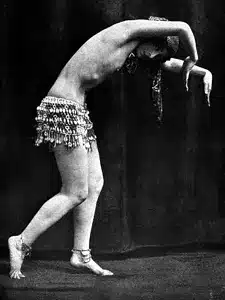
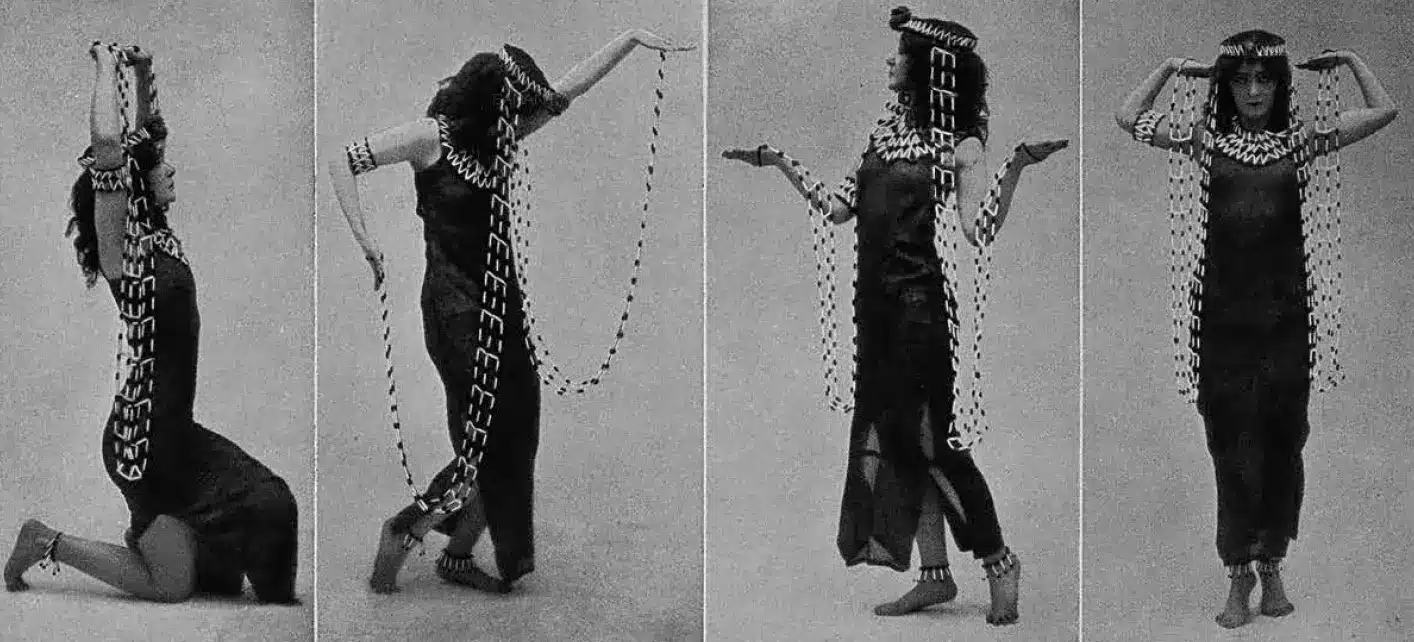
The book is mostly in French, although there are press accounts in German and English. It contains many full-page photographs of Villany in dance poses, a good number of them nude or semi-nude.