
Behind the Scenes in Beauty Land — by Florenz Ziegfeld, Jr.
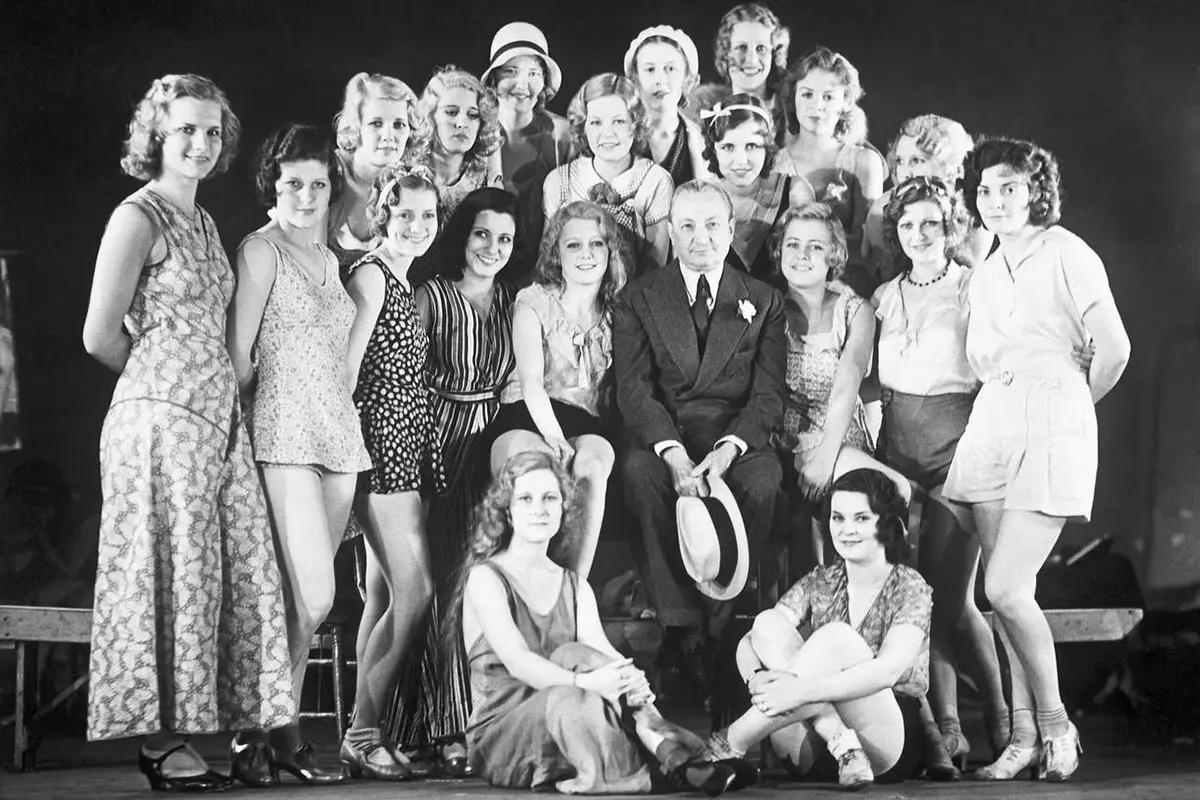
By 1921 Florenz Ziegfeld was practically a household name. As the impresario behind the wildly successful Ziegfeld Follies, the man was popularly known for his skill in “selecting the most beautiful girls in the world.”
Ziegfeld was also masterful at promotion — both for his shows and for himself — and set out to burnish his reputation still further. He did so via a ten-part series syndicated in newspapers across America that ran on Sundays from July 24 to September 25, 1921.
In Behind the Scenes in Beauty Land, Ziegfeld held forth on a variety of topics relating to the young women he appraised and selected for his Broadway shows. He wrote about where they came from, how they were chosen, how they lived, and how they were trained and dressed. To today’s eyes, his account flips oddly back and forth between praising their discipline, hard work and professional skill, and reducing them to objects to be measured and managed.
Given the continuing interest in what have come to be known as “Ziegfeld girls,” the series is an invaluable primary source.
Two years later Ziegfeld returned to the subject in a second syndicated series, Ziegfeld on Beauty: The Complete 1923 Newspaper Series — five articles that turn away from the chorus and address the reader directly, telling ordinary women how to acquire the standard described here.
Behind the Scenes in Beauty Land: the ten articles
- Where Do the Chorus Beauties Come From? — July 24, 1921
- Selecting the Super-Beauty — July 31, 1921
- The Beauty's Hard Work of Keeping Beautiful — August 7, 1921
- The Lure of the Stageland Beauty — August 14, 1921
- From Chorus Beauty to Star — August 21, 1921
- The Passing of the Stage Door Johnny — August 28, 1921
- How Beauty Dictates Fashions From the Stage — September 4, 1921
- Has American Beauty Declined? — September 11, 1921
- The Chorus Beauty in Art — September 18, 1921
- Ziegfeld Tells Where Chorus Beauties Go — September 25, 1921
Article I
Where Do the Chorus Beauties Come From?
The Star Press, Muncie, Indiana · July 24, 1921 · view the original page
**
The author of these articles is the acknowledged arbiter of feminine beauty in America. As one of the country’s foremost theatrical producers he has personally passed on the qualifications of more than [50,000?] pretty applicants for positions as chorus beauties.
Foreword
I was born in Chicago and first became interested in music and chorus singing when I was a boy wandering about my father’s music studio there. I entered the theatrical business when only 23, and have been absorbed in it ever since.
When I was in my twenties I lived in Paris for several years, and there I conceived the idea of an Americanized Revue.
But if the inspiration was partly French, the girls who have made our revues famous are strictly American—and it is of their kind and in their behalf that I write this series of articles.
They are without doubt the cleverest and most-beautiful stage beauties in the world—these American chorus girls—and they make up a class of women much misrepresented, and even maligned.
It is my purpose now to reveal to the American public the truth about the chorus girl.
Who is she? Where does she come from? Is her life one round of midnight suppers and showers of diamonds from giddy admirers? It is time that some one who knows should speak the truth about these things.
How does she attain her astonishing popularity? How does she hold the beauty and grace which are her stock-in-trade?
What does the chorus girl do off the stage? Has the stagedoor Johnny passed from America? Is the standard of American beauty ascending or descending?
And if these facts, which I am about to present, have the effect of puncturing a number of popular fallacies, I can only hope that the great American public—always fair and just when it really knows—will be glad to have the case of the chorus restated in a truthful light.
Crash! went the cymbals.
The orchestra struck up the tingling air again, and they swept back from the wings into the limelight—a madcap, prancing chorus of young beauties bursting with infectious laughter as their ringing voices hurled the song “hit” across the footlights for the seventh time.
My friend from the West was bewitched.
“Ziegfeld,” he said, as the curtain finally rang down, “what I’d like to know is this, ‘Where in the world do they come from?'”
I suppose I have been asked that question about chorus beauties a thousand times in the last twenty-five years. And yet, until now, I have never taken the trouble to answer it except by saying:
“Oh! from everywhere.”
Of course, this is true. A census of all the 15,000 to 20,000 chorus girls in the United States would reveal that every state in the union was well represented in the beauty crop that claims so large a share of attention upon the American stage each year. But it is possible to go further than that and say that certain sections and particular cities seem to furnish an extraordinary percentage of pretty show girls.
Begin with New York. There is a great deal of popular misconception about Father Knickerbocker as a producer of chorus beauties.
It is true, of course, that you will find many beautiful women in the millions that are to be seen on the asphalts of Brooklyn and Manhattan. Personally, I do not hesitate to say that neither Paris, London, Vienna, Berlin, nor any other great capital in the world, can equal in charm of appearance the beautiful girls you can see in the Wall Street financial section almost any noon of the year.
For perfect features, for intelligence and alertness of expression—for verve and personality—all of which go to make up real beauty, where can you match them?
The answer is that you can match them only within the United States.
Do you know the Eastern beauty type? The picture of Pearl Germonde of New York, shown on this page, well represent it [sic].
The Middle West? Barbara Dean of Cincinnati, is worthy of the honor.
You could tell the South’s choice without a label, so typical is Emily Drange, of Louisville, Ky.
For the Pacific coast I have chosen Betty Williams, a striking young woman from San Francisco.
Yet, New York does not yield any more bountiful a crop of chorus beauties, considering her enormous population, than Chicago, Cleveland, Kansas City, or any of the smaller cities in the great grain belt between St. Louis and Paul [sic]. I have heard it said by men of wide experience in musical comedy that more chorus girls come from Iowa than from any other state, in proportion to population, and it would not surprise me if it were so.
But there is a wealth of beauty which comes from the Pacific coast, particularly from San Francisco, Seattle, Portland and Los Angeles. There has been a great influx of this type of late years. It will doubtless surprise many also to learn that New England, particuarly [sic] Boston, furnishes far more pretty girls for the chorus than does the South, whose bountiful beauty crop for many years has been widely heralded.
Direct From Home to Stage
What occupations do the chorus girls come from?
I estimate that fully 40 per cent of them have never worked before when they make their debut before the footlights. Of these a very large number are girls who come to New York or Chicago from small towns to seek their fortunes on the stage.
Many of the two hundred chorus beauties in my various productions have gotten their first job with me. Marion Davies, from Kentucky [sic], one of the hits of the 1916 Follies and now a film star, was one of this kind. Emily Drange, of Louisville, a recent chorus favorite, had never worked before she joined my company.
Others who had never been previously employed are Janet Megrew, who was a society girl of Washington, D. C.; Mary Hay, of Texas, now a star in “Sally”; Betty Williams, of San Francisco, whose only previous work had been the organizing of women’s clubs, and Barbara Dean, of Cincinnati, a “show girl” who applied to me in New York and received a part in “Sally” as a first job.
Of the other 60 per cent of chorus girls—who have had previous working experience—I suppose two-thirds have had stage training before applying to us. The remainder have come from the ranks of the telephone operators, stenographers, manicurists, etc.
You sometimes find a very beautiful girl in the very humblest walks of life. I remember one day last year that I rushed into a little restaurant in uptown New York to get a sandwich and a cup of coffee. I was busy thinking about some stage stunt and hardly noticed the girl that waited on me until I was ready to leave. Then I caught sight of her and instantly I knew that beauty like hers had no business wasting itself on a restaurant. She belonged on the stage and that is where she is now. Katherine Rasche was the young lady’s name; she was one of the prettiest of the season. Her discovery, you see, was purely a matter of chance.
It is quite common to discover beauty and personality in the stenographers of our big cities. Many chorus favorites are recruited from this profession. Out of eighty girls in a recent New York chorus four had been stenographers, four had been manicurists, four telephone operators, two waitresses, and one a hairdresser. The majority of the rest had had previous chorus or dancing experience, and a few had never worked before.
The chorus girl of today is a far better educated woman than most people give her credit for being. For instance, all but two or three out of a chorus of eighty for one of my recent shows have had at least a high school education. In one of the recent Broadway musical comedies, no less than five of the chorus girls had at one time or another, been school teachers. One of them, in fact, had been a high school teacher. Another had been a librarian and is considered an authority on Gaelic. Still another chorus girl I have heard of speaks four languages and talks fluently on literature from Ibsen to Browning, from Spinoza to Gorki.
Various Types of Beauty
People often ask me how the country lines up on the various types of chorus beauty.
The Southern type usually has dark hair and dark eyes. She is very graceful and has that important, indefinable thing: charm of manner.
What might be described as the New York type has a great deal of assurance and is less natural than the Western type. The New Yorker is conscious of her power to attract. The Californian, for instance, is less conscious of this power. With her free, athletic carriage, suggesting outdoor life, she makes an effective stage beauty. Blue or gray eyes, fair or brown hair, are much more common in the Middle West than in the East.
And lest any one think that the stage does not like red-heads, I will state emphatically that it does. It is a well-known fact, of course, that most persons with red hair have more than the average amount of personality. Just why, we don’t know, but it is so with chorus girls, too. I always have several red-heads in shows, and they are always popular.
When you get down to the subject of blondes, however, there is a surprising fact. They seem to be diminishing in numbers in the ranks of the show girls. Justine Johnstone, who was probably the most talked-of beauty of the 1915 Follies, is a striking blonde who has made a fort[une] in motion pictures. But girls of her type are rare.
This scarcity may be due, of course, to the fact that artificial blondes are going out of style. There is a distinct trend toward naturalness both on and off the stage today, with a consequent scarcity of really beautiful blonde chorus girls. This shortage has sometimes been very keenly felt—and thereby hangs a tale.
A certain theatrical producer in New York was once almost beside himself to find a real blonde chorus girl of sufficient beauty to stand up by the side of the blondes already in his chorus.
“I’ve got to get a blonde and get her quick,” he snorted around his office one afternoon as his clerks came filing in from lunch. “She’s got to be tall and she’s got to be slender and—”
“Say, boss,” said a bookkeeping cub, “there’s a Swede down at Mike’s, slings ‘ham and’ for us that’s got that gang of yours beaten a mile. I don’t suppose you’d think—”
A Venus Waitress
Without a word the director clattered down the stairs, made for Mike’s unpretentious hash-house on a side street, and walked in. He could hardly believe his eyes. There, hanging over the mustard pots and the cruets of her greasy table stood this Swede—young, tall, slender, with spun-gold hair, a distracting ankle and the beautiful face of an angel pensive [sic].
Now, it is a matter of record that this stunning girl could not speak English beyond a few painfully delivered phrases. Neither could she take an order correctly, nor serve without spilling the soup. But that didn’t stop the rejoicing director from bringing her back under contract that very afternoon and installing her with honors in his beauty chorus.
This girl never took a part which required any brains, to be sure, for the very good reason that she never developed any. When the company went on the road, the other girls would take turns at dragging “the Swede” down to the depot in time to make a train. But nature had chosen her from among thousands to be the expression of physical perfection of her beautiful race—and beauty like that commands its price as imperiously as a diamond of purest ray of [sic] a perfect pearl. This girl, incidentally, [finally] married the heir to a British title.
I referred to the Swedish race as a race of beauty. There is also the Irish. The majority of very beautiful girls in American choruses, I should say, are Americans with either Swedish or Irish blood in their veins.
The Swedish type, of course, is usually blonde, statuesque, dignified, queenly-looking. They have rather less temperament than their bewitching sister-type, the Irish. The beauties of Irish descent usually have alluring eyes, a good nose and an expressive mouth. They also have plenty of temperament—and often you can drop off the last two syllables and still fairly describe them.
English girls have a beauty of their own, and those who come to us from across the water are valuable recruits because they are trained dancers to begin with. But most of the pretty girls in the choruses are Americans—and by that I mean native-born Americans. I would even go further than that in speaking of the choruses of my own companies and assert that a majority are of long-standing native stock—girls whose parents, grandparents and remoter ancestors were native Americans.
Beauty Through the Mail
Here is a striking fact. Our strictly American girls offer a greater number of types of beauty—more varieties of charm—than any other nationality in the world. You would agree with me if you could go over my daily mail which pours in from hamlet, village and industrial center the nation over, and see the photographs of stage-struck girls anxious to become Marilynn Millers.
There are rugged, bold-chinned beauties from the mountains and ranches of the Rockies. There are the languishing types from the South who are “just dying to see New York because Cousin Amy saw the Follies last month and thinks I would make a right smart chorus girl.”
There are the pathetic photographs that come with letters from little Middle Western villages—from the daughters of the corner druggist or grocer:
“And don’t you think, Mr. Ziegfeld,” they conclude after five pages of rambling of themselves, “that considering my experience in the choir and stage presence with [sic] my high school recitations have given me, that I could stand a good chance in your company?”
All this being pinned to a much-thumbed snapshot photograph of a sweet-faced “flapper” so young that the Gerry Society wouldn’t allow her on the stage.
If you are a theatrical producer of musical shows, however, you can’t afford not to wade through your applications and their photographs, no matter how busy you are. I recall a number of particularly striking girls who have been discovered in this way in recent years.
One morning, two years ago, as I was going through what seems to be an interminable mass of letters and photographs fresh from the mails, my attention was arrested by a strikingly pretty girlish face. From the description of her height and weight given in the letter which accompanied the photograph, I judged that she was of the dancing girl type. I read the letter and then made a few notes on my memorandum pad, so that I might keep her in mind.
The upshot of this letter was that Rita Otis came from her little Ohio town and soon was accepted for a position in the chorus of a show. She made good and is now an understudy to a principal.
Billie Dove is another instance. She came from Pennsylvania and applied for a position by letter. After some correspondence we interviewed her and gave her a position in the Midnight Frolic, where she made good as a dancer. She is an interesting type of brunette beauty.
It is a large country, the United States, and there are a good many thousand fine-looking girls scattered throughout it—of all types, in all circumstances of life. To get beautiful girls is not so hard as to get girls who have beauty plus personality, vivacity, and dancing ability [sic]
Sources of Beauty Supply
I watch all sorts of sources for a supply of girls of this rare kind. There are the newspaper and magazine beauty contests, which may unearth some bewitching face in the most obscure corner. There are the motion pictures. Many girls are now entering the chorus from the movie field, thus reversing the order of things several years ago, when there was something of an exodus from the stage to the film. The reason for this change, of course, is that the movies have ceased to be such prolific producers.
And so it goes, year in and year out, with the theatrical producers and directors who are continually searching for beauty. For the one girl unearthed from obscurity, however, there are five hundred who are actively seeking a chorus career. I have had as many as 5,000 girl applicants in one month for a dozen positions in the chorus of my productions.
“But how do you ever pick them? What makes a beautiful chorus girl?” are questions that people frequently put to me.
When I tell them, they scarcely believe me, because it is contrary to their preconceived notions of what makes a chorus girl attractive. How the chorus girl is selected, therefore, and what constitutes beauty on the stage will be covered in my next article.
Captions as printed
FLORENZ ZIEGFELD, Jr.
Final Selection From a Try-Out Squad of Forty-three Applicants Representing Nineteen Different States.
Every state in the Union and nearly every country in the world contributes its quota of beauties to the American stage. A census of the forty-three girls in a typical try-out squad (the final pick of which is shown above) reveals that they come from nineteen different states and two foreign countries, thus:
| | | | | | | |—|—|—|—|—|—| | Ohio—4 | Michigan—2 | Massachusetts—3 | Missouri—2 | Texas—1 | Georgia—2 | | Pennsylvania—3 | New York—5 | Connecticut—1 | Kentucky—2[?] | Minnesota—1 | England—1 | | Illinois—4 | Iowa—3 | Indiana—2 | California—2 | Maryland—2 | Argentina—1 | | | | | | Kansas—2 | |
Fifteen of the forty-three girls in this squad of chorus aspirants had never worked before. Of the remaining twenty-eight:
19 had been on the stage [before] 4 had been stenographers 2 had been telephone o[perators] 1 had been a hairdresser 1 had been a manicurist 1 had been a depart[ment store] clerk.
Left-centre photograph: The Pacific Coast Type of Beauty as Illustrated by Betty Williams from San Francisco — An Organizer of Woman’s Clubs in San Francisco Before She Joined the Beauty Chorus.
Lower-centre photograph: The Southern Type of Beauty: Emily Drange, of Louisville, Who Is One of the Highest Salaried Chorus Beauties in the World!
Lower-centre-right photograph: The Middle West Type of Beauty, as Illustrated by Barbara Dean, of Cincinnati.
Bottom-right photograph: The Eastern Type of Beauty: Pearl Germonde, of New [York] — (right end of the caption lost to damage at the page edge)
Transcription notes
- A torn column runs down the right-hand side of the Star Press page, destroying the ends of about forty lines. Those passages — the close of “A Venus Waitress” and the whole of “Beauty Through the Mail” — are supplied from The Buffalo Times printing of the same installment (July 24, 1921, page 38). Nothing is conjectural: every supplied word was read off the Buffalo scan.
- The figure in the editor’s note — “more than [50,000] pretty applicants” — is blurred. It is a five-digit number ending in “,000,” and the first digit reads most like a 5.
Article II
Selecting the Super-Beauty
The Star Press, Muncie, Indiana · July 31, 1921 · view the original page
[EDITOR’S NOTE—Where the American chorus beauties come from was the subject of Mr. Ziegfeld’s first article in this fascinating series which began in last Sunday’s Star. Illustrating his narrative with hitherto unpublished stories of famous stage beauties, the acknowledged leader of experts on American beauty compared the various cities of the land for their beauty crop yield, and revealed the astonishing fact that nearly half of American chorus girls come direct from the home to the stage without previous employment of any kind. Mr. Ziegfeld also told of the dramatic discoveries of certain beauties in humble walks of life and of their meteoric rises from obscurity to the bewildering limelight of national popularity.
“The chorus beauty,” he asserts, “has been grossly misrepresented for many years. It is my purpose to reveal the truth about her. If my story punctures a number of popular illusions about her life, habits and workaday conduct, I can only hope that the American public—always fair and just when it really knows—will be glad to hear the facts from one behind the scenes who is in a position to speak.”]
ARTICLE II.
Selecting the Super-Beauty
You are sitting at a table watching while a line of five thousand girls goes passing slowly by.
Not this many miscellaneous girls [sic], scooped up haphazard from a crowded street, but five thousand young and pretty girls, all chic, piquant, radiant, some of them astonishingly beautiful.
There are all sorts of types before you: Blondes, brunettes and Titian-haired maidens with dancing eyes. As they pass, you see “Southerner” plainly written on the personalities of some. Others swing easily by with that lithesome carriage that so often betokens a rearing in the free and open places of the West. From every state they have come.
They are virtually the cream of the girlish beauty of the whole United States, these five thousand girls before you. And it is your job to select from this large, distracting field of loveliness a chorus of sixty super-beauties who will charm the nation individually and collectively.
“What is the recipe for a chorus beauty, anyway?” somebody asks.
“That is simple,” says the man on the street, ” a pretty face and a good figure.”
And that is exactly where he is wrong, for this question of beauty is a very complex one—and mere prettiness and symmetry of figure are far less essential to the successful aspirant to the beauty chorus than most people imagine.
I have been actively interested in the production of musical comedies and revues for over twenty years, the last [sic] being my greatest successes, “Sally” and the Follies of 1921. In that time I suppose I have watched more than fifty thousand candidates for beauty choruses pass in gay parade before the inspection table. And out of my experience I have gleaned what might be termed an effective preliminary test for beauty.
- The eyes. They must be large in size and soulful in expression. In color they should be blue, brown or black, for gray eyes that have fire and animation are the exceptions rather than the rule.
- The nose. It should be straight and shapely, and in proportion to the rest of the face.
- The teeth. They should be regular and pearly in whiteness.
- The hair—so often referred to as the crowning glory of womanhood—should be thick and lustrous. Moreover, it should be natural in color. It is true that occasionally a girl with artificially dyed hair is accepted for a beauty chorus, but for my part I dislike any attempts to improve on nature.
- Feet and ankles. Both should be small and trim. Broken arches and flat feet are almost irreparable bars to true beauty.
- A buoyant carriage of a well-proportioned figure. It is possible for a beautiful woman to weigh as much as 150[?] pounds so long as the weight is evenly distributed and does not interefere [sic] with graceful walking and dancing.
These things, roughly speaking, may be said to constitute beauty. I should say that they were essential. A girl might not have these characteristics and yet have wonderful charm, even brilliant and attractive power [sic] on the stage. But if we are to call a girl beautiful, in the ordinary sense of beauty, she must have these six things at least.
The Short Upper Lip
“Isn’t it true,” a man from St. Louis asked me, “that a short upper lip is [illegible] to true beauty in a woman? Wouldn’t you add that to a preliminary test of good looks?”
“No,” I answered, “although I confess it is a mistake which a person might easily make.”
It does seem plausible, because when you reflect, you realize that probably three-quarters of the beautiful girls who have won beauty chorus distinction during the last few years have had this feature.
Mary Hay, the little 19-year-old El Paso, Tex., beauty, has it. She is small, slender and has brown eyes and brown hair. Dolores, of “Sally,” an English girl of entirely different type, has it too. The latter is almost six feet tall, has blonde hair, gray eyes, and an altogether regal personality, contrasting with the piquant, diminutive grace of Mary Hay. You will also find it evident in those excellent types of natural blonde beauty, Irene Marcellus and Gladys Bowie, whose pictures are shown on this page.
Here, for example, are two girls from different sections of the country—Miss Marcellus from Boston, where she had been employed as a stenographer and was supporting her widowed mother, and Miss Bowie from New York City, where she had been a telephone operator up to the time of seeking her fortune in the beauty chorus.
Both have regular features, glorious blonde hair, good teeth, etc. The soul of Miss Bowie’s beauty lies in the shades and depths of slumberous brown eyes. In the pensive blue eyes of Miss Marcellus the careful observer will find artistic temperament indicated by the white of the eye showing beneath the pupil. And both have the short upper lip.
Altogether different types of beauty, you will admit. It might seem to indicate the essential importance of the short upper lip, but it does not. A girl can be stunningly beautiful without this feature, as for instance, Miss Barbara Dean of Cincinnati—a young lady of classic beauty whose proper proportion of features would mark her as one woman in fifty thousand in any country of the world. Her facial beauty does not depend upon an upper lip shorter than the average. This cannot be entered upon the list, therefore, as an absolute essential to be classed with the six points I have just mentioned.
A Second Test
Not every girl in the five thousand on inspection who meets this preliminary test, however, would be selected for any famous beauty chorus. There is a second test numbering nine questions which you must ask yourself about each applicant who has passed the preliminary one.
Is she truly beautiful, or have you been misled by her exuberant youth and glowing health?
One evening, just as I was about to go home, a young girl came into my office to apply for a position in a beauty chorus. She evidently had come straight from the train and was somewhat bewildered by the rush and turmoil of New York. It was easy to see that she was from the country. Her eyes were clear as crystal, she had a marvelous complexion, unspoiled by powder, and the roses in her cheeks were not artificial.
In spite of her dusty, travel-worn clothing, she appeared to be in that wholesome state of health and exuberance which the public so admires. As she stood there, she seemed much more radiant than she actually was. I was so impressed with her that I thought I had discovered a new beauty, and I asked her to report the following noon for a try-out in the company of other girls.
It proved to be a wise step. Next day, surrounded by other girls of varying types, the country maiden turned out to be merely healthy looking. She was pretty, perhaps, but she was not a real beauty.
Some one asked me the other day if the wholesome type of girl was liked on the stage, meaning by that the girl who looks genuine, sincere, natural or “nice.” Yes, she is. Of course, she must be pretty, too. But if she is pretty and nice, she will arouse plenty of admiration.
Girls, Don’t Be Vamps
A great many girls come into the offices of theatrical managers in the United States and make the absurd mistage [sic] of trying to imitate the vampire type, which is supposed to have been so popular. Most of these girls are not vampires by nature, any more than a kitten is a hyena. But for some reason or other a very large number do try to be “vamps.” My advice to them is to forget it. The vampire is not a popular household pet. The girl with bounding health and a wholesome, youthful appearance, with not enough real beauty, however, to get into the super-beauty chorus, would do better to rely on her natural charms and not attempt the suicide of imitation.
Is the contestant for beauty honors naturally comely to a degree that she can dispense with cosmetics?
Ninety-five per cent of the girls of America seem to believe that paint and powder are an infallible aid to beauty, and it seems to me that this excessive use of cosmetics is likely to ruin the complexions of American women if it is not checked. As for exaggerated make-up, which we see on the streets nowadays, it is positively repulsive. There is no doubt but that women all over the country—in the theater and out of it—have been going through a period of “kalsomining craze” which has reached the limits of sanity. It has been so extreme that there is bound to be a reaction—and I, for one, will be glad to welcome it.
So, while it is true that the blinding glare of the footlights and calciums demands a certain amount of stage makeup to prevent a beautiful girl from looking ghastly on the stage, it is not true that the girl should rely on it for her beauty. She never can and get into the super-beauty chorus [sic].
Does she stand as straight as a lance?
I knew a girl who came all the way from the Pacific Coast to New York to try for a position as a stage beauty and failed only because she did not have a free and erect carriage. She was beautiful when seated in a chair, but unfortunately there is no demand for passive beauties on the stage. She did not stand well. This was a strange case, too, for the girls from the West usually have had outdoor life and athletic training to develop a graceful bearing.
Does she walk well?
In testing out girls it has been my invariable habit first to eliminate those whose facial beauty does not meet requirements; next to discard those too slender or too stout; third, to make them walk across the stage to music. A very simple test, but one that eliminates a great many real beauties who have not that very essential thing called graceful bearing in action.
Can she dance to music?
By this I do not mean that each girl is expected to be a highly trained, expert dancer. That training—a wonderfully interesting process in itself—is given to her after she is elected to the final squad. But she must have the dancing instinct. She must naturally take to expressing her beauty in graceful and rhythmical movements.
Can she wear beautiful frocks like a gentlewoman?
Of course, ninety-nine out of a hundred American girls think they can, and I am bound to admit that our American women are the best-dressed, generally speaking, in the whole world. I think that it is the opportunity to wear beautiful clothes that attracts so many pretty girls to the American stage. Fine feathers usually do help to make fine birds, even when the subjects are beautiful to begin with.
Most girls in a well-costumed show are prettier on the stage than off. But it is only one in fifty that can really wear marvelous gowns as if “to the manor born.” Freedom from self-consciousness is the determining factor here.
There is no better example of the “show” girl than the queenly Dorores [sic] whose presence and general personality display to astonishing advantage the most beautiful stately creations of the modiste’s art. I have seen this girl come upon the stage from the rear at the moment in the performance when principals occupied the center of attention—and in a trice the eyes and thought of the whole house have switched and become riveted upon the stately figure of the beauty of the chorus as she swept forward, regal in a gorgeous gown and train.
“Heavens! how that girl can wear clothes,” you hear on all sides—from men as well as women, for while the “show” girl and her beautiful frocks and costumes make their strongest appeal to the feminine part of the audience, it is vividly apparent even to the average man.
“Can she wear beautiful clothes?” is, therefore, an important question, but at that it is not so important as the next point in the final test.
Is she intelligent?
I was talking with one of my directors once about this.
“Now what shall we do about Molly Blye?” he said, referring to a raving [sic] young beauty who had been retained up until the final cut-out of a squad of several hundred.
“I’m afraid she hasn’t any brains,” I replied, “but she has real beauty.”
“Take my advice,” he said, “and drop her. I’ve made desperate efforts to teach her how to think on the stage, but she seems to be thought-proof. There’s one principle I always follow:
“Never give a girl a job in the beauty chorus if she hasn’t intelligence.”
And that just about sums it up. Of course, there are exceptions. We sometimes make place for a girl without brains if she is just so lovely in face and form that you can’t pass her by. But we never give such a girl an important part in the activities of the chorus.
This popular notion that the chorus beauty is a light-headed, giddy young thing who merely displays herself—is wrong. To be an attractive chorus beauty is a complex job. Beyond a certain point of good looks, intelligence weighs far heavier in the deciding balance than physical beauty.
Can she make exotic stage costumes seem a natural and lovely adornment?
Self-possession! That is what is required in the wearing of ordinary pretty clothes and besides it—imagination.
For instance, in my latest production, “Sally,” I paid out thousands of dollars for beautiful butterfly costumes—artistically painted and bejeweled.
I wanted the chorus beauties who wore them to act and look like real butterflies. For this, specially gorgeous scenery had been prepared. Altogether the act was to last but a few minutes on the stage. The effect was to be splendid—brilliant in the eyes of the audience.
At the dress rehearsal on came the butterfly girls. They fluttered in and it came time for them to group. One of them sank into a pose intended to be a gentle droop of the wings. Instead it resembled the crouch of a mechanical locust. The scene would have been spoiled. She did not have the capacity of wearing anything but conventional clothes of the twentieth century. She could never again be a super-beauty in the chorus-elect. She was not possessed of imagination. It is as important a qualification as a trim ankle.
Has she a positive personality?
You may think that a chorus beauty can make a “hit” just because she has a pretty face and a good figure. But if these are all she has, she will never create more than a passing impression and she will not do for the super-beauty chorus. The girls who make the biggest successes in the beauty chorus—and in the ranks of the stars, too—can even be short on beauty if they have enough of the rare personal magnetism and charm which we call personality. Physical beauty is something you see. But personality is something you feel.
Personality Gets the Job
One afternoon two young girls came to my office in New York and sent in cards bearing the names “Marion Fairbanks” and “Madeline Fairbanks.” They were twins and looked so much alike that if they had changed places you couldn’t have told whether you were addressing Marion or Madeline. They were good looking, but not exceptionally beautiful. But in each of them personality stuck out all over.
They were distinctly new beings [sic]. No one could disregard them. Their dancing was a further revelation of their unusual personality. Here was a case where I simply had to find a place for a very attractive feature. I engaged them on the spot and created a special act for them in connection with the chorus.
So much for the tests which we apply to chorus beauty applicants. Out of every thousand pretty girls who come seeking their fortunes on the stage, seven or eight will be able to stand the test. I have sifted as many as 6,000 fine looking girls to get a super-beauty chorus of thirty. Upon another occasion, for the production of a special kind which required dancers for a small theater whose stage is very close to the audience, more than 400 beauty applicants yielded only twenty girls.
And when the super-beauty is selected—what then?
The public has gotten the idea that she immediately steps out into the limelight of national popularity and admiration. But she does not.
Now that the super-beauty has been chosen, it remains for her to take up the difficult task of holding her beauty—perhaps improving it if she can.
There is no royal road to success in this new and honorable profession of beauty. There are rules of conduct which must be observed as religiously as the orders of the coach are followed by the college athletes. These are things of which the public hears little, but which are important in the making of a chorus beauty.
I shall deal with them in the next article.
How does a popular beauty keep her figure well-proportioned?
What are the “ten rules of conduct” for chorus beauties?
How does a woman first begin to show her age?
These and many other questions will be answered in Mr. Ziegfeld’s third article: “The Hard Work of Keeping Beautiful,” which will appear in next Sunday’s Star.
Captions as printed
Florenz Ziegfeld, Jr.
The Pensive Blue-eyed Blonde Type Represented by Irene Marcellus, Formerly a Boston Stenographer and Now a Chorus Beauty. The White of the Eye Showing Beneath the Pupil Indicates Artistic Temperament.
The Brown-eyed Blonde Type Represented by Miss Gladys Bowie, of New York. She Was a Telephone Operator Until Achieving Success in the Ziegfeld Chorus. Regularity of Features and Glorious Golden Hair Most Striking Characteristics.
The Black-eyed Brunette Beauty as Represented by Miss Lillian Woods, of Cincinnati. According to Ziegfeld the Salient Beauty Characteristics of This Type Are the Snapping Black Eyes With Long lashes [sic] and the Perfectly Formed Mouth.
Full-length photo, lower left:
Illustrating Point 9 of Ziegfeld’s Beauty Requirements. Perhaps One of the Most Striking Exponents of “Personality” on the Stage Today Is Dorothy MacKaill, a New York Chorus Beauty. Note the Magnetism and Charm of Her Unstudied Pose.
DIMENSIONS OF THE AVERAGE CHORUS BEAUTY
Compiled by a noted New York theatrical costumer, who has fitted over 14,000 chorus girls in the last eighteen years.
Height—5 ft. 4 inches. Weight—120[?] lbs. Bust—34 inches. Hips—35[?] inches. Thigh—22[?] inches. Calf—13½[?] inches. Ankle—7¼[?] inches. Feet—Size 4.
Florenz Ziegfeld’s Nine Points for Super-Beauty
1. Is she really beautiful, or are her good looks [merely?] youth and health? 2. Is she naturally comely to a degree that she can [dispense?] with cosmetics? 3. Does she stand as straight as a lance? 4. Does she walk well? 5. Can she dance to music as though a part of the [melody?]? 6. Can she wear beautiful frocks like a gentlewoman? 7. Is she intelligent? 8. Can she make exotic stage costumes seem a natural and lovely adornment? 9. Has she personality?
Transcription notes
- One line at the foot of the first column is a solid smear: “a short upper lip is [illegible] to true beauty in a woman?” The missing word runs to about nine letters — “essential” would fit the space and the sense — but it cannot be read.
- An ink blot down the edge of the “Nine Points” sidebar obscures the ends of four items. The bracketed words there are supplied from the parallel wording in the body text.
- “150[?] pounds” in the preliminary points, and several of the second digits in the measurements sidebar, are blurred beyond certain reading.
- “She never can and get into the super-beauty chorus.” is printed exactly so; a line of type appears to have dropped out.
Article III
The Beauty's Hard Work of Keeping Beautiful
The Star Press, Muncie, Indiana · August 7, 1921 · view the original page
[EDITOR’s NOTE—Where the beauties of the chorus come from and how they are selected were the subjects of Mr. Ziegfeld’s previous articles in this fascinating series appearing each Sunday in The Star. Iowa, he pointed out, probably yields a bigger beauty crop in proportion than any other state in the Union; while the Pacific Coast, New England, Middle West and East all lead the South. Illustrating his narrative with hitherto untold stories of famous chorus stars, the author also revealed the tests for facial and bodily beauty employed in selecting sixty super-beauties from a field of 5,000 pretty aspirants.
“They are without doubt the cleverest and most beautiful stage beauties in the world—these American chorus girls,” Mr. Ziegfeld asserts, “and it is in their behalf that I write this series of articles. My purpose is to reveal the truth about a class of young women long misrepresented and even maligned in the popular mind.”]
ARTICLE THREE
THE BEAUTY’S HARD WORK OF KEEPING BEAUTIFUL.
By FLORENZ ZIEGFELD, JR.
Acknowledged Arbiter of American Beauty.
“She’s a beauty!”
“She certainly is. But, Bill, it won’t last long.”
“No—never does with these chorus girls. I wonder how old she is?”
“Nineteen, maybe. Not a bit more than——”
I left the two men still talking in the theater lobby. They were the wiseacre type that speak knowingly about chorus beauties. Well-meaning chaps, but typical of the popular ignorance of the facts.
It might have surprised these men to know that the girl they spoke of was not nineteen but twenty-three.
And what would they have said if I had stepped up and told them:
“Seventy-five per cent of the real beauties on the American stage today look younger than they are—for the very good reason that they observe strict rules of beauty training.”
I told this to a promising young western girl once just before I picked her for a beauty chorus, and she gave the startled cry:
“Will I have to practice hard and keep a set of training rules and all that sort of thing to succeed in the beauty chorus?”
“There’s no other way to do it and keep up your success,” I replied. “You might run along for a year or so without paying any special attention to yourself and be popular, but if you want to stay beautiful and improve your charm, you’ve got to work hard like any other artist.”
And this little Westerner, I am glad to say, abandoned her notion of a royal road to stage popularity and settled down to the hard work of keeping beautiful.
Evanescent Beauty
There is a great deal of popular misconception regarding American chorus beauty. Most folk’s idea of the life of the chorus girl is—well, it isn’t fit to print. They think that she burns the candle at both ends. They think her beauty is of short duration.
The truth, however, is that the average chorus beauty of today takes good care of herself. Such care, in fact, that she often makes the audience think that she is much younger than she really is. Of course, this illusion can sometimes be facilitated by clever use of make-up, but for the most part it comes as the result of hard work in maintaining her beauty by natural training.
I have selected girls for the beauty chorus who were as young as sixteen—but most of them are in the twenties. In some cases you would not have thought that there was three years’ difference between them. [sic]
The oldest chorus beauty that I know of, in musical shows has attained substantial age [sic] of thirty-eight. She is still attractive—and what’s more of an asset to her on the stage, she is an excellent dancer. She has a grown daughter who is also a chorus beauty, although they do not play in the same production. So far as I know, the record of this woman is unique.
People often say to me:
“How does a beauty begin to show her age? What are the first signs of departing charm?”
There are unmistakable signs. The girl who has not come to realize that beauty is an evanescent thing, easily lost forever, will learn to her sorrow the importance of such a thing as beauty training.
At first, perhaps, her crystal-like eyes will grow a little less clear—less full of the depths and shades which give beauty to the eyes.
Then it is likely that her cheeks will sag just a trifle from their former natural firmness and roundness.
Her chin will be affected next, in all probability. A tendency toward a double chin, however slight, will definitely remove her from classification in the super-beauty chorus.
Later the “turkey-neck,” herald of middle age, may approach—and then it is time for her to be thinking of an entirely different career.
These are dreadful suggestions to the young beauty, who is charming thousands daily as she trips lightly over the boards to the blood-tingling air of a jazz orchestra. She may well pause at the height of her glory and consider how she can best prolong her beauty.
“I tell Virginia she’s got to change her habits of eating,” a charming Southern girl said to my director the other day, “or she’s just plumb going to ruin her precious beauty.”
The Case of Virginia
The director looked up the case of Virginia and found that her chum’s statement was right. Here was a case of a remarkably pretty girl—new to the stage—whose beauty gave sign of fading because she had not realized the importance of eating her meals in a leisurely fashion.
It was easy enough to understand. The girl had come to the beauty chorus a little while before from the business world where none too much time had been customarily allowed for meals. She had formerly been a private secretary to one of those business men who work fourteen hours a day and expect their associates to do the same. She could get her lunch only when her employer was out snatching his sandwich and coffee—with the result that she, too, developed the unhealthful habit of taking quick stand-up lunches at the nearest soda fountain.
Now this is all wrong for any girl, particularly a chorus beauty. How Virginia ever came through two years of this and still kept charming, I cannot explain. But it was certain that she couldn’t stand the pace in her new career of popular beauty—so we arranged to have ahalt [sic] called on this habit. The Southern girl, who had first warned us, was made a sort of deputy-warden of Virginia’s meals. She even took up her residence in Virginia’s aparement [sic] to make sure that her chorus chum did not slump back into fast eating.
“Thirty minutes for each meal” was the specific instruction daily from her watchful friend, and it was vigorously enforced. The result was that charming girl [sic] who might have lost her beauty within a year is now every bit as charming and radiant three years later as she was when she first left secretarial work for the stage.
Another important rule of conduct for the girl anxious to maintain her beauty is:
“Laugh heartily at least twenty times a day.”
At first this may seem to be ridiculous, but it is not. Beauty and mirth on the stage go hand in hand. The world doesn’t love a serious, sober beauty half as much as the one who is a burst of sunshine and merry laughter. I am aware that some beauties consider it altogether too common to laugh heartily, but I think they will find that it is the girl with a great fund of real hilarity who stays longest in the race. Frequent laughter does more than merely exercise certain muscles of the face and forestall premature lines of age. It imparts a brilliancy and alertness to the eyes which are most desirable in the preservation of beauty.
Beauties Must Laugh
We have heard a good deal from William James, the psychologist, about “the will to believe” and during the war we heard much of the German theory of “the will to win.” There is a theory of the stage which might similarly be described as “the will to laugh.” The beauty who hopes to prolong her reign of charm and popularity should develop it.
If she has “the will to laugh” she can seem merry even if her heart is not at that moment joyful. The life of a chorus beauty, of course, is just as subject to alterations between sunshine and shadow as the life of anyone else. Perhaps she is even more likely to have “moods,” for she is often a temperamental creature. But whatever the gloom in her heart, she cannot appear anything but carefree and happy in the glare of the footlights.
I well remember the pathetic case of a certain beauty from one of the far Western states who was playing in New York a few years ago. For months she had been the gayest, brightest figure in the whole bubbling show. Beginning merely as one of the chorus—and an ordinary sort of pretty girl, at that—she had gradually enchanted [sic] her beauty and personality by hard work and study to the point where she was chorus leader. As such she lead [sic] the intricate dance evolutions of the whole line of fascinating girls. And most important of all she lead [sic] them in laughter.
How the girl developed her marvelous facility of winning praise by her smiles and laughter, I had never known. Then suddenly one night the secret was revealed under circumstances so dramatic, so tragic, that those behind the scenes were choked with emotion.
It was a rainy, dreary night outside. The audience, which had been gathering early that evening, was not one of those friendly sympathetic “houses” so popular with stage folks. It was what we call a “cold house,” and even the rollicking opening numbers failed to elicit from it the cordial feeling of approval, which performers are quick to sense and take as encouragement.
Here and there about the house could be noted clumps and blocks of spectators sitting as impassive as stone lions. They simply watched—without either sound or expression of the face. Not even the girlish laughter of the “Sunshine Queen” could melt these cold spots in the audience into an apparent form of approval. Nothing is so deadening to a performance. The first curtain rang down on a very discouraged lot of principals and chorus.
The Pluck of Beauty
Was this a foreboding of things to come? As the chorus beauties dashed to their dressing-rooms to change their gay costumes for others, the stage-door man whispered to the director and placed in his hand a yellow envelope. It was a telegram for the girl called the “Sunshine Queen.” It was sent at once to her dressing-room from whence a moment later came a girlish shriek and muffled sobbing that told only too plainly of bad news. A moment later, word went around the stage like wildfire that the mother of the Sunshine Queen had died suddenly in their little Western home while on the point of coming East to see her daughter play.
I do not believe that in all that land there was any girl who loved her mother with a more touching devotion than this chorus beauty who got the telegram that night. Neither was there any braver woman nor one more loyal to her art and fellows. Nothing could keep her off the stage that night. With a toss of her beautiful head she flung the tears from her eyes and smiled bravely as she took up her station in the wings. “The show’s got to go on,” was all she said and as the orchestra struck up the merry air for the entrance of the chorus, the Sunshine Queen was seen to brace herself and smile.
You may call it hysterics if you choose, but I call it superb nerve and a powerful will, for it is a matter of record that the “Sunshine Queen” danced and sang and laughed that night as she had never done before. The effect of the audience [sic] was electrical in its swiftness. Even the cold spots which had so deadened “the house” came to life and burst into spontaneous applause as the lithe figure of the little beauty whirled the chorus line merrily across the stage and back again to the rollicking pom-pom of the music and the ringing bursts of their own infectious laughter.
Encored again and again, always responding with a face of joy, this beauty with “the will to laugh” drove herself before audience [sic] and carried through to a brilliant finish a performance which had bidden fair to be a failure. And as the curtain fell, the “Sunshine Queen” sank fainting into the wings.
No, it is no easy life, the work of being a stage beauty. It takes rather more courage, stamina and perseverance, I would venture, than is usually required in ordinary occupations of young American girls. It takes especially a real devotion to one’s art.
Beauties and Hobbies
The beauty who desires to remain a beauty—on the stage or off of it—will find out that she must include in her course of training many diverse rules. It is not merely a matter of keeping in good physical condition. She must be fit mentally as well.
It is as important for her to have a hobby and relax her mind from her daily work as it is for her to skip rope or take setting-up exercises to keep her figure in perfect condition.
“What hobbies do chorus girls frequently turn to?” I am asked.
There was a girl on the New York stage who used to keep a note-book with her and jot down little happenings of the rehearsals and the performances. She studied human nature as it reveals itself in all sorts of circumstances. Sometimes a humorous thing would strike her, or again it might be a pathetic incident. This girl would make a note of her impressions, and later write them up in a diary form. It was good mental relaxation—the kind of change she needed from the dancing, laughing and singing of day after day. It also proved to be good experience, for in later years when this particular beauty grew too old for the stage she got a job on a daily paper as a reporter.
Collette Ryan of the Follies is a dog fancier in spare time [sic]. She has raised some very valuable Belgian police dogs in recent years. Another girl, Olive Osborne, seeks relaxation in pastelle painting. She has become so proficient with her crayons and pastelle pad that she can sketch off a colored caricature in very short order. One of them, as I recall it, hangs in a theater in New York.
And so it goes; some of the chorus beauties have rather bizarre hobbies, and some take their recreation in very simple form such as riding on the Fifth avenue busses, or driving about the parks in their own machines. Since the war we have noticed that sewing and knitting have been on the increase. It is an actual fact that this makes it much easier to rehearse chorus beauties.
Before the war there was a great deal of nervousness and fidgeting in any group of fifty chorus girls, either trying out for the chorus or rehearsing for the show itself. They lacked composure and were apt to skylark. Often they become [sic] rather unmanageable. But today the directors find more of the girls working off their extra spirits in some useful little hobby such as sewing, knitting, crocheting or sketching—and rehearsals run more smoothly. Moreover, the girls who follow some definite method of relaxation preserve their beauty longer than those who do not.
Symmetry of the Figure
“How do you keep your weight down, Mary?” I heard one show girl say to another in the wings one night.
“I go up to the Neptune pool every noon, an hour after breakfast, and swim a quarter of a mile,” was the answer.
It was a sensible plan and one that is sometimes used to great advantage by the “show girl” type who does not get so much exercise in rehearsals as her sister types “the pony” and the “ballet.” The main function of the “show girl,” as her name implies, is to show off or display beautiful gowns. She may be neither a clever dancer nor a fine singer, but she has rare beauty and bearing, or as the French have it, “maintien.”
It is the “show girl” who delights particularly the feminine portion of the audience. She is always marvelously tailored or gowned and be-jewelled, and her motions on the stage are often confined merely to a rhythmic stroll or gentle dance to the music. With her, therefore, the matter of weight control is generally a more serious one than with the dancers who get a great deal of quite violent exercise day in and day out.
Swimming, then, or indeed any other sport which tends to develop or maintain symmetry of the body is a desirable part of the training of a chorus beauty. Rope-skipping is another valuable exercise.
The three girls skipping rope whose pictures are shown on this page are excellent examples of the benefit of this form of training to keep beautiful.
Perle Eaton, a blonde dancing girl from Norfolk, Virginia, has been declared by physical culture experts to possess an almost perfect figure. As an aid to beauty Miss Eaton has formed the invariable habit of taking rope-skipping exercises three times a day in twelve minute periods. In addition to ordinary daily baths, she takes a Turkish bath twice a week.
Addie Rolfs, who came originally from Norway, is an example of the blonde type of Scandinavian-American which has furnished so many charming girls to the American stage. As an expert dancer of considerable experience, she relies upon rope-skipping plus regular morning “setting-up” exercises to keep herself in good physical trim. Incidentally, Miss Rolfs is one of the increasing number of girls who enter the ranks of the beauty chorus for sheer love of dancing. With her father, who is a famous collector of botanical specimens, she has traveled widely throughout Europe and South America; but dancing is her passion and she stoutly maintains that she would rather spend her time at the hard work of a chorus career than in traveling or any other occupation in the world.
Vangle [sic] Valentine, a strikingly beautiful girl from Milwaukee, is also a faithful adherent to what might be termed the chorus beauty’s ten rules of conduct. She is a dancer and as such is required in the course of the day’s performance to travel some two miles and a half, running and dancing at top speed, with few intervals. She found it necessary to get her mind completely off her work, and in her search for an absorbing hobby hit upon the idea of making and coloring wax beads. These she makes into necklaces, hair and dress ornaments for herself and her friends.
Beauties Shun Lobster
Perhaps there is no other one rule of training harder for the chorus beauty to keep than that which forbids midnight suppers of lobster, pastry or other rich foods. It is the easiest thing in the world, after a long evening of fatiguing mental and physical strain, for a group of girls to wander into a softly lighted restaurant and turn the waiter loose at bringing in all the delicious and tempting dishes that the French language can catalog on American menus.
And yet there are things which the beauty who really means to preserve her beauty cannot do. She cannot fall into this deadly habit of feasting upon lobster a la Thermidau [sic] or Crab Ravigote, topped off with coffee, and pastry or whipped cream covered parfaits. It really won’t go. There is no surer road to loss of beauty than this. The chorus beauty needs a midnight meal, to be sure, but it is to her what dinner is to the man or woman who works from 9 to 5. So the wise ones of her type eat accordingly or [sic] substantial, simple food.
What else must a girl do to preserve her beauty?
I will tell you the most important thing of all. It is more important than sleep, diet, laughter, exercises and all the rest. It is this: if she has been graced with the God-given endowment of rare physical beauty, she must not think about it continually.
She must forget that she is good-looking. She must keep away from the full-length mirror that stands back there in the dressing room. She must learn to carry herself with that simplicity, naturalness, and humility of manner which is of all things most attractive about any woman, whether beautiful or not.
Literally, she must forget that she is beautiful—and then perhaps, there may be added to her beauty that yet more rare, inexplicable and mysterious quality of being fascinating. With this I shall deal in my next article.
Boxed feature
The Super-Beauty’s Ten Rules of Conduct for Preserving Beauty
- Sleep at least nine hours a day.
- Spend thirty minutes at each meal.
- Laugh heartily at least twenty times a day.
- Eat a midnight supper, but not one of lobster or pastry.
- Shun rouge and merely flirt with powder.
- Swim, skip rope or take some similar exercise to keep the symmetry of the figure.
- Learn the art of complete muscle relaxation and practice it after all exertions.
- Take frequent facial and scalp massages.
- Allow the neck, arms and face to bathe frequently for brief intervals in the bright sunlight.
- Have a hobby and forget that you are good-looking.
Coming-next box
How Does the Beauty Chorus Fascinate the Tired Business Man?
Is the Stage Growing More Modest?
How Does the Audience Appear to the Chorus Beauty as She Dances in the Glare of the Calcium Light?
These and many other questions will be answered in Mr. Ziegfeld’s fourth article entitled: “The Beauty in the Limelight of Popularity,” which will appear in next Sunday’s Star.
Captions as printed
Centre-left photograph (full-length figure, columns two–three): The “Show Girl,” Who Is Always Marvellously Attired in the Latest Creation, Swims Often to Maintain Symmetry of Figure.
Florenz Ziegfeld, Jr. Acknowledged Arbiter of American Beauty.
Banner headline over the bottom photograph (columns five–seven): The Chorus Beauty Skips Rope to Keep Her Figure in Proportion.
Three Well Known Chorus Girls of the Midnight Frolic. Left to Right: Perle Eaton, Norfolk, Va.; Addie Rolfs, Norway; Vagle [sic] Valentine, Milwaukee, Wis.
Transcription notes
- The original is inconsistent on one name: the body text reads “Vangle Valentine,” the photograph caption “Vagle Valentine.” Both are given as printed.
- “In some cases you would not have thought that there was three years’ difference between them.” — set exactly so. The sentence does not follow from the one before it, and a clause appears to have been dropped in the original composition.
Article IV
The Lure of the Stageland Beauty
The Star Press, Muncie, Indiana · August 14, 1921 · view the original page
[Editor’s Note—In previous articles, Mr. Ziegfeld has told where the stage beauties of America came from, how they are selected for their work of fascinating the American public and what, in his expert opinion, constitutes a truly beautiful woman. He has also explained how America’s most popular stage beauties keep themselves beautiful by daily exercising and careful dieting.
“The stage beauty,” asserts Mr. Ziegfeld, “is not at all the kind of girl that the general public thinks she is. It is my purpose in this series of articles to reveal the truth about her—to show her as she is, an industrious, likable, four-square type of modern woman with as much goodness and refinement in her as a type as in any class of women in the country.”]
ARTICLE IV.
The Lure of the Stageland Beauty
A New England gentleman of the cloth had cornered me at a reception and was telling me things.
“Come now, admit it. Mr. Ziegfeld, the stage is getting worse and worse every year! Don’t you confess yourself that it has become simply shocking?”
“Getting worse? Shocking?” I answered. “It isn’t getting worse at all. On the contrary, it’s getting much cleaner. It has been getting cleaner every year for the last twenty years, and I don’t think it is as shocking today as the avenues of any of our leading cities. I assume you refer to women’s dress?”
My minister friend nodded.
“There isn’t any kind of stage in America—dramatic, vaudeville, musical comedy, or even burlesque—which has not steadily grown cleaner and higher in moral tone within the last generation,” I told him. “And if you had followed the trend of the stage, dominie, I think you would realize that I am telling you the truth.”
I wish that I could have persuaded this preacher to go and see one of the musical comedies which I had just then finished producing. The people were flocking to it in crowds and I should like him to have seen what it was in such a show that really fascinated the audience.
Do you think for one moment that it was “shocking things” that they were going to see? Do you think that American theatergoers want indelicacies on the stage?
No, they are going to see and hear beautiful things—and that is what I should like to have impressed upon the uninformed mind of this minister. The secret of the fascination of the stage today is beauty, not suggestiveness.
Beauty in the face and forms of its actresses.
Beauty in costumes and scenery.
Beauty in music and mirth and personalities.
A great many people have told me after a performance that they admired the vigorous acting, the life, snap or, as some said, the “pep” that had been packed into three hours of entertainment.
“It’s positively refreshing to see the vitality and radiating personality of those chorus girls,” they would say.
And right there you have the explanation for the lure of the stageland beauty. It is bounding vitality, not a display of silk stockings, that makes the real hit.
It is personality, not sex appeal, that fascinates the much-talked-of tired business man.
I told this once to a Western woman who was visiting in New York and she wouldn’t believe me.
“Everybody knows all about these girly shows,” she said. “Why they are just gotten up for the men from start to finish. All the T. B. M. wants to see nowadays is a row of kicking chorus girls.”
I pointed out to this lady that she was mistaken.
In the first place, quite contrary to public opinion, more than half the seats at the so-called “girl” shows are occupied by women. I should figure it rough at 60 and 40 per cent. So, you see, the shows are not built entirely for men from start to finish. More than 60 per cent of the whole show—dress, scenery, character of the chorus and principals, dancing and the show itself—is constructed for the special benefit of the preponderating feminine element of nearly every audience.
In the second place, the modern musical revue or comedy is not so weak and lifeless a thing that it has to depend for its popularity upon an emphasis of sex appeal on the stage.
People often ask me:
“What is your attitude on this much-discussed matter?”
My answer is:
“I aim to disregard the sex factor in my efforts to present a truly beautiful entertainment which will delight the eye and ear. I do not ignore it; it can not be ignored. But I never aim to emphasize it.”
Now, I am well aware that the popular, cynical view is that the majority of audiences are fascinated by the purely physical appeal of the lovely girls whose beauty adorns the American stage. But it isn’t so—and the proof lies in the sort of girls that attain the greatest popularity.
The most popular girls are not the ones who have the best figure or the ones whose stage parts require costumes more scanty than others. And they are not the ones who are lacking in modesty in either dress or manner.
The girls who fascinate the tired business men are the girls with brains, originality, warmth of manner, dash and with modesty—rather than immodesty.
I heard a story of a chorus beauty the other day which well illustrates this truth which I have stated. It seems that this particular young girl came on from the Southwest where she had been reared on a ranch. She had spent her early life among rugged cowpunchers and bravado boys and, although demure and modest as any young girl ever was, she could command upon occasions that splendid Western fire and dash and charming frankness which a life in the open traditionally develops.
It took an experienced eye, however, to discern these possibilities behind the exterior of shyness and reserve which surrounded the little rancher when she appeared on the stage of a large theater in New York to try out for the beauty chorus of a musical comedy.
“Ordinary face, ordinary figure,” said the young assistant. The director himself had observed the girl’s actions when spoken to by more blase girls around her and he had decided that she was well worth keeping.
The days passed and when the final selection for the beauty chorus came the little Westerner, in spite of her none too beautiful face and commonplace figure, was retained. Her costume was prepared for her, the big opening night arrived and when the curtain went up there she was in the front row of the beauty chorus, full in the glare of the footlights.
“That is the trying situation,” said the director, “that is the acid test for the lure of the stage beauty. Does she ‘get across’ with the audience? Can she fascinate the people?
“I have never seen more striking evidence of it than this little Western girl gave us that night. Soon after the opening curtain the play called for each of the chorus in turn to dance from the rear to the very front of the stage and say to the audience, amid a brief cessation of the singing:
“‘Did you ever know a girl like me?’
“Well, the stunning beauties came up, smiled coaxingly and asked the question. And the girls with the finest figures flirted their skirts and coquetted and spoke their query. But the most that any of them got was a slight titter of approval. Then up pranced the little Westerner at a madcap sort of dancing gallop, for all the world like one of her own dashing, quivering ranch ponies, and clicked her heels together like castenets [sic] as she snapped to standing position.
“The orchestra and chorus song stopped with a crash and a tremendous silence hung over the whole theater as the little girl flashed her eyes commandingly over the audience and demanded in a proud, merry, say-what-I-want-you-to-air [sic]:
“‘Did you ever know a girl like ME?’
“I tell you, the superb insolence of the thing was electrical. You could feel in an instant that this girl was different from others.
“‘No!’ roared a voice from the audience ‘there isn’t any other like you.’
“And the house burst into universal applause. Now that’s what I call fascination. That girl didn’t have the face or the figure that lots of girls have, but she did have the ‘secret of fascination and that is personality. [sic]“
Prohibition and Stage Modesty
Of course there are some plays produced whose ability to entertain and fascinate the public seems to depend upon their lack of modesty. I am aware that such exist, but I think they are going rapidly out of vogue for the very good reason that this basis of appeal is unsound. Curiously enough, the coming of prohibition is helping to kill off this type of play. In spite of much criticism one way and another, prohibition has had a decidedly beneficial effect upon the moral tone of the entertainment offered on the American stage.
How? Today the tired business man, who used to come to the theater with a few drinks under his belt, and consequently was extremely tolerant of displays of sensationally suggestive things in the matter of costume and action, now brings his family with him. He, therefore, demands that a better standard of entertainment be provided. And it is. The result has been the elimination of many needless exhibitions of the nude body or of bare legs in unnecessary display.
The only cases where bare legs are permitted today in my beauty choruses are in child impersonations or in such effects as the Ben Ali Haggin “Pastels,” which were used in the “Follies,” representing historic scenes or famous paintings. As for the nude on the stage it also is used only where tableaux representing paintings of scenes from history demand the use of the nude feminine figure as a tribute to the veracity of art.
One such scene I recall was used in a recent “Follies,” which represented the burial couch of Queen Simonetta. The nude figure was artistically beautiful and no suggestiveness attached to it.
The dignity of the use of the nude is felt by the chorus beauties who are asked to pose in this fashion, and whereas years ago it was an expected part of any chorus activity, today it is excusable and participated in by the girls themselves only when they are convinced that its purpose is dignified and artistically justifiable.
This modern tendency in the American theater is not prevalent, however, on the continent. The stage beauty of France, for instance, goes farther than her American sister. In Paris today at the Follies Bergeres, there is one entire scene in which the chandeliers, the newel posts, the posterns of window and salon lamps are made up entirely of absolutely nude women. Aside from whatever slight artistic excuse there may be for this sort of thing, it would hardly be tolerated on the American stage, and in my opinion is not ethically acceptable. Beauty excuses anything, so long as it is artistic and dignified and so long as the spirit of the attempt is within the bounds of sober and veracious representation of the truth. But when the nude is displayed simply because it is the nude, it becomes at once suggestive and has no place.
A New England Girl’s Mistake
A few years ago a young girl of striking beauty came down to New York from New England and applied for a position in our Follies beauty chorus. This girl doubtless had Puritan ancestors and had rebelled against her heritage, for she was constantly seeking to give the impression that she was no prude.
“Yes, my dears,” she would say to her companions in the try-out squads, “It is said that we’re a solemn crew up in Massachusetts, but believe me, here’s one baby that isn’t a kill-joy.”
Do you know what happened to that girl? I mention it simply to give the public the correct view of the beauty chorus of today. The director of the company overheard her make some similar remarks and therefore watched her more carefully.
He soon discovered by her actions with other girls, by the manner of dress in which she appeared for rehearsals, and by the way she looked at the stage attendants, that this girl was too challenging, too brazen, to permit on the stage. She was dwelling under the stupid delusion that the modern musical revue seeks salaciousness. Nothing could be farther from the case, of course. this [sic] is merely an isolated instance. We have some splendid characters from New England in our beauty choruses. Indeed, we will have no other kind, no matter how striking her beauty. No matter how clever a dancer or sweet a singer, the girl who emphasizes sex appeal in her appearance will not be tolerated.
Makeup and Stageland Lure
One of the questions most often asked of theatrical producers is this:
“To what extent is the stage beauty’s fascinating appearance the result of make-up?”
This seems to be a topic of particular interest to all women.
Personally I am rather proud to say that all the beauties in my choruses have the common sense and the innate taste to deal sparingly in makeup even on the stage. I have already expressed my amazement at the short-sightedness of the average girl you meet on the streets—the girl whose complexion is rapidly being ruined by excessive rouge and powder. And I take particular pleasure in here puncturing another great illusion of the American public—that the fascination of the stage beauty lies in makeup.
It does not. A little of it, of course, is necessary even for the ruddiest of complexions exposed to the brilliant lights of the stage, but you will find that the chorus beauty uses as little as possible.
It might be interesting for the girls not on the stage to know how a queen of the realm of beauty prepares her face for the public gaze—and particularly they might like to know how she preserves her beautiful complexion.
How the Beauty Makes Up
In making up for public performances the majority of the stage beauties use what is known as the “dry” makeup, that is, a makeup that is superimposed upon the dry skin after the latter has been covered with a white powder. The lip stick, generally a more vermilion red than the street variety, is employed to accentuate the curve of the lips, and the rouge is applied to the cheeks a trifle heavier than would be expected for street use and daylight exposure.
Next the eyelids are covered with either black, purple or a mixture of black and blue grease. A little touch of the same mixture is spread below the lower lashes. This is used to enhance the size and glow of the eyes; the lashes themselves are generally touched up with what is known as mascara—a paste substance that adheres to the lashes. This is the extent of stage makeup today and, as will be seen, differs from the street variety only in the extra coloring of the cheeks and the rather more elaborate effect about the eyes.
The “wet” makeup is applied in the same way, except that the skin is first covered with cold cream, and the rouge and other coloring is done by means of grease paint. It makes a more pronounced effect, not so delicate as the dry makeup, but less apt to be disturbed by the violent exercise of dancing and by perspiration.
Care of the Complexion
Some chorus beauties and principals, among both men and women, still use a drop of belladonna in the eyes to enhance their glow and brilliancy, but this practice, injurious in the long run to the delicate membrane of the eye, has been generally discontinued. The mascara used on the lashes sometimes gets in the eyes themselves and is not any too good for them. Many beauties use a wash of salt water every evening after the performance to cleanse the eyes of this substance and to rest them from the strain of working in the dazzle of the footlights and “spots.”
One great difference between the stage beauty and the average girl on the street is this: the beauty knows enough to cleanse her skin after making up. The skin of the stage beauty’s face is regularly cleansed with cold cream and good hot water and soap. Often to prevent the nose from becoming shiny a touch of cold cream is applied and powder rubbed in afterward, but this also is carefully removed after working hours.
There is, indeed, nothing that can be done to preserve her charm of fascination which the stage beauty leaves undone. For the ambitious beauty, as you will see later, is continually striving to rise above the level of the beauty chorus into the heights of popularity enjoyed in stardom. And to these she attains far more often than the public imagines.
Did your film favorite begin her career in the beauty chorus, as many cinema stars did?
What makes a chorus beauty leap into international fame almost overnight?
How did Justine Johnstone get her start?
What famous stars of the legitimate stage began as chorus girls?
These and many other questions will be answered in Mr. Ziegfeld’s next article, entitled, “From Chorus Beauty to Star,” which will appear in next Sunday’s Star.
Captions as printed
1. (Large photo, top center — group of chorus beauties): One of the secrets of the beauty’s power of fascination, says Ziegfeld, is the bubbling, girlish laugh and the infectious smile. Personality, not mere physical symmetry, is what determines a girl’s popularity.
2. (Photo, lower left center): Simplicity and unconsciousness of beauty always fascinate the tired business man. Annette Bade in this picture is the debutante type of attractive beauty.
3. (Photo, lower right): Chorus beauties short in stature become extremely popular in “little girl’s” roles. This “child appeal,” according to Ziegfeld, is particularly effective with men.
Transcription notes
- A tear crosses the words `show[s,” s]he said`. Those characters are lost, and the reading is inferred from the surrounding letterforms and sense. It is the only place in the article where printed characters could not be read directly.
- The director’s long speech opens every paragraph with a double quotation mark and does not close it until the end. The marks are given as printed.
- “‘Ordinary face, ordinary figure,’ said the young assistant. The director himself had observed the girl’s actions…” — the abrupt jump from the assistant’s dismissal to the director’s contrary decision is as printed. Nothing is missing at the column break.
Article V
From Chorus Beauty to Star
The Star Press, Muncie, Indiana · August 21, 1921 · view the original page
[Editor’s Note—Florenz Ziegfeld, Jr., the author of these articles, is the acknowledged arbiter of feminine beauty in America. During the last twenty-five years he has inspected more than fifty thousand applicants for the beauty chorus. In previous articles Mr. Ziegfeld has told where the beautiful women of the stage come from, how they are selected, how they are trained and how carefully they work to preserve their beauty. It is his contention that the lure of the beauty of today is not merely a matter of sex appeal and that the American stage is really growing more modest with the passing years.
“America’s stage beauties,” Mr. Ziegfeld asserts, “have been grossly misrepresented for many years. It is my purpose to reveal to the public the truth about this interesting American type.”]
From Chorus Beauty to Star
Who is your favorite actress?
Who is your favorite film star?
The chances are about one out of five that she began in the beauty chorus of some musical show and worked up to her present popularity through sheer grit. An astonishing number of present day favorites have done this.
“I have no patience with folks who think that beauty has a royal road to fame and fortune,” said a successful film star recently in my presence. “It’s gruelling hard work from start to arrival—that’s what it has been in my case and I know twenty others who have told me the same thing. If you write those articles, Mr. Ziegfeld, for heaven’s sake tell girls the truth about the alleged easy life of the stage.”
This lady, whose income now runs into six figures each year, began as a $25 a week chorus girl back in the days when that was considered a good salary. Of course, a girl of today does have it somewhat easier in starting, for the scale of salaries has gone up. A really striking chorus beauty nowadays can easily command not less than $75 and if she can add to her ordinary abilities the capacity for clever dancing or some other kind of specialty work, she automatically adds from $50 to $75 to her income, and soon becomes a principal.
But so far as the upward grind is concerned, the film star is quite right. There is no royal road to success even for a stunning beauty. She can pose and pose till the cows come home, but it will never get her any more popularity with the public, nor ever double and triple her earnings. There are just four things that will turn the trick: Personality, Dependability, Self-Assurance and Talent. It is by developing these qualities that the stars of today have risen from humble positions to the limelight of popularity.
From Chorus Girl to Film Star
At the age of 14, Justine Johnstone was playing small parts in a stock company of small renown in New Jersey. One day, as luck would have it, a New York press representative had wandered over to Jersey on the lookout for beauty and charm for Broadway’s current musical revues. And there, in the little theater at Union Hill, was the lovely Justine Johnstone doing small bits of drama and comedy—doing them well, let it be said, but there was no future in it.
“With your beauty and personality,” said the newspaperman, after he had been presented and the first formalities were over, “you could make New York sit up and take notice!”
Now we all know that it is not hard to persuade a beautiful woman that she is beautiful, and soon the newspaperman had secured an opening as a camera model for Miss Johnstone in New York. It is a matter of record that she did this with creditable success for several years, and it was while she was posing for a picture one morning that I first came across her, and immediately saw the success she would make in the chorus of the “Follies” of that season.
She had not been spoiled with compliments, although there must have been many in her young life, for when I told her that I would like to engage her for the beauty chorus of my show, she simply opened her pretty eyes wider than ever, looked at me in amazement for a few seconds and then very bashfully accepted. She then thanked me and was engaged. And how that girl did work!
Audience and critic at once fell under the spell of the magnetism of this beautiful blonde, although at first she had no speaking part. The next season, however, we were compelled to give her a small role, so bewitching was her charm. She became enormously popular. I do not suppose that any one else in the Follies was so much talked of that year as Justine Johnstone.
From the operetta “Madam Sherry” and in the “Follies Bergeres” in New York, in both of which she took part following her chorus season, she finally starred in “Over the Top.” Then along came a movie producer with perception and induced her to sign a contract for the films. Today there are thousands in every state of the Union who watch eagerly for the appearance of her new films.” [sic] Her income runs into I do not know how many thousands per year.
Once in the Beauty Chorus
The list of famous stars who have risen from the ranks of the chorus is startling and may include names which the averous [sic] reader least suspects. Among them are:
Elsie Ferguson, Julia Sanderson, Lillian Russell, Louise Alexander, Carroll McComas, Marguerite Clark, Mae Murray, Joan Sawyer and Marie Dressler—and the rather impressive tally of stars who have been graduated from what I call “Ziegfeld’s Follies University,” of whom the following are the most important:
Marion Davies, May Hay [sic], Justine Johnstone, Martha Mansfield, Lillian Walker, the late Olive Thomas, Mary Leslie [sic], Diana Allen, Rubye de Remer, Kaye Laurell and the Fairbanks twins.
You can take this list and check it carefully over—and I do not believe you will find a single case of undeserved success. There is no such thing as a stage beauty winning fame and fortune simply on her face or by a lucky chance. She must toil for it.
To be sure luck has something to do with it even with the chorus beauty. Prof. Richot of the French Academy of Sciences, you will recall, has stated that 30 per cent of every one’s success in life is pure luck. I cannot agree with this for success on the stage. The Richot analysis of success is:
“` Brains ………………………. 50% Industry ……………………. 20% Luck ……………………….. 30% —- Success (either business or pro- fessional ……………….. 100% “`
Now, while it is true that many chorus beauties have received their first chance through some accident to the star of their company or some other lucky turn of the wheel of fortune, I should like to point out that ability to seize opportunities thus afforded [has?] come, if it has come at all, by painful, persevering labor.
For the beauty on the stage, therefore, I would revise the Frenchman’s table as follows:
“` Brains (including personality)…. 60% Industry ……………………. 20% Beauty ……………………… 15% Luck ……………………….. 5% —- Stage beauty success ……… 100% “`
The Story of Mary
Of all the interesting stories which they tell in stageland about the rise of actresses from obscurity to the calcium glare of popularity, none is more charming, I think, than the story of one whom we will designate as “Mary.” You will see that while luck played a part, preparatory work counted more heavily.
Mary was a girl of refinement and education who hailed from Texas, where her family was socially prominent. She was considered the belle of a certain city. Well, Mary applied for and secured a job as chorus girl in the Midnight Frolic, later going into the Follies chorus. The director saw at once that she had personality, self-assurance and decided grace and that she could consistently repeat. She was used as leader in various chorus formations, and when there was a little extra bit she handled it creditably.
One afternoon Mary was wanted on the phone. The voice at the other end of the wire was requesting that Mary get to the theater a little early that evening as Miss X, one of the principals, was ill and might not be able to go on.
Mary was tremendously excited—she had been tentatively understudying the role for several weeks, and she spent the next two hours going through the steps the principal used in her song and dance number.
That evening, after a few hours’ practice with the stage director, she stood in the wings waiting her chance to make good as a principal—the big moment for which she had been longing. She was nervous and a little faint, although the sympathetic smiles and words of encouragement of the other girls were very comforting. Finally the music struck up her entrance cue and she pranced out onto the stage.
It felt strange to be alone, out before the grinning row of footlights, but Mary was made of the stuff that measures up to the big moments, so she put everything she had into her acting. Her voice was nothing remarkable, but it had personality and magnetism, and the audience “caught on.” She was recalled and she repeated her dance, the natural suppleness of her youthful beauty captivating the entire auditorium.
A few nights later the principal returned to the cast. But Mary was no longer to hide her talents in the ranks of the chorus, for shortly after that an opportunity came in the cast of a new musical comedy under the direction of the same producers as had discovered her. And Mary just naturally fitted into the new cast and made good as a principal and star.
The Ponies Stand Highest
I should say that it is from the ranks of the ponies—the small dancing girls—that the majority of future stars arise. These girls, if they are clever and have some originality, get more chance to display their talent, for they are naturally thrust more toward the center of the stage. Sometimes special ballets are formed from the “ponies”—they are likely to be girls who have learned toe-dancing and other intricate steps.
There are many refreshing instances of quick promotion. Take the case of Bernice Ware, niece of the well-known actress Helen Ware. She was a dancer in our Follies chorus who showed us soon after rehearsals began that she was quick to grasp new ideas. We gave her a part the very next season. There was Emma Haig, who was in the Follies chorus five years ago. She worked hard, was promoted, later studied specialty dancing and went into vaudevlile [sic]. Ann Pennington was another from the Follies; Janet Dietrich another.
Do we encourage chorus beauties to rise?
We certainly do. No one is happier over a new found success than the producer. No one understands the chorus beauty’s hopes, ambitions and the obstacles in the way of those yearnings, better than he.
Turning Victory Into Defeat
The case of May Leslie, one of the best known “show girls” of her day, is typical of the almost baffling discouragements which an ambitious young woman in the ranks encounters.
An exceptionally pretty girl, Miss Leslie had a desperate ambition to rise to something higher. It was her raison d’ etre—she dreamed of it, and she bore it in mind every minute, whether she was on stage or off. Every night, there she was, a smiling, earnest, eager young thing, wearing the pretty costumes of her show with so much charm and putting into a gesture or a glance what she could to please with such evident determination to make her part of the show as telling as possible, that the management were eventually attracted to her, and began to throw in small lines for her. To be sure, most of these are known as “house warmers,” the preliminary prattle which is always half lost in the confusion of the later arrivals.
For years she did these “bits” most acceptably—thankless “bits” they were, too, until finally a sympathetic librettist, attracted to the girl by “that something” which was later to be so evident an asset, worked in a full scene for her at the opening of a new musical comedy. The girl labored over that part as if it were to be a command performance before the king of England. She became letter-perfect; the scene was a charming addition to the original ensemble, and it all seemed like a dream too good to be true to the girl who had long dreamed of just this sort of opening.
Standing in the wings the night the play opened for a tryout, dressed, eager, ready to go on and the dream of success in her young eyes brought to startled consciousness of reality by the manager’s voice.
“Darned sorry, too,” he was saying, “but we’ve got to cut out your scene to make room for an extra musical number in the last act.”
For a full minute, the girl was stunned into silence, and then, because she was very young, and because the dream had been so close, she burst into tears.
“Gee, I get so discouraged,” she sobbed miserably. A few minutes later the curtain was up and Miss Leslie was trying to smile into the myriad faces across the footlights just as if nothing had happened.
Now there is a third actor in this little drama, one Harry B. Smith, who happened to have been in the wings and heard the whole thing. A few weeks later he wrote a sketch based on Miss Leslie’s pathetic little “Gee, I get so discouraged,” and as if the gods wished to make very merry over it all, Miss Leslie was engaged to play in it in the Follies for a whole season. Her star had risen at last.
Ziegfeld’s Formula for Beauty Success
Both stars and producers in stageland are so frequently asked for the secret of popularity that I have long since reduced my answer to be a formula which I send out in reply to numerous questioners. I reproduce it here just as I write it to applicants for positions as principals in my shows:
- Personality—Have you the ability to contribute something unique to your job? Can you register primarily as an attractive individual?
- Consistency—Can you be depended upon to be always ready to win your audience? Or are your talents the product of a momentarily favorable combination of chance and environment? In other words, have you something tangibly part of yourself which wins favor because you know how to get it across?
- Self-Assurance—Have you that subtle appeal the audience feels in the actor or actress who is convinced that he or she has something of value to contribute to their entertainment? This is neither a quality of boldness nor of brazenness, but a just appreciation of oneself—a rare accomplishment in itself.
- Grace—Have you grace, that attribute which, aside from beauty or vocal talent, proclaims that a girl can do what she has to do gracefully—or graciously—even if she only “talks” her songs, or dances very rarely? Grace is not the least of the four requisites to beauty success.
[Editorial teaser, set as its own paragraphs at the end of the article:]
Do the Johnnies wait at the stage door nowadays with bouquets in hand for the chorus beauties?
They do not, says Mr. Ziegfeld, and in his next article, entitled “The Passing of the Stage Door Johnny,” he tells how and why this unsavory figure has been virtually driven from the land by the new profession of beauty.
It is a story which has never been told to the American public. Florenz Ziegfeld, Jr., is the one man in the world capable of telling it from the inside. See next Sunday’s Star.
Captions as printed
1. (Top, columns 2–3 — full-length photo of a woman in a fur-trimmed coat and hat)
Success on the stage, says Ziegfeld, is 40 per cent brains, 30 per cent industry, 20 per cent beauty, and 10 per cent luck. Here is Mary Hay, diminutive Texas beauty, who has risen in two short years from chorus girl to star.
2. (Top, columns 5–6 — photo of a woman in a light gown and wide-brimmed hat)
Julia Sanderson, star musical comedy dancer, rose from the chorus by her steady, persistent devotion to her work as understudy. One matinee the leading woman was summoned to the bedside of a dying relative, Julia was thrust into the limelight and so took the audience by storm that she became a principal at once.
3. (Bottom, left half of the double-circle photo, columns 2–4)
Justine Johnstone when she was a chorus beauty in Ziegfeld’s Follies earning possibly $75 a week. Before this she had played in stock company and was posing as a camera model when Ziegfeld discovered her.
4. (Bottom, right half of the double-circle photo, columns 4–6)
Justine Johnstone as she is today. Her beauty has made her world famous as a film artist and has raised her present income to many thousand dollars per week.
Transcription notes
- The paper swaps two performers’ names between the star list and the rest of the page. The dancer is Mary Hay, printed “May Hay” in the list; the show girl is May Leslie, printed “Mary Leslie” in that same list. Each form appears here where the paper set it.
- The deck spells “Carrol McComas” with one l, the body “Carroll McComas” with two. The actress was Carroll McComas.
- One word is obliterated by an ink blot: “ability to seize opportunities thus afforded [has?] come.” The space is right for three letters and a tall ascender survives, which fits “has,” but the letters themselves cannot be read.
- “Standing in the wings the night the play opened for a tryout…” has no main verb as printed; a “she was” appears to have dropped out.
- The percentages in the first caption disagree with both of the tables in the article body. The caption is given as printed.
Article VI
The Passing of the Stage Door Johnny
The Star Press, Muncie, Indiana · August 28, 1921 · view the original page
[Editor’s Note—In this remarkable series of articles by Florenz Ziegfeld, world famous theatrical producer, the real truth about the American chorus beauty is revealed for the first time. Mr. Ziegfeld was persuaded to write only when convinced that the public was dwelling under completely erroneous delusions regarding a type of popular entertainer much in the public eye.
Previous articles have told where the chorus beauties come from, how they are selected for their jobs, how they keep beautiful and the secrets of their fascination for the tired business man. It is the author’s contention that the American stage has steadily increased in modesty and that the chorus beauty of today is the exponent of charm through personality and vivacity and not through mere sex appeal. The articles constitute what is probably the most authoritative treatise on feminine beauty ever presented to the public. They will continue for several weeks in the Sunday Star.]
The Passing of the Stage Door Johnny
Twenty years ago in New York City a theatrical man made a wager with a friend that the ten best known chorus beauties of the city would be still sleeping at three p. m. on any day when there was not a matinee.
“I’ll bet they’re all been out on gay parties the night before,” he said, “and will not come to the telephone.”
To settle the wager they telephoned one Friday afternoon, with the following results: all ten, word came, were asleep and could not be disturbed.
A few months ago the same two men, recalling their wager, tried the same experiment with the ten most popular beauties of the 1921 stage in New York. The results were differen. [sic] None of the ten were asleep. Six were at their dancing master’s; two were shopping with their mothers; and two were down town taking music lessons.
And there you have in a nutshell the difference betweent [sic] the chorus girls of the last generation and those of the present day. The former lived largely for a good time. The latter are ambitious, studious and businesslike. Let me tell you a story which will illustrate the chorus beauty’s attitude in those days of Stage Door Johnnyism.
One brisk winter morning some fifteen or eighteen years ago, a certain theatrical manager walked into his theater on Broadway, New York and came pretty near to tearing his hair at the sight which awaited him on the dimly lighted stage. For there, instead of the eight chorus beauties who comprised his then famous dancing octette, was only one. She was waiting patiently for the manager and his director, both of whom were a few minutes late.
“Where are the rest?” asked the bewildered manager.
“Harry Thaw’s come to town,” the sole remaining beauty replied, “and they’re all gone off shopping together.”
“No! don’t tell me they’ve gone and done that again!” the distracted manager wailed, “why, they promised they never would. How the devil do they think we’re going to run off a show here if those cursed Stage Door Johnnies keep breaking up rehearsals? Tell me, did he take all seven of them?”
“Yes, sir; they all got in a big machine and went off to Fifth Avenue. Personally, I think it’s getting to be awful, sir.”
The only reliable member of the beauty octette was right; it was getting to be awful. The manager knew it too, and because he and other managers knew it and came to realize the vital importance of it to the stage, a great revolution occurred in the profession of beauty. From then on, the sinister character known popularly as the stage door Johnny was doomed to a rapid extinction.
Now, lots of people do not know that the Stage Door Johnny has passed. They still associate with chorus beauties the dashing figure of a wealthy young blood, clad in the latest mode, bouquet in hand, waiting eagerly at the rear or side entrance of a theater. They take it for granted that chorus girls are a fast set, never happy unless they are flying off on some giddy joy ride to a gay cafe where champagne is secretly uncorked and a general wild orgy ensues.
This simply is not true of the modern chorus beauty. To hold such a belief is unfair to an eminently respectable, hardworking class of American girlhood, and it is with particular pleasure that I take this opportunity to confute any such ridiculous notion. The story of the passing of the Stage Door Johnny is also the story of the rise of the chorus beauty’s profession to the high standard of dignity which it now enjoys. What I tell you of a historical nature, therefore, you will see has direct connection with the popularity of the very beauties who are now favorites on 1921’s stage.
Come back with me fifteen years. It was then that the gay Lotharies [sic] hung thickest about the stage doors of theaters all the way across the land. It mattered not where you took a show — Broadway or Hickville — the Johnnies always turned up to greet the chorus beauties of that day.
“What is a Stage Door Johnny anyway?” some one asked me the other day.
That is almost as hard a question to answer as:
“What is a man about town?” to answer which, if you remember, O. Henry wrote a delightful short story.
Well, like the “man about town,” the Stage Door Johnny was some times a bounder, sometimes just a plain young fool. Some times he was an old fool and very often he was downright vicious. The type always included a sprinkling of millionaires who would get the chorus beauties into fearfully extravagant habits of living. The great majority of the rest had much more money than brains and were of the kind that pestered a girl most annoyingly with their silly attention.
You must remember that at this time the average chorus girl was of no more importance to the actual performance of the play than parsley sprigs are to the enjoyment of a planked steak. They were mere decorations; nothing more. Many of the less reputable of the managers, it must be admitted, tolerated the girls on their payrolls simply as a sort of advertising attraction for this very class of Stage Door Johnny patronage to which I have referred. Indeed some of them, it is known, actually encouraged flirtations and gay escapades begun at the stage door—the great wrong of which they could not grasp until their pocketbooks were subsequently affected.
I suppose that $25.00 a week, at his particular time [sic], was considered a high salary. Not all girls got that. They were struggling to exist on this pay and advance their profession at the same time—and it was a terrible task. Could the beauty of those days really be blamed if she accepted luncheon and dinner engagements from the stage door Johnny? With her it was often a case of getting enough to eat. She had expensive clothes to buy and might be ordered on the road at any moment, with no larger pay to compensate her for the extra personal expenses involved in travelling.
I recall a pathetic instance of those days which will give you a graphic conception of the poverty of chorus girls possessed of really striking beauty. It is a thing which could not happen today.
Some twenty years ago a young girl came on from California to New York—the city of her dreams. She was a girl with that rare sort of beauty which enchants at first sight. She struck the metropolis with a high heart, high ideals and a lot of ambition. Seventy-eight dollars in a chamois bag under her dress was all the money she had in the world.
Making the rounds of the theatrical managers’ applying for a job in the chorus, it took three weeks for this rare beauty to land a position. (They did not know how to play up beauty effectively in those days. Nowadays this same girl would have been snapped up eagerly by the first producer who saw her). And her pay was $22.00 per week, out of which she was compelled to purchase shoes, stockings and tights used in the comedy. This girl, then, had to clothe herself for off stage, pay for her room and board and all other expenses, out of a net income of probably $17 or $18 per week, which was not conductive [sic] to beauty maintenance. And besides paying her own expenses, she proved she was made of the stuff that heroines are made of—for she sent money home regularly to her aged parents in the West.
Well, it was hard work but it was a labor of love with her, and all went well until a certain notorious society millionaire, who haunted the theatrical district, fell in love with her looks. The philander had seen the little Western beauty in the chorus one night, and made up his mind to meet her, and forthwith started a seige [sic] of flowers, candy, perfumes and notes imploring her to dine with him. All of these she refused, much to the amusement of many of the other girls, although I happen to know that there were many times when she walked uptown two miles or more after the show in order to save carfare and send that much more home.
Now, it is a matter of unfortunate record that the Stage Door Johnny in these days sometimes could wield influence with a weak kneed manager, and this is exactly what happened in this case. Angered at her repulses, the millionaire roue schemed to have her discharged from her position in the chorus; and although he must have known that it might blight the girl’s career, he persevered until he was successful. The rare beauty from the little California town, who had fairly and squarely conquered Broadway on sheer merit, was defeated because of a pernicious system of Stage Door Johnnyism.
I will skip the story of this girl’s discouraging struggles in New York at that time. Her beauty made her many enemies and many would-be friends. Indeed it was probably her very beauty that stood in her way, for time after time, from restaurants where she had gotten a job as waitress and from barber shops where she manicured for a living, she was finally dropped. It is refreshing to learn, therefore, as I did only the other day, that this girl—now a woman—has succeeded in esablishing [sic] in one of our largest cities of the West a flourishing millinery business which pays her a handsome income. She is married now and has two handsome boys—boys, I warrant, who will never be found hanging around a stage door entrance waiting to greet some beauty of the chorus. Their mother knows too well the dangers of that now fortunately obsolete institution — Stage Door Johnnyism.
What a marked contrast these days of low wages and no-recognition make with those of today?
Today the chorus beauty is economically independent. She has neither need nor desire for a Stage Door Johnny to buy her suppers. Her salary ranges today from forty to one hundred dollars a week. She is paid part salary while rehearsing—an unheard of thing in the early nineteen hundreds. When she goes on the road she is apt to be paid more than when in a long “stand” in a single city. And she is treated as a laborer worthy of her hire. Moreover, as I have pointed out in a previous article, the chorus beauty can add rapidly to her salary.
Do not wonder then, that a new and higher type of chorus beauty has come to displace the old style of kicking chorus girl who was merely a garnishing to the musical comedy dish. The better educated, better bred girl is continually entering the chorus as a profession.
For instance, there is the beautiful Beatrice Milner, a Follies girl whose early education was gained in one of those well-nigh inaccessible seminaries for young women near London. She comes from an English family, prominent in society abroad. After her schooling she broached to her parents the idea of entering upon a stage career. They would not hear of it, I understand. But this is the day of independence and self reliance and Miss Milner determined to follow out her natural inclination. One day she left England, sailed for America and was in New York City when I had the good fortune to discover her. Struck with her beauty, I engaged her on the spot.
Then there is the case of Miss Mona South, a well-known beauty of Broadway’s chorus sorority. Miss South, too, has that personality and grace born of a well developed social training. I am told that she comes of a prominent Tennessee family of wealth and social prestige. In spite of her arduous stage work—for the life of the chorus beauty, as I have said repeatedly, requires zealous perseverance to her art—Miss South manages to find time each winter to fly to Palm Beach and rest a bit with her society friends. Also from the South is Miss Janet Megrew, the Washington society girl whose picture appears in connection with this article. As one of the “Butterfly Girls” in “Sally,” she has won her way to the admiration of many thousands.
It is obvious that with girls of this newer type of education, breeding and culture holding the limelight, there can be no crude Stage Door Johnny business around the modern theater. The day of addressing a note to “The Third from the Right” or “The Tall Blonde on the End” and expecting it to reach a certain girl in the chorus line is long since over.
Some people have thought that we are unduly strict about this sort of thing. Some think that after the chorus beauties leave the stage it is none of the theatrical manager’s business whether they meet a millionaire’s son for dinner or go home with their girl chums. Nevertheless, I have never tolerated and never will permit any one to loiter near the stage entrance of the theaters where our performances are taking place.
We want none of the stage door Johnny—not even the guileless looking college boy type. The new profession of beauty is a serious businesslike profession. We pay girls well and we expect from them strict attention to the business of providing the public with artistic entertainment. For frivolity we have no use. My stage door attendants have strict orders to allow nobody near the stage entrance who has not some earnest business in connection with the show.
I will go farther and say this: in twenty-five years of theatrical production I have never permitted any man not a journalist to go “backstage” during a performance. I feel so strongly upon this matter of non-interference with our employes that I have frequently declined to allow even my personal friends to witness a performance from the wings. I can recall moreover, only a very few journalists to whom this privilege has been extended and then it has been granted that they might observe the technical phase of the conduction of a modern revue.
Old Fogy Notions Hang On
In spite of the strictness of the modern stage manager, however, the public still holds ridiculously antiquated opinions about chorus beauties and Stage Door Johnnies. I regret to say that I am reminded very often of the narrow-mindedness of many of my fellow Americans when our companies go on the road. A large class of people still cling to the belief than any girl [sic]—no matter how well behaved she may be or how sterling a character she may appear—must be shunned if she has been in a chorus.
It has been the unfortunate experience of some of the smaller musical comedy companies, I understand, to find certain cities on the road itineraries devoid of hotel accomodations [sic]. To lodge the chorus beauties overnight it has been necessary, therefore, to seek accomodations [sic] in boarding houses and, in cases of emergency such as the holding of a convention in the city, to apply even at private houses.
What have been the results? In many cases the mere mention of “chorus girls” has caused the door to be slammed in the face of the questioner. It has taken a detailed house to house canvas to secure lodgings for perfectly reputable young women who are in every way as fit to mingle in respectable society as any other women who work for a living.
A Brooklyn Bigot
I must confess that this puritanical bigotry is not confined to the small towns or even to the cities outside of New York. One of the most unjust attitudes ever taken toward chorus beauties was displayed only recently by a Brooklyn landlady in whose boarding house a well known New York show girl had been living with her invalid mother for several months.
By some remarkable freak of nature the landlady had failed to ask this beauty where she was employed. The girl, very businesslike and dignified, had kept to her own affairs like the perfect lady that she is and had never mentioned the fact that she was connected with a theater in any capacity. She left the house every day at noon and did not return till midnight, minding her own business and devoting herself to waiting on her mother when she was home.
It happened that one day the beauty’s mother was confined to her room with some slight aliment [sic] and required assistance in taking her medicine. In a quandry [sic], the girl turned to the landlady:
“Would you mind looking in on mother at S and at 10 tonight [sic]?” she asked, and then added her explanation.
“I may be late in leaving the theater tonight.”
“The theater, did you say?” queried the landlady in icy tones. “Why do you go to the theater when your mother is ill?”
“Why, I’m not going to see a show,” laughed the girl, “of course I wouldn’t go if I didn’t have to. But, you see, I’m in the show. I’m in the chorus.”
The landlady’s face registered an expression of prim horror and the girl fled from the house fearfully upset. Upon her return that evening she found pinned to her door a note which only too clearly confirmed her suspicions.
“You have been staying in this house under false pretences,” ran the message of this woman who lives in the Twentieth Century, “and I shall have to have your room at the end of the week.”
Competition From Society Girls
I will tell you another reason why the stage door Johnny passed as rapidly as he did and why, accordingly, the dignity of the chorus beauty’s profession has risen to its present generally accepted heights — Brooklyn landladies and “Main Street’s” lodging houses notwithstanding. Long ago the great rival for the attention of a stage door Johnny—the smart society girl—began to worry about Johnny spending so much of his time with the old time chorus beauties.
The society girl, in New York, Chicago, San Francisco and every city in between, deliberately set out to study the reasons for the chorus beauties’ popularity. She found that it attracted this type of men to be gay, and the more daring society girls thereupon began to grow less conventional. They began to smoke. They took to the cocktail. They took up eagerly the latest dance indiscretions from Paris. They showed their pique at chorus beauties in the very cut of their clothes. So that today what is the result?
Nowadays, as every one knows, the society girl sometimes is “faster,” more sophisticated, infinitely more daring, than her sister.
No, the stage door Johnny has long since departed from the theatrical world, and if he survives at all—as some people affirm is likely—he must be re-incarnated in the form of the gay young blood who hangs on at our wealthy country houses, sporting clubs and dances of the rich. For I am sure that this gentleman does no longer seek the favor [sic] of the chorus beauty.
How do chorus beauties dictate the styles to modish American women?
How did the extreme short skirt originate?
Who starts the freak fads like the ankle bracelet and the swagger stick for girls?
These and many other questions will be answered in Mr. Ziegfeld’s next article entitled “How Beauty Sets the Styles”—a discussion which will be of particular interest to women. It will appear in next Sunday’s Star.
Captions as printed
1. [Oval photo, top of columns 2–3] Dorothy Bryant, Secretary and Leader of the Chorus Equity Society in the Fight Against the Stage Door Johnny. As a Result of Miss Bryant’s Crusade, the Species Is Now Practically Extinct. Although the Daughter of a One-Time Chorus Girl, Miss Bryant Has Never Been on the Stage Herself.
2. [Butterfly-costume photo, top of columns 5–6] One Reason for the Passing of the Stage Door Johnny, Says Ziegfeld, Is the Higher Type of Girl in the Modern Beauty Chorus. This Is Miss Janet Megrew, a Former Society Girl from Washingtgon [sic], D. C. The Desire to Wear Beautiful and Expensive Clothes Provided to Chorus Beauties Draws Even Well-to-Do-Girls to the Stage Today, According to Mr. Ziegfeld.
3. [Wide chorus-line photo across the bottom of columns 2–6] In the Days Gone by, the Stage Door Johny [sic], From His Orchestra Seat, Would Send a Note to “First on the Left” or “Third From the Right.” Making Engagements With Strangers Is Now Strictly Prohibited by W atchful [sic] Managers.
Transcription notes
- “mother at S and at 10 tonight” — the character before “and” is unmistakably a capital S, a mis-set 8. Given as printed.
- The paper sets many of its dashes with a space on either side (“Broadway or Hickville — the Johnnies”); that spacing is followed here.
Article VII
How Beauty Dictates Fashions From the Stage
The Star Press, Muncie, Indiana · September 4, 1921 · view the original page
[EDITOR’S NOTE—This is the seventh of a series of articles written by the world’s foremost arbiter of feminine beauty—a man who has done more to bring the musical comedy stage to a high standard in America than any other one person.
“It is my purpose in what I write,” Mr. Ziegfeld asserts, “to give to the American people the real truth about the chorus beauty; where she comes from, why she is popular, what she does day in and day out, what kind of a character she is, what [are?] the secrets of her charm, and how she has changed in recent years. The public has misunderstood the chorus beauty entirely. It is my aim to reveal the facts about the prettiest and most vivacious girls in the world—American chorus beauties.”]
How Beauty Sets the Styles
I was sitting in my office one afternoon recently when a letter from one of our customers was placed before me. It was a bill for making seven gowns for seven of our chorus beauties—and what do you suppose the cost of each frock was?
They averaged $500 each. And these were made for beauties of the chorus, mind you, not for principals in the cast. Gowns for the latter often run to twice as much as the figure mentioned.
This will strike the average man and woman as a good deal to pay for a single garment. It’s an expensive pace. No one knows that better than a theatrical producer. But it is necessary because the American public has come to demand great things from the beauties of the stage in the way of stunning gowns. It is not too much to say that the chorus beauty, to a large extent, dictates the styles and modes in clothing, hairdress, millinery and many other things, to women in every state in the Union.
The interesting part about all this is that it is a comparatively recent development. Fifteen years ago it wasn’t so. Then it was the society women of the country who laid down the law of what’s what in feminine dress. They got their ideas from Paris, and from Palm Beach, Newport, Virginia Hot Springs and other nationally frequented resorts, they imposed them on the public.
But the beauty chorus jumped into competition about 1907 and since then it has completely vanquished the Smart Set. Indeed, society itself now copies what the stage beauty sets as a mode.
How Short Skirts Originated
I suppose that most people do not realize that the present day short skirts, which women young and old affect, started in the chorus. For a long time it was easy to blame everything on the war, whether it was a defective flue or a poor season for mushrooms, but when I say that the present day short skirts are due to the war, I speak truly. And this is how it came about. In Paris, in the latter days of 1916 material for women’s clothes became very expensive and hard to get, with the result that every woman, already economizing in astounding ways, added another sacrifice to her list—she used less material in her frocks.
But it was left for an enterprising theatrical manager to grasp the opportunity and make of the deprivation a sweeping fashion success. That winter he brought out a new revue in which the entire beauty chorus appeared as attractively gowned as before, but every girl’s skirt was so short that even Paris gasped a little at so radical a change in the mode.
Here was an example of a completely utilitarian determination of style. Frocks made in this manner economised in several yards of valuable material. They were also more comfortable than their tight, ankle, clinging precedent, and had the added charm of being something absolutely new. So at a time when the world was wringing its hands and trying to take interest in something other than war office reports, the short skirts slipped into the affections and wardrobe of every well gowned woman in Paris. Of course, it spread to London and thence to New York very rapidly, and soon acquired universal acceptance.
Now, it is not my business to dictate what will be the new mode, but already the next catch is on the way. The gowns of the Follies this season have been made long and full in the skirt. I venture to predict that in a few months all the world of fashionable women will have adopted the new mode, and we shall have another case of the chorus beauty dictating the style to the country.
The Work of Fixing the Styles
I think it will interest you to know how it is that the most gorgeous dress creations of the stage are brought into being. We do not simply turn a dressmaker loose on a batch of girls. A far more elaborate process is necessary.
In the first place, the theatrical producer summons to his sanctum his scene artist, the director, a representative from a well known millinery salon, together with modistes from chosen dressmaking establishments. This is as important and as impressive as a bank president’s conference with his directors. With an artist to present their plans as they are conceived, these style princes go into executive session and map out a plan for exactly what gowns, hats, stockings and footwear are needed for each member of each scene. Sometimes the modiste is responsible for the way the shoulder strap is fastened, or the fur cloak fastened, and sometimes the nature of the scene determines these things, as in Oriental scenes. But in every instance it must be remembered that the players are thrown against an elaborate background of exaggerated color and line arrangement, and the costumes must be made to fit the ensemble, both in color and in silhouette.
The Importance of Colors
This alignment of color is therefore much discussed at the conference of the manager and his henchmen, for it is well understood that here fashion is born, and the styles for thousands of smartly dressed women from Maine to California established. Before the importance of color contrasts was thoroughly understood in this country, some absurd effects were seen on the American stage.
I well recall one elaborate production, which I shall not mention, in which the leading lady—a person of considerable temperament — insisted upon wearing a beautiful scarlet evening gown in a bedroom of pale blue. The stage lights accentuated the red gown so acutely that the poor lady stood out of the set with a ghastly persistency which all but lost her beauty fame.
In my own case, after the scene artist and the director have completed their plans, I personally go over each costume and give it my final disapproval or O. K. It is no exaggeration to say that the chorus of the Follies today would present as beautifully gowned an assortment of women as the smartest drawing rooms of the world’s most famous hostesses. And when I tell you that their clothes are as carefully made as any special order was ever executed on Fifth avenue, I know that you will be moved to remember the old days when the effect was the thing, and the construction of the gown was never given a thought.
“Does the chorus beauty have nothing to say in regard to her clothes?” is a question I am frequently asked.
Chorus Beauty’s Own Ideas
Yes, we do allow the girls to indulge their own whims and fancies. The case of a particular blonde girl comes to mind. She was a striking type of fair haired beauty, and she discovered, by a careful study of her own type, that a certain bluish silver bodice not only heightened the gold of her hair, but accentuated the fairness of her skin. Needless to say, when she suggested the scheme to me and held the shimmering thing up to her under the lights, I raised no objection. And so, in this way, we encourage beauty-aids whenever they really are aids.
One young woman, however, with a fondness for barbaric jewelry asked me one day if she might not wear her gold bracelets and some really beautiful heavy gypsy-like necklaces. But the set was a drawing room scene, at tea time and she wore an ingenue frock of gray chiffon, simple, demure, girlish, so that I was obliged to discourage the combination. It readily will be seen why jewelry is frowned upon. It is not because it fails to “carry on” with the costume, but because the best taste has dictated that a lavish display of jewelry is not good form. It is only just to say that we have very little trouble on this score; high class chorus girls are generally young women of refined tastes and habits who do not need to be told what is permissible and what is not.
How the “Spit” Curl Started
This matter of indulging the chorus beauty’s fancies in the way of dress and coiffure, however, is the very thing that has often resulted in the setting of new fads and fancies. A few seasons ago, one of our chorus beauties, a Miss Taschman, came to rehearsal with her hair arranged in a new and startling manner. It was slicked back tight on her shapely head, and on each high cheek bone was a little flat curl. Being a striking brunette, the stark simplicity of her coiffure heightened her charm with amazing success.
That evening when she was getting ready to go on, I asked the stage director to convey my congratulations to Miss Taschman, and ask her to wear her hair as she had at rehearsal in the afternoon. She did, with the result that when she came on with the other girls, one could hear a little gasp of excitement from many feminine lips. Here was a novelty in coiffures. Not long after that Frances White appeared in the cast with the same sort of hair arrangement, and if you will recall the particular epoch, you will remember that five out of every ten flappers at the beaches and resorts were imitating the new style. It seems to me it was known as the “spit curl.”
The Origin of Bobbed Hair
The present popular craze for bobbed hair started in the chorus. A young woman from a fashionable finishing school in Washington secured a job in the chorus of a Broadway musical comedy. She was not a beauty, as beauties go, but she was perceptive enough to know that her graceful angularity could be emphasized and made charming by a distinctive contour of the head. So it was that Mrs. Irene Castle got the notion of bobbing her hair—a bizarre enough idea at the time—but one which has recommended itself to many diverse types of femininty [sic] for its manifold comforts, its real chic. You now see at least one bobbed head to every square acre of every city and town in the country.
Although it is dependent more or less upon the individual, or the particular characterization called for, the matter of hair dressing is left to a large degree to the tastes of the girls themselves. Already this year there is a chorus beauty in New York who elects to wear her pretty locks down her back. The effect is really charming, but whether or not it will create a new fashion among society’s younger set remains to be seen. At present the flapper is a decidedly sophisticated person, but we may have a reversion to the Miss Simplicity of a generation ago. If we do, it is not improbable that the coiffure will undergo a change, as well as less tangible things like customs and morals.
The Mode in Millinery
A brilliant stage director once said to me: “Do you know what it is that reflects, more than almost any detail of the costume, the personality of the wearer?”
I confessed that I had not thought it out.
“The hat,” he answered with conviction. “Moreover, I find that what a young woman wears on her head is a good indication of what she has inside of her head.” And if you will consider for a moment, you will see that it is quite true, as far as taste and personal discrimination go. But I am tempted to cite an instance which disproved the rule.
This same stage director then pointed to a young woman who had applied that afternoon, and pronounced her hat “an absurdity.” Looking at the newcomer, who, by the way had a very definite manner and charm, I beheld a rather athletic looking girl wearing a modest, it is true, but becoming frock of some soft crepe. But her hat! It was very high of crown and narrow of brim, with little turned up places at either side of her head; and, waving and flapping as she moved, long streamers of three decidedly different colors sprang out of nowhere and suddenly took posession [sic] of the upper air. She might have symbolized “the spirit of the stock ticker,” but she seemed prettily unconscious of her outrageous bonnet.
The director said nothing at the time, but the next day when she appeared with an even more grotesque hat, he took her aside, with the idea of finding out where in heaven’s name she got her hat recipe. It was not long before he discovered he had found an extraordinary personality. I will not give you that girl’s name, but some of you may recognize [sic]. At the end of the season, the librettist had written in a whole number for her alone—a number in which she won a name as a comedienne, for the amusing and ridiculous hats which she changed every minute. She had profited by her own eccentricity, in the annlysis [sic] of which there is the basic reason for more than one big success.
A few seasons ago, due to the public craze for horse racing, a new style was created by the chorus girl’s striking manner of wearing a certain hat. The first appearance of this fad was in the Midnight Frolic, wherein I had a special number of jockey girls. As a chorus number to the act, we had designed a number of women’s hats, round in the back with large visors, and all covered with tulle—a modification of the real jockey cap, but really very suggestive of it. Well, it was not five months before every milliner on Broadway had imitated the design and the hats became a common style throughout the country.
Patches for the Shoulder
Readers may recall the summer and winter when the eccentric beauty patch on the shoulder for evening wear was all the vogue. It had its origin in the chorus, and this is how it all happened:
One evening, in a popular Broadway show, six girls were getting dressed for a dinner gown set. The costumes were very beautiful, though cut extremely low. One girl, dressed before the rest, took her companion’s eyebrow pencil, and in a moment of mischievousness, drew a raven on the girl’s back. It was roughly done, to be sure, but when the girl moved her shoulder muscle, the wings rose and fell as if the bird were in flight.
The girls had a good laugh as the tatooed [sic] one walked on with the bird still painted on her white shoulder. It created a good deal of mirth, and when the comedian took the cue and referred to it, the audience was enthralled by a new idea. That summer enterprising novelty firms got out freak shoulder patch designs, and the novelty had a brief but hectic career.
Freak Fads From Foreign Choruses
The swagger stick for women, though not widely adapted on this side of the water, started in the London music halls during the war. Chorus beauties, dressed in khaki, or in the snappy uniform of the Royal Flying Corps, carried these smart little sticks. Displayed in smartest shops in the British metropolis, they soon became the rage all over London.
Other fads, almost too numerous to recount, have started in the chorus. The ankle bracelet, the ever popular vanity bags, women’s cigarette cases, these are a few of the fads which started in the American choruses and were quickly emulated not only in the great cities, but even in the remotest hamlets of the country, with eventual exportation to eager London.
And so it goes. We hear a great deal of the style dictatorship of the French mannikins on the Champs Elysees and the chorus girls from the Follies Bergeres at the Longchamps races. But we must not forget that as far as American women are concerned the American beauty of the chorus is much more important. It is she who really sets the styles in this country.
“Is American Beauty Declining?” is the fascinating subject of Mr. Ziegfeld’s next article, which will appear in the Sunday Star next week. Taking up the most beautiful women in the last two generations, he compares them with the outstanding beauties of today and draws startling conclusions.
Captions as printed
THREE OF THE LATEST MODES IN WHICH NEW YORK CHORUS BEAUTIES ARE LEADING THE WAY
(Left)—A Futuristic Suggestion for Milady’s Boudoir in the Shape of Close-Fitting Pajamas of Silver Lame Faced and Bound with Emerald Green Trimmed With Silver Galoon.
(Center)—The Celebrated “Touseld Tonsure” [sic] Variation of Bobbed Hair, a Distinctively Different Mode, if You Please, From the Orderly or “Smooth Bob.”
(Right)—Full and Long Evening Dress of White and Silver Brocade With Wreaths of Feathers.
Chorus Beauties Have the Style Instinct, Says Ziegfeld, They Can Wear Effectively the Garb of Any Period of History, From Classical Times to Autumn, 1921. Fancy Dress Is Frequently Employed on the Beauty Stage of Today in Connection With Tableaux, of Which the Above, Entitled “The Bride,” Is a Ziegfeld Favorite.
Transcription notes
- A black scan artifact covers one short word in the editor’s note: “what [are?] the secrets of her charm.” No letterforms survive. “Are” is required by the sense and matches the standing editor’s note used elsewhere in the series, but it is inferred rather than read.
- “but some of you may recognize. At the end of the season…” — the object really is missing, and the full stop after “recognize” is in the original.
Article VIII
Has American Beauty Declined?
The Star Press, Muncie, Indiana · September 11, 1921 · view the original page
[Editor’s Note—Florenz Ziegfeld, Jr., the author of these articles, is America’s acknowledged connoisseur upon matters of feminine beauty. His judgment on the American type of womanly beauty might well be termed the last word, for in his twenty-five years’ experience in selecting beauties for his productions he has inspected more than fifty thousand applicants for the beauty chorus. In previous articles Mr. Ziegfeld has told where the chorus beauty comes from, how she trains to keep her beauty and how she fascinates her audience. The passing of the Stage Door Johnny and the chorus girl’s dictatorship to women of society in matters of dress were also discussed.]
Has American Beauty Declined?
I heard two men talking on Broadway the other night.
“No, they’re not what they used to be, Sam,” the older one was saying, “their equals simply don’t exist, that’s all there is to it. Prettier clothes nowadays, maybe, but not looks.”
His companion smiled.
“I don’t know about that,” he replied, “it seems to me there are an awful lot of pretty girls on the stage and on the street now, Bill. I don’t know about the old days, of course—I’m younger than you are—but I’d sort of bet on our modern beauties both in quality and number.”
People might think that because I am engaged in the theatrical business in which beauty plays a prominent part I might be prejudiced as a judge in awarding a decision on a debate of this kind. But when you ask me to answer the question: “Has American beauty declined?” you must also bear in mind that I have been in this business for twenty-five years and have had rather more opportunity to observe, I suppose, than any other expert in the country.
I have seen the evolution of the American beauty chorus from the olden days when it was merely a side issue in musical comedy straight up to the present hour when the chorus takes rank as a feature second in importance to none in the production of a show or revue. And I do not hesitate to say that it is Bill—and not Sam, the oldtimer—who is right.
American beauty has not declined. American womanhood is today more beautiful, more sparkling, more attractive as a personality, than she has ever been. I say this wholeheartedly—without that condescension of the cynic who grudgingly admits that there are just as many beautiful girls as there ever were, but maintains that, owing to the scarcity of cocktails, men draw the beauty line sharper than they used to draw it!
I will go farther than this. I will admit that the critics of feminine beauty may indeed be more fastidious, but there are a good many thousand more reasons why they can afford to be! For, today, there are twenty real beauties to every mile of American city streets where twenty years ago there was but one.
Reasons for the Beauty Boom
Whenever I say this to any of my friends, they immediately come back with this question:
“How do you account for this condition? What is it that has caused this boom in beauty?”
A great many people think that it is due to the development of the modern beauty parlor, to the refinements of cosmetics, lotions and modern treatments of the hair and skin. But these, I think, are rather an effect than a cause. I cannot rank the beauty parlor more than eighth in the actual causes for the great American beauty boom.
Outdoor life is the great thing. Outdoors exercise, fresh air, automobiles, motor boats, tennis courts, golf links, modern dancing with its splendid physical exercise if not overdone—these are the outstanding causes for the increase in American beauty. All classes have profited by this improvement in looks—society girls, school teachers and chorus beauties alike.
Particularly is this true of the girl who is fortunate enough to have or to earn herself sufficient money to enjoy this outdoor life. Did you ever stop to consider what a very large percentage of her time the typical well-to-do American girl now spends out of doors? And do you realize that this is the main reason why the world rates her so high in beauty and charm of personality?
Secrets of the American Girl’s Beauty
Nowadays the American girl often drives her own car. She belongs to the country club where golfing and tennis are her sports. You see her managing her own smart little sailboat in a stiff breeze, or diving off the stern of a yacht ‘way out in the middle of the ocean, or sauntering through the “general store” of the small summer resort town wearing her riding breeches, silk shirt and trim leather boots with an unaffected self-assurance that makes the “natives” thrill at seeing “city folks’ goings on!” You see her in any or all of these roles make her emancipation and her creation of a new type a matter for applause and commendation.
And so the American chorus girl is the representative, if not indeed the pioneer of this type. Take any summer Saturday night after the performances in New York. It’s either a taxi to Penn station or Grand Central, or perhaps her little roadster waits at the stage door ready for her to jump in, take to the road and make the drive to a summer resort with dizzy speed. The next day, Sunday, finds her ready for a full day of fun.
I was telling a society “bud” once about some of the girls in our choruses bathing, and playing on the sands in the hot sun. This debutante, who was what you might call a denizen of the great indoors, was horrified beyond words. She looked at me, gasped, and finally stuttered:
“Do you really mean that they risk their complexious [sic] in the bright sun-Doesn’t [sic] it just spoil them for the stage?”
Of course this debutante isn’t typical of American girlhood, I am glad to say—else there would have been no beauty boom in the last twenty years—but she is typical of a great many fussy persons who don’t realize that fundamental health rules are the primary secrets of beauty.
Hair More Important Than Complexion
Of course stage beauties play in the hot sun. Most certainly they are not afraid to get a coat of tan. They realize that the natural way of keeping a good complexion is the surest way. But with their hair, it is different, I am told. I guess you would find almost any chorus beauty in the country willing to sacrifice a new article of apparel for the sake of a scalp treatment. I have heard of actual cases where chorus girls have taken money saved for a new hat and spent it all on two or three luxurious shampoos. “Anything to make the hair clean and lustrous,” is the slogan. I suppose that the hair may be truly said to be of much more importance to the chorus beauty than the complexion.
Olden Chorus Beauties
I hope you will not misunderstand me in regard to the beautiful women of the past generation. There were many such and naturally most of the rarest beauties were prominent on the stage. I do not maintain that the girls of today surpass in actual loveliness the most beautiful of the famous American beauties of the eighties, the nineties and even of the early 1900s. But I do say that whereas Lillian Russell, for example, in her day may have had less than a half dozen real rivals in beauty, today there are on the stage and screen at least two score super-beauties who reach the same heights.
And as for the olden beauty choruses, too often they did not deserve the name at all. It was a tremendously hard job twenty-five years ago to assemble in one chorus enough lovely girls to fill the ranks. You will remember that I told you in a previous article of the necessity for sifting down, eliminating, picking and choosing our modern choruses of forty or fifty, say, from a small army of several thousand applicants. No such field existed in the nineties, however. The theatrical producer of those days never dreamed of such a wonderful level of excellence in beauty as is now frequently presented to the public. The alleged chorus beauties of those days were very apt to be of the heavy, plump type, sometimes pretty, sometimes pert, but rarely beautiful.
The Gospel of Beauty
I believe that one of the main reasons why we have had a great beauty boom is the tremendous publicity given to beautiful women through the highly-developed newspaper and magazine of today. A friend of mine collected some statistics the other day. He took 100 prominent Sunday newspapers and fifty different magazines—all published in America within the last few months—and tabulated the space given to pretty girls’ faces and figures. He included not only the excellent front covers and story illustrations, but the strikingly handsome girl pictures in advertisements. The results were astonishing: 15 per cent of the entire space of the publications was taken up with pretty girls.
That is preaching the gospel of beauty on a big scale. This missionary work for beauty has been going on for many years, until today we really think beauty, talk beauty and nearly 100 per cent of our American women try to be beauties. Little wonder then that we have many more beauties on the stage today than ever before.
“How does the beauty of today differ from the beauty of the past generation?” is a question that I am frequently asked.
Well, twenty and even fifteen years ago the public seemed to admire beauty at the sacrifice of nearly every other accomplishment. If a girl was pretty, it was thought enough; she need not have talent. Brains were not essential. But today we demand beauty and brains, too, for beauty without intelligence is like a picture without perspective. Everywhere you will find this is the case—very often are found beauties are writing their own plays and songs [sic] and scenarios, or producing or directing their films.
City Girls More Beautiful Than Country Girls
A western critic of my acquaintance recently raised this interesting point regarding beauty:
“Which produces more beauties—country life or city life?”
He himself was at first inclined to believe that the strain of city life, due to the complexities of modern existence, would injure beauty. He thought that the quiet, healthful rural life ought to be conducive to pulchritude. But exactly the opposite seems to be the case.
I think that city life aids rather than detracts from the beauty of modern women. It is true that city life puts a strain on feminine beauty, but it also adds the element of competition. Where I have found one beauty from the country, I have found ten who were reared in the city. The city girl, as a rule, has more life and dash in her. She gains, by social contact with many persons, a charm of manner and polish which the country girl rarely acquires. She has had to meet competition in attracting attention.
Do you remember what the English said of the relative merits of their city and country regiments during the war? The London boys, reared in the tenements and crowded environs of the metropolis, they say, proved more aggressive fighters, displayed more initiative than their country cousins. It was attributed to the fact that they had been thrown into the hard competition of city life. I think that the very same thing is true of girls in respect to beauty. The city-bred girl will win nine times out of ten.
Brunettes More Reliable Than Blondes
There is another very interesting beauty fact not generally appreciated by the public, and that is this: Blonde beauties, generally speaking, are less reliable than brunettes. There are many exceptions to this rule, of course. Some of the finest characters in the world of American beauty are very clever and may be depended upon for excellent work at all times. But by large [sic] it is the brunette beauty who will stick at her job and get ahead.
Why is this so?
I think one reason is that many of the blonde beauties come from Europe or European stock (particularly Scandinavian) and are consequently imbued with the European attitude toward a woman’s place in the scheme of things. For the blonde of this extraction, marriage is often a more alluring inducement than a career.
Thus it is that out of two groups of beauties—in one, ten blondes; in another, ten brunettes—seven brunettes will be found sticking to their work at the end of six months compared to three or four blondes remaining. As a rule the brunette beauty possesses not only better staying qualities, but has more initiative. It is the brunette type who has caught the true spirit of the great American beauty boom. She has been first to learn that beauty plus brains will outpoint mere beauty every time. It is due largely to her that American beauty has not declined, but, on the contrary, has increased in strength and numbers.
[Editorial teaser, set as its own paragraphs at the end of the article:]
What great pieces of modern art has the chorus beauty inspired?
Who are the beauties most sought for models by the artists?
These and many other questions are answered in Mr. Ziegfeld’s fascinating and beautifully illustrated article entitled: “Art the Chorus Beauty Has Inspired,” which will appear in next Sunday’s Star.
Captions as printed
1. (3, upper middle — Kirchner drawing of a seated woman with a small dog; caption set below the picture)
LOVE ME, LOVE MY POODLE.
Raphael Kirchner’s Masterpieces of the American Chorus Beauty.
2. (Center of page — large circular Kirchner drawing of a woman seated on a tall stool; caption set at the lower left of the circle, in column 3)
AWAITING THE BALLET.
Raphael Kirchner’s Masterpieces of the American Chorus Beauty.
3. (7, top right — photograph of a woman in a beaded and feathered gown)
Dolores, a Queenly Stage Beauty Who Has Inspired Many Artists as a Model for Paintings.
4. (6, lower right — Kirchner drawing of a woman with a large fur muff; caption set above the picture, in column 6)
THE MUFF GIRL.
Raphael Kirchner’s Masterpieces of the American Chorus Beauty.
5. (photograph of a woman in a light dress holding a fan or plate)
MRS. OWEN MOORE,
Second Wife of the Former Husband of Mary Pickford, Has Posed for the Illustrations of Many Well Known Advertisements. She Was Formerly Kathryn Perry, a Chorus Beauty.
Transcription notes
- “their complexious in the bright sun-Doesn’t it just spoil them for the stage?” — the original sets a hyphen where a question mark and a word space belong. Both are given as printed.
- “very often are found beauties are writing their own plays and songs and scenarios” — garbled in the original; a word such as “who” appears to have dropped out.
- The sidebar box of ten names is complete and in the printed order, with the paper’s own spellings of Marilynn Miller and Peggy O’Neil.
Article IX
The Chorus Beauty in Art
The Star Press, Muncie, Indiana · September 18, 1921 · view the original page
[EDITOR’S NOTE—There is no man in the world better fitted to write of beauty than Florenz Ziegfeld, Jr., theatrical producer of twenty-five years’ experience and acknowledged arbiter of feminine beauty in America. During his study of American types, the author of these articles has inspected and passed upon the claims to beauty of more than 50,000 pretty girls from all sections of the United States and Europe. In previous articles he has told where the chorus beauties come from, how they manage to keep beautiful, and how they fascinate the tired business man. The stage is growing more modest, Mr. Ziegfeld asserts, and at the same time it is growing more beautiful. He is also authority for the statement that there are twenty times as many beautiful American girls today as there were in the late nineties.]
ARTICLE IX
The Chorus Beauty in Art
“Wonderful pose! Wonderful!”
It was indeed a striking pose. The stage director for the benefit of a group of foreign artists attending the rehearsal had asked one of the most beautiful of the chorus line to strike a few attitudes in some entirely impromptu one-girl tableaux. The director had faith that she would do credit to his training. How much credit she did could be measured in the hearty burst of applause from the visitors.
“As if she had posed all her life!” exclaimed one.
“Surely a girl of great experience in the studio!” another insisted.
But the director smiled and shook his head.
“Thank you. [sic] gentlemen, for the compliments,” he answered, “but this girl has never posed for an artist. It is simply that our American chorus girls get drill in striking and holding artistic poses as part of their beauty chorus training. When I say that almost any one of them could do as well, 1 [sic] am speaking the truth.”
The Ideal Artist Model
I believe that this is true. The average American chorus beauty is naturally a splendid model for artists to work from because with her signal beauty is combined a rare ability to strike fetching attitudes. It has been a part of her daily work to flash into a fascinating pose and then—when the spot light falls upon her—to freeze into a beautiful statue and hold the pose for a considerable time. It is a gift that stirs artists to heights of joy.
I shall never forget the evening last winter when the celebrated French artist, Paul Helleu, came to attend a performance of the Follies. I suppose that few foreigners had been so widely heralded as judges of beauty as had this gifted dry-point etcher from France. He had traveled throughout the world and appraised beautiful women of every nation.
Indeed, I understand that Helleu had visited many states before he came to New York and had searched carefully and methodically for beautiful women who might be regarded as typical of American beauty. But it is hard for a foreigner to come in contact with people of a strange land and hard for him to find what he wants. He had not yet found everything he desired in pulchritude. And then some one was good enough to tell him that I had some little reputation for selecting rare types of American beauty for the chours [sic]—and he came to a performance.
As the distinguished artist sat in his chair and gazed upon the first ensemble of beauties, his eyes sparkled and he became galvanized into an admiration which was enthusiastic even for a Frenchman.
“Mon dieu! comme elles sont charmantes!” he cried aloud in excitement.
Helleu’s Favorites Were Blondes
When it was explained to M. Helleu that the chorus beauties who had commanded his admiration had come from many different states in the Union, he became all the more interested and insisted that he be informed as to which types might be said to represent the various regions. The noted artist then made arrangements to have some of the most attractive beauties pose for him in his New York studio. I recall that among his models at this time were Dolores, the queenly show girl whose picture is shown on this page; Gladys Loftus, a rare beauty, and the late Olive Thomas.
Helleu’s flair seemed to be for delicate blondes—and although real blondes, as I have said before, are getting scarcer and scarcer in America—we managed to find enough exquisite specimens in the chorus to furnish models for many etchings and paintings.
Points of American Beauty
Many persons have asked me why foreign artists are so strongly attracted by our American types of beauty.
Well, the first reason of all is that here in America we have a very large number of real super-beauties—more in numbers, I should say, than any other country in the world. Next in importance, we have more different types of beauty than any other people. And this is only natural, for we have drawn for our population on all the other people of the world. Third, there is a certain dash and independence about the American beauties which is lacking in continental types. I believe that this distinguishing air comes from the great freedom which American women are accorded in all walks of life. And I believe that the foreigners are greatly taken with this independent air when native Americans may never notice it.
American Chorus Beauty Popular Model
Perhaps you do not realize how very important a part the chorus beauty plays in American art. Yet it stands to reason that if the stage gathers in 85 per cent of the rare beauties of the land—as I certainly believe it does—that the artists must come to the footlights for their inspiration. Howard Chandler Christy, Harrison Fisher, Charles Dana Gibson, Archie Gunn, Alonzo Williams—these are men who have carried the gospel of American beauty to the ends of the earth. And in many, many cases their models have been chorus girls—girls of humble families, and of high social position alike.
For instance, there is Gladys Bowie—a popular horsewoman and society girl before she chose the stage for a career. She has been in great demand as a model for noted American artists. You have seen her beautiful countenance on countless calendars, posters and magazine covers. In Miss Loftus’s [sic] astonishing beauty there is that subtle, undefinable [sic] charm of personality—typically American—which inspires artists to real heights in painting.
A Beauty From the West
I do not suppose that you would attach any significance to a reference to a beauty by the name of Martha Ehrlich. But if I were to say:
“Martha Mansfield is much sought as an artist’s model,” a host of movie fans would smile with pride.
This young lady, Martha Ehrlich, a stunning beauty from Ohio, found soon after her entrance to the New York beauty chorus that she could spend some of her time profitably by posing for well-known artists. She has inspired some of the most distinctive work in American art. With her fame came opportunity on the screen. She soon became a film star, and began to earn a fabulous salary. The name which she adopted as her last name was taken from her home town, Mansfield, O.
The Pretty Girls in the “Ads.”
No phase of art has come so universally before the people of the country in the last twenty years as the illustrating of advertisements for the newspapers, magazines and billboards. Pretty girls confront us at every turn. Where do they come from?
Whether it be reproduction of photograph, painting or drawing, it is safe to say that 60 per cent of the famous illustrations of attractive advertisements are inspired by girls from the beauty chorus.
An artist friend of mine has gone so far as to estimate this at 90 per cent, but I prefer the more conservative figure.
Modistes, furriers, hat shops, manufacturers of soaps, cosmetics, hosiery and a hundred other things are continually clamoring at the gates of the beauty chorus for models to pose for illustrations of their advertisements. The result is that the faces and figures of many beauties are well known to many millions who have never seen them in their real glory on the stage.
Discovered Through Art
Sometimes famous chorus beauties are found in this way. A firm of soap manufacturers a few years ago brought out a very attractive window poster advertising their wares. It was a girl with long golden locks seated on an ocean jetty washing her hair with the soap in question.
A New York theatrical man who acts as a sort of scout for pretty chorus recruits, saw the poster and was so attracted by the picture that he went to the concern and asked for the model’s name. Finally they consented to give it to him and a short time later he met, and persuaded to join the chorus ranks, a girl who has been a popular beauty ever since. She is today one of the highest priced chorus queens on Broadway. Billie Dove is her name. She comes from Pennsylvania.
Kirchner Greatest Chorus Beauty Painter
Perhaps the greatest of all the celebrated portrayers of modern chorus beauties was the brilliant Raphael Kirchner of France, whose death is still lamented in art circles. Kirchner was one of the very first men to discover the radiant beauty of American women and to paint it as it really was. He did not idealize or conventionalize beauty; he truthfully portrayed it.
It is a matter of some pride to me personally to know that Kirchner, like Helleu, found his inspiration for his greatest work in beauties, then appearing in one of my productions. Several of his best paintings now hang in Chicago and New York art galleries and practically all of his work has enjoyed a wide popular sale.
Chorus Beauty in Sculpture
The beauty of American womanhood in face and form, as exemplified in famous chorus beauties, has also been immortalized in sculpture. George Grey Barnard and Mrs. Harry Payne Whitney have used chorus girls as models. Miss Gladys Loftus’s [sic] figure served as model for a striking statue which adorns the facade of the Municipal Building in New York. Martha Mansfield is also well known as a sculptor’s model. This popular film star, who is of a musical nature, has music played for her while she poses. It is her conviction that the soft strains of an orchestra or the vibrant warmth of a beautiful voice lend “atmosphere” to the scene and make more real the emotional experience of the model.
The Beauty in Camera Art
It is not going too far to say that there are several photographers in the United States today who rank with our very first creative artists. And in all their art—so marvelously developed in the last decade—the chorus beauty looms an important figure. The work of these men is not commercial—that is, the photographs are not used for advertising purposes, but are sold to private collectors just as a beautiful painting would be sold. Some of the sums received for these exclusive, artistic photographs of chorus beauties are astonishing.
I have in mind one particular artist-photographer—a young woman from an exclusive family who became discouraged with her work while she was studying painting in Paris. Realizing that she would never learn to paint, she came home and decided that she must portray beauty in some fashion, and finally took to the camera—I mean to cameras, for she acquired a very costly and wonderful collection.
One night at a musical revue, she became interested in one of the girls of the chorus, a Miss V——. Miss V—— was a tall girl of 18 whose slimness made her the envy of every woman who looked at her. Her hair was black. She had a rare and fascinating complexion which was neither white nor pink, but of such illusiveness [sic] and transparency that one could see the tiny blue veins beneath the thin skin. Her lips were naturally red, her mouth was not small and she never “giggled,” but preserved an aloof and altogether charming expression which mystified one, and made one wonder what was going on behind the gray eyes.
In her the artist found a continual source of inspiration. Sometimes she posed her before the camera in vivid Russian gypsy garb. Then again one would be sent cards for a private exhibition, and arriving at the gallery beheld a gorgeous photograph of Miss V—— dressed as a faun with a background of large symmetrical grape leaves. Always it was art.
But the photograph which I remember most vividly, and which, indeed, won for the artist considerable fame, was an almost life-sized picture. It was a picture of a young girl silhouetted against the sky walking on the top of a hill with the April wind blowning [sic] her hair and chiffon skirts. Her large gray eyes looked out at one, mysterious and beautiful, like the symbol of Youth.
The photographer sold three copies of this particular photograph at $300 each.
One of them hangs in the salon of a New York woman of discrimination, and she claims that it has the mystical power of making her feel young every time she looks at it.
What percentage of chorus beauties marry wealthy husbands?
What becomes of the stage beauty when her prime is past?
Which beauties have gained foreign titles? Which have won business distinction? High places in society?
Mr. Ziegfeld answers these and many other questions in his fascinating article, “Where Do the Chorus Beauties Go?” which will appear in next Sunday’s Star.
Captions as printed
1. Standing caption above the top group of four oval portraits (centre-top of page):
“These four beauties are among the ten most beautiful women in the world. More definite ranking than this, no one but a fool would attempt.”—Ziegfeld.
2. Large oval portrait, centre-left:
MARGARET THWING, of New Orleans Her marvelous beauty marks her as one woman in 10,000,000.
3. Oval portrait, right of centre:
HELEN WORTHING “Just like Peggy Hopkins,” was Mr. Ziegfeld’s comment of this beautiful pose by Helen Worthing—one of the outstanding beauties of the day.
4. Oval portrait, lower centre-left:
EVA BRADY The beautiful brunette from Chicago who was an artist’s model before she entered the beauty chorus.
5. Oval portrait, right-centre:
KATHLEEN MARTYN Rare blonde beauty of the American beauty chorus, came from London.
6. Photograph, top of far-right column:
LILLIAN RUSSELL Famous musical comedy beauty of the eighties and nineties, had few rivals. Today according to Ziegfeld, there are a score of chorus beauties who are her equals.
7. Wide photograph of an old-time chorus line, foot of page (right):
The “Beauty” chorus of the last generation, says Ziegfeld, was seldom deserving of the name. In sheer beauty, in grace, in ability to wear stunning gowns and in group dancing, the old time chorus beauties were amateurs compared with their modern sisters.
Transcription notes
- The paper introduces “Gladys Bowie,” then twice calls the same woman “Miss Loftus.” The inconsistency is the original’s.
- “well, 1 am speaking the truth.” — the original prints a figure 1 where “I” is intended. The same syndicated text in The Buffalo Sunday Times sets a clean “I,” so this is a defect of the Muncie printing.
- The cross-head “A Beauty From the West” heads a passage describing a beauty from Ohio.
- A crease down the left edge of the first column blots two words; the reading “in the studio!” is confirmed from the Buffalo printing. The editor’s note passes under the same crease, and a handful of its words were read from surviving letter-fragments rather than whole.
- The text says Dolores’s “picture is shown on this page,” but no portrait in the Muncie printing is captioned Dolores. The art was evidently reset for this paper.
Article X
Ziegfeld Tells Where Chorus Beauties Go
The Star Press, Muncie, Indiana · September 25, 1921 · view the original page
[Editor’s Note—Never until now has any competent authority given to the American public the real truth about that popular figure, in the eyes of the whole country—the American stage beauty. Florenz Ziegfeld Jr., acknowledged arbiter of American beauty, has spoken in previous installments out of the depth of his twenty-five years of experience in producing theatrical shows in which pretty girls play a prominent part. Where chorus girls come from, how they are trained, how they keep beautiful, how they have increased in numbers in the last decade—all have been covered in recent articles.
“The American public has suffered for many years,” says Mr. Ziegfeld, “from a number of ridiculous illusions about the chorus beauties who are popular on the stage. It is my purpose in these articles to reveal the truth about the chorus girl and explode some of the popular fallacies which misrepresent and even malign her.”]
ARTICLE X.
Where Do the Chorus Beauties Go?
By Florenz Ziegfeld Jr.
Acknowledged Arbiter of American Beauty.
One day last spring a group of theatrical wiseacres were gathered in a prominent New York club discussing a topic which is as absorbing in Main street as it is on Broadway. It was the old, old subject of beauty.
“Yes, I remember that girl when she first arrived,” one of them would say, “let me see * didn’t she marry a duke or a baron or something or other across the water?”
“Yes,” came an answer, “but don’t you remember she couldn’t stand the quiet life off the stage and came back to a music hall five years later. And she does acts at charity entertainments and society pageants * beautiful girl!”
Before the group had broken up they had combed and recombed the list of chorus beauties famous in the past and had pieced together out of their combined memories, the fates which had followed some hundred odd beauties. I give it to you in rough figures as it came to me. It will help to answer the often-put question: Where do the chorus beauties go after their reign of popularity?
101 of 107 Chorus Beauties Married
The list of the representative chorus beauties made upon this occasion—and so far as I know the only list of its kind ever compiled—comprised 107 girls. It was found that:
Seven had married within one year from their debut in the beauty chorus.
Twenty-one more married within two years.
Fourteen more married within three years.
Thirty more married within four years.
Twenty-nine more married within seven years.
Total of 101 who had married within seven years.
The years covered by these figures ranged from 1899 to 1919 and this undoubtedly accounts for the abnormally large percentage of marriages. That 90 per cent of chorus beauties marry within ten years of their stage debuts would be a fairer average than the 95 per cent indicated in the figures above, for the stage beauty of today is more devoted to her art and less easily parted from it than the girls of a decade or two ago.
A Phenomenal Business Success
I have often been asked whether chorus beauties have shown a disposition to join the mad rush for business success which has lately seemed to sweep the women of the country. Everywhere we read of women who have won fame in this or that important commercial venture, women drawing fabulous salaries for their services.
I don’t believe that 3 per cent of the beauties turn to business careers when they leave the chorus and I have often wondered at this. With the publicity which they receive, it might be supposed that more would settle down (upon retirement from the stage) to the managing of specialty stores or art shops or the like and thus attract a large popular patronage. But the cases are few.
Probably the most conspicuous case of business success of one who came from the ranks of the beauty chorus is that of Frances Rockefeller King of New York. This enterprising girl determined to rise in the theatrical world, and forthwith conceived and executed a plan for a career which might well be the envy of many so-called able business men.
She had long noticed that there was a heavy demand in the great cities of the country for private entertainments. Wealthy persons giving parties might want a minstrel troupe or a ballet of chorus beauties or a team of comedians to furnish entertainments for their guests. The field had never been properly organized. An agency was needed to connect the artists and the patrons and Miss King determined to do the work better than it had ever been done before. Her success has been remarkable. She is now the director of private entertaining for the entire great Keith vaudeville circuit and is said to know her business more intimately than any other person, man or woman, in the United States. Her agency work brings her an income which makes her one of the half dozen best paid business women in the world.
Few Fortune-Hunters in Chorus
Contrary to public opinion—which has been formed by consideration of a few sensational cases receiving widespread publicity—the chorus beauty does not have for her chief aim in life marriage to a millionaire. It is true that there have been many instances of millionaire-chorus girl marriages and that, generally speaking, they have not turned out to be models of domestic felicity. But remember that there are from 15,000 to 20,000 chorus girls in the country and that the vast majority of these modern girls have gone into the profession to make good and earn as high a salary as possible.
I have seen thousands of beauties applying for positions in the chorus in the last twenty years and I can truthfully state that of recent years there has been a tremendous change in the sort of girl and in the motives which seem to actuate stage aspirants. It is no longer a desire to get into the limelight, as it once was. Fifteen or twenty years ago title seekers and gold diggers were quite common among chorus girls. In those days of the stage door Johnny, of which I have told in previous articles, it was common for rehearsal or even a performance to be held up because some chorus beauty had eloped. But nowadays the chorus beauties are more devoted to their art. And marriages are more deliberate, and generally speaking. [sic] more fortunate in their results.
The Original Florodora Sextet
I should not like to have any one gain the impression that all of the chorus beauties of the last two decades who married wealthy men could be classed as fortune hunters. There are many exceptions. I suppose that no single group of musical comedy beauties of its time has had half the public adoration and applause as that enjoyed by the original Florodora sextet in the palmy days.
Again and again people have asked what happened to those popular girls of that day who were so prominent in the limelight—and since the latest information has just come to my attention I shall detail it as a matter of interest.
Millions of Americans interested in beauty and song will remember that historic sextet, in spite of a multitude of claims—I have heard it said that the number of women who claim membership in the original sextet runs into the thousands—there were only six “originals.” They were:
Margaret Walker, Daisy Green, Agnes Wayburn, Marjorie Relyea, Mary Wilson and Vaughn Texsmith.
Each of these, it is said, married a wealthy man. Each of them, up to a short time ago, at least, was living a busy life. It is interesting to note their several paths in life.
Marjorie Relyen [sic], who was considered by many to be the most beautiful of the famous “Pretty Maidens” (as the song ran), was married to the late Richard P. Holmes, a nephew of Andrew Carnegie, the capitalist. Upon his death she inherited a fortune. She later married a Wall street broker.
Marie Wilson [sic], the first to leave the sextet, married Frederick Gebhart, a wealthy New Yorker. They were living in Washington at the time of Mr. Gebhart’s death.
Daisy Green became a prima donna and later married a wealthy stock broker of Denver. They are now residing in New York City.
Vaughn Texsmith, the widow of Isaac J. Hall, multi-millionaire silk manufacturer of Paterson, N. J., has taken up her husband’s business and is said to be conducting it in able fashion.
Agnes Wayburn wedded a South African of means and moved to Johannesburg, while Margaret Walker married an Eastern capitalist and lives in Atlantic City.
It is true that today there are many marriages between wealthy men and chorus beauties, but you will find that even after marriage the call of the footlights often brings them back to the stage. For the modern beauty with personality wants to do more than lead a quiet life. Again and again it has been the case that after several years of domesticity a chorus beauty will come to a theatrical manager and apply for a job again in the beauty chorus. And often she is taken back.
On the other hand, the beauty from the chorus has a much better time in society now than she used to enjoy. It was not infrequently years ago to hear of instances of snubbing at the hands of alleged social superiors who did not believe that a chorus girl was quite the sort of person they wanted to recognize. These foolish lines, however, have largely broken down and the chorus girl who now marries and moves into a typical American community is received just as any other person should be—according to her character, education and refinement merit.
Inspiration of the Star
“It seems to me that every girl in this country is trying to become a principal,” one of my directors once said to me at the close of a rehearsal.
“I wish they could all attain their ambition,” I replied, and that is the way that most producers think of it, I am sure.
The chorus beauties, you see, have always in front of them, night by night before the footlights, the shining example of some star who, like as not, has herself risen from the ranks of the beauty chorus.
This is a great inspiration. It has a marked effect on what that chorus beauty is going to do in future years. The inspiration of the star has led scores of chorus girls on to high fame.
It is said of Elsie Ferguson that from the moment she set foot upon the stage in the beauty chorus and saw the desirable position of principals on the stage, she determined in her heart to advance to the top of her chosen profession. How famous she has become, both on the stage and on the silver screen, is a matter of public knowledge. And Elsie Ferguson is but one of many who have profited by the inspiration of principals.
There is one point which I should like to make before I close this series of articles—the first, I think, ever to give the American public the real truth of what goes on behind the scenes in the beauty land of the stage and it is this:
The American chorus girl, for all that she is misunderstood and maligned, is, generally speaking, an admirable character. I have had to do with a good many classes of persons in Europe and America in the last twenty-five years—all kinds of Americans, all kinds of foreigners. I have had opportunity to observe how men and how women act in times of danger, stress and sorrow. And I am willing to say this: That there is no more generous, more loyal, braver and unselfish type of human being in the two hemispheres than the American chorus girl.
I am well aware that this is not commonly known or believed. I am also aware that the existence of such fundamental virtues as these can do little to save the chorus beauty from the condemnation of the puritanical-minded who have been always so quick to malign her.
But to those who really know her, the chorus beauty needs no defense. She has the satisfaction of knowing not merely that she is the most beautiful type in the world, but also one of the most agreeable and the most honest.
THE END.
Captions as printed
Statistics of Beauty Chorus Graduates.
According to Mr. Ziegfeld there are 15,000 to 20,000 chorus girls in the United States.
This beauty crop averages a reign of two and a half years of popularity.
What becomes of the chorus beauty is graphically indicated by the following percentages:
Seventy per cent marry and never return to the stage.
Five per cent remain, and whether married or not, attain positions of prominence on the stage.
Seven per cent enter vaudeville and burlesque companies.
Three per cent enter the business world.
Fifteen per cent leave the stage to run boarding houses, become dress models, etc.
FRANCES BELMONT. Well-known chorus beauty of a few years ago, who married Lord Ashburton, wealthy English Peer, who was later killed in the war. Lady Ashburton then married another Englishman.
A millionaire-chorus beauty marriage which was the talk of two continents. Mr. Frank J. Gould and his divorced wife, Edith Kelly, once a New York chorus girl. Their domestic troubles in Paris were the gossip of Europe and America.
RUBYE DE REMER. Pronounced by Ziegfeld one of the most beautiful women who ever played on the American stage, gave up the beauty chorus to pose for artists and act in the movies.
AFTER THE CHORUS, WHAT?
Here Is What Happened to a Number of the Celebrated Beauties of American Choruses.
GERTRUDE HOFFMAN—Once a chorus girl, married Baron Hoffman, the musician. Has attained worldwide fame as a dancer.
BESSIE McCOY—”Yama Yama Girl,” married Richard Harding Davis, the journalist. After his death she returned to the stage.
CLARA TAYLOR—The famous chorus girl who married the English Lord George Cholmondeley—now divorced.
ELSIE FERGUSON—Married Thomas Clark, a New York broker of wealth. Her brilliant success on the stage and in the movies is well known.
EDNA MAY—Famous as a beauty in “The Belle of New York,” married the millionaire Oscar Lewisohn, and was welcomed in England’s and America’s best society.
INA CLAIRE—Got her start in the chorus. Now a star of the legitimate drama.
EDITH KELLY—Once a beauty in the musical comedy, “Havana.” Married Frank J. Gould, the millionaire; now divorced.
MAY LESLIE—Was one of the most beautiful chorus girls in the world, now happily married and has two children.
JULIA SANDERSON—Famous musical comedy star who has been playing leads for several years.
LEONORE ULRICH—Who has risen to be an emotional actress of prominence, developed by Belasco.
MARY HAY—Rose to be a principal in “Sally,” and married Richard Barthlemess [sic], the film star.
LILLIAN WALKER—Once a “Follies” girl. The first chorus beauty to attain international fame as a film star.
IRENE CASTLE—Famous dancer and film actress, got her start in the chorus.
MARIE DRESSLER—Rose from the chorus to be a musical comedy star.
MAE MURRAY—The beautiful actress who made fortune and fame on the silver screen.
JOAN SAWYER—Once a chorus beauty. She specialized in dancing and has made a phenomenal success.
HAZEL DAWN—From beauty chorus to principal of musical comedy successes.
Transcription notes
- The paper is internally inconsistent on two names: “Mary Wilson” in the sextet list against “Marie Wilson” three paragraphs later, and “Marjorie Relyea” in the list against “Marjorie Relyen” at the head of her own paragraph. The two settings genuinely differ in the original. Relyea is the historically correct form.
- “and generally speaking. more fortunate in their results.” — a period where a comma belongs, almost certainly broken at the press. Given as printed.
- This is the finale. The body announces the end of “this series of articles,” and the text closes with THE END.
Cite This Transcription
This transcription is deposited with Zenodo and carries a permanent DOI. If you need a citation that will outlast this website, cite the DOI rather than the page address.
The deposit holds HTML and PDF editions of the text as it stands here. The source text is in the public domain; this transcription and its editorial apparatus are released under CC BY 4.0.
Part of a collection. This transcription is one of a growing set of Jazz Age primary sources, transcribed in full — memoirs and articles from the silent-film and Ziegfeld world, each taken from the original printing and deposited with a DOI.