
Ziegfeld on Beauty: The Complete 1923 Newspaper Series
Between June and July 1923, Florenz Ziegfeld, Jr. — the man who had spent
fifteen years selling America an idea of feminine beauty through the Ziegfeld Follies revue — wrote five syndicated newspaper articles telling ordinary women how to acquire it. The complete
series is transcribed below for the first time.
It is the closest thing we have to Ziegfeld explaining his own standard in his own words: what he thought a
figure, a face, a voice and a daily habit ought to be, written for readers who would never audition for him.
Two years earlier he had described the machinery from the inside in
Behind the Scenes in Beauty Land; here he turns outward and
addresses the reader directly.
1. Whose Face Are You Wearing?
Sunday, June 24, 1923
Detroit Free Press, scan p. 44 · second witness: The Idaho Statesman, August 5, 1923, p. 19
WHOSE FACE ARE YOU WEARING?
Women Spoil Their Natural Beauty by Imitating Other Women’s Charms. Originality is the Cardinal Charm, Says Florenz Zeigfeld [sic], Jr., and He Ought to Know.
By Florenz Ziegfeld, Jr.
IT’S amazing to see how few women there are in the world who have faces of their own.
That’s because, in faces as in other things, the majority of women follow the herd. They don’t realize that current styles in expressions don’t necessarily suit them, and so, when it’s the fashion to look bored, to have a Cupid’s bow mouth that is painted bright scarlet, to look distrait, they all follow the fad.
Walk up the boulevard in any town any afternoon. See the women who have just come from their boudoirs, who for the moment at least represent their idea of what they want to look like. You’ll find very few of them who have dared to follow the style in faces that should be theirs. You can pick out those who have chosen to look like some successful actress, or some famous beauty. Let a woman who is much in the public eye appear with her hair drawn back from her face, long earrings dangling from her ears, her mouth drooping, her face ivory white. Perhaps that’s the style that suits her—but half the women who adopt it are mere walking caricatures of her, and cartoons of themselves.
The beauty is the woman who does not spoil her looks by conforming too closely to custom.
In my work producing big musical shows and the Ziegfeld Follies, I am constantly on the lookout for girls who have originality, and nowhere is this more apparent than in their faces. No matter how pretty a girl may naturally be, if she comes to apply for work with her face made up so that she thinks it’s going to look pretty, I’m likely to pass her by for someone else whose looks have more personality.
Let’s suppose that you have blue eyes, yellow hair, pretty features. Well, you may belong to any one of half a dozen different types. Unless you find out where you belong, you’re going to have no more distinction than do those long strings of paper dolls that can be cut out, fifteen or twenty at a time. You’ll be pretty, perhaps, but you won’t be a beauty. Your beauty won’t be one hundred per cent efficient, if it’s to be put into commercial terms.
If you were in New York, I’d say to you: “Go about town a bit, to the theatres and restaurants and clubs where beautiful women can be seen. Study them. Study the blondes; see how they differ. Perhaps there’ll be one who cunningly emphasizes her beauty by the colors she uses in dressing. If you’re her type, see how she does it. Try it at home.”
There Are Blondes—and Blondes!
She may be a blonde of the type that is always very young looking, babyish in expression, sweet, helpless looking. All right. Probably she’ll look her best in soft colors—in blue, pink; in simply made frocks, big, floppy hats. Beginning with that assumption, the girl can develop some originality of appearance by emphasizing her type. This won’t make for artificiality, as you might think, because as a usual thing a woman naturally fits into her type. Its manners, its language, its habits of thought, come to her easily. It is only when she tries to ape someone else that she becomes artificial.
Perhaps she’s a gray-eyed blonde, whose hair is almost ash colored. Then she is the more intelligent type. She can wear black, effectively, as the French women wear it. She can permit herself little eccentricities of man-ntr [sic]. She can exercise great charm, because people will expect it of her. They will endow her with magnetism of manner, because, instinctively, they expect it of her. She will not have the appeal that the babyish blonde will have; not for her are the sweet, candid gaze, the dependent ways. She is irresistible, but in a different way.
Now, surely you can see that if one of these girls tries to fit herself into the other’s groove, she is going to lose out. She will be a very square peg in the roundest kind of hole.
These things I know because years of studying women have taught me to classify them almost at a glance. They will have individuality, true enough, but it will be based on certain general types. The girls whom I select for the Ziegfeld “Follies” are of all types; I select them because when they come to me they have already learned to develop their individuality by first learning along which lines it must be brought out.
Why Wear a Mask?
You have no doubt seen the masks which of late have been so popular; several dancers have worn them, and have done dances to fit them to express the type of personality represented by the masks. Now, if you belong to one type and try to make yourself into another one, you might just as well be wearing a mask. Furthermore, it will be a mask that won’t fit at all.
In arranging the different numbers in the “Follies” in which the girls appear, great care is exercised to pick for each number the girls who are best suited for it. For instance, there may be some of them who aren’t at all the fluffy-ruffles type. I can’t use them in a song like the “Rambler Rose” number, for instance; they wouldn’t fit into it at all. They can’t wear clothes of that type, as well as they can wear soft, clinging things.
On the other hand, the girls who are not suited to that number are most effective in one which is differently costumed.
Now, that’s the way it is in life. There’ll be one brunette who is distinctly Italian in type, for example. She can wear hats with drooping coque feathers, clinging black frocks, dark, silky furs. People will have a feeling of satisfaction when they look at her; unconsciously they will have the conviction that she is beautifully gowned, simply because she has made herself decorative by being suitably dressed, and because her expression fits in with her clothes.
Let her act like a vivacious flapper, a brunette of the type that has a tilted nose, dancing eyes, a pouting mouth, and she’ll spoil her looks.
Study yourself if you want to be beautiful. That is advice as old as the pyramids, but it’s good, nevertheless. And few women realize it.
Study your face. Classify it. Then don’t try to adopt moods and expressions that don’t belong to you. Don’t try to wear a face that belongs to someone else. Wear your own, and make the most of it.
In many a town one very popular girl has made herself more attractive, simply because so many less popular girls tried to look like her. They saw that she was receiving a lot of attention, and in their attempt to emulate her they went too far, by trying to look well in the sort of clothes and mannerisms and expressions that perfectly suited her. They tried to put her trademark on themselves.
Beauty Bears Its Own Copyright
If you want to be beautiful, you must have a trademark of your own.
As a rule, foreign women have more courage in this respect than American women have. They dare to look like themselves. Until you decide to do that, you are going to waste some of the looks that are naturally yours. No matter how pretty you may be, you won’t be as pretty as you might be; it’s doubtful whether you’ll ever attain real beauty or not.
But if you wear your own face, and know how to do it, you’ll achieve results that will surprise you.
American women have suffered in the past from lack of originality, so far as their beauty was concerned. They were not afraid to wear clothes that expressed the spirit of novelty, nor did they fear coiffures that were unusual, but they had conventional faces. That is, they made a desperate effort to look like the reigning beauties of the day.
Nowadays the younger women, at least, dare to depart from prevailing styles. If you will study the photographs of the Ziegfeld “Follies” girls, you will see that they do not conform to any one type, that they realize that one’s girl’s [sic] beauty may be another’s disfigurement.
To expect Helen Lee Worthing to look like Naomi Johnson, and then demand that the other girls look like her, would of course be absurd. Yet women in general are likely to do just exactly that. Instead of selecting a famous beauty who is of their own type and then adapting her coiffure and expression, they just select anybody who has been proclaimed a beauty and then try to wear that girl’s face. It won’t work!
There is a new “Follies” girl, Blossom Vreeland, the niece of a famous beauty of some years ago. She is now in the chorus. She has been brought up to be a “Follies” girl, by her aunt, who feels that that is the first step in the career which she desires for her niece.
She Grew Into Beauty
Miss Vreeland is studying dancing, singing, art. She will some day be a prima donna, if she shows the improvement that is expected of her.
This beautiful girl was not brought up to conform to a type not suited to her. She grew into beauty, of an unusual order, because she was not brought up to try to look like anyone else. Her aunt recognized her type, and cultivated the girl’s beauty to conform to it.
Have the courage of your convictions! There are just about so many types of beauty in the world, and you’ll find that you come in under one of those general headings. You may not care for it; you may wish that you were a languid brunette instead of a peppy one.
But don’t let that make any difference. Wear your own face, your own manners, your own coloring. You’ll achieve distinction of your own, instead of merely apeing that of someone else.
Illustration captions.
Transcription notes
- The misspelling “Zeigfeld” came from the syndicate, not the paper. Both the deck and the byline read Z-E-I-G, and The Idaho Statesman — a different paper, a different compositor, a wholly different page layout — sets the identical misspelling in both places. Two independent settings of type do not make the same error by chance, so it was in the Wheeler Syndicate copy as distributed. Within the body text all four occurrences are correctly “Ziegfeld” in both papers, so the error belonged to the display matter only.
- Two errors that are Detroit’s own, each corrected in the Idaho setting: “little eccentricities of man-/ntr.” [sic] for manner, and “that one’s girl’s beauty” [sic] for one girl’s.
- The name label at the extreme right edge reads “MISS ADDIE ROL[—]“; the letters after “ROL” are lost to fade and no conjecture is offered. The Idaho page does not carry this photograph, so it cannot supply the name.
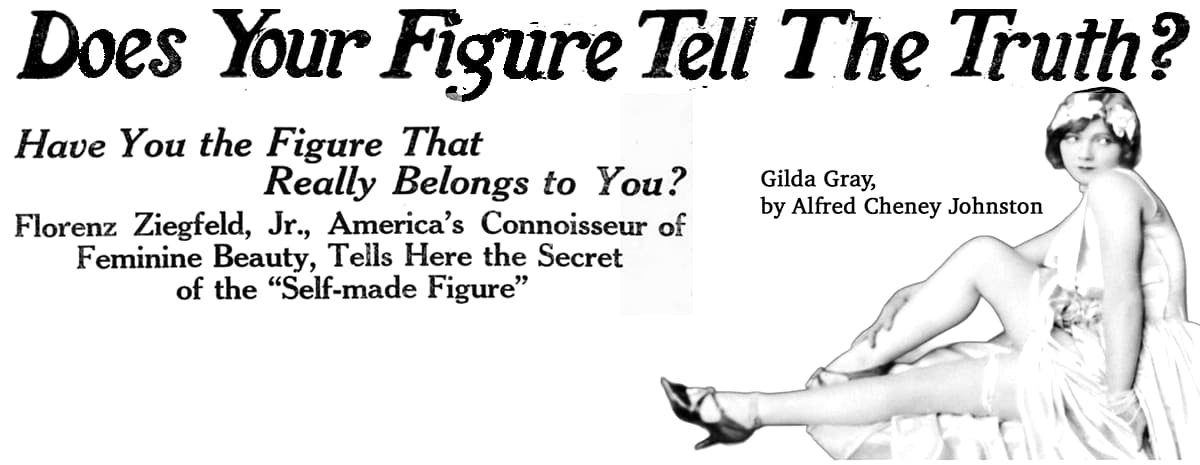
2. Does Your Figure Tell The Truth?
Sunday, July 1, 1923
Detroit Free Press, scan p. 50 · second witness: Tacoma Daily Ledger, July 15, 1923, p. 58
DOES YOUR FIGURE TELL THE TRUTH?
Have You the Figure That Really Belongs to You?
Florenz Ziegfeld, Jr., America’s Connoisseur of Feminine Beauty, Tells Here the Secret of the “Self-made Figure”
By Florenz Ziegfeld, Jr.
I VENTURE to surmise that nowadays not one woman in twenty-five—possibly in a hundred—has the figure that suits her. She wants to be thinner, or fatter—thinner, usually, because in this country a passion for slenderness prevails. It’s a shock to an American to go to the countries just south of us, where avoirdupois is considered beautiful.
“She’d be beautiful if there were about twenty-five pounds less of her!” I heard one American business man say of a South American. “She’s far too fat!”
And the young lady’s countrymen considered him a strange, strange man.
Now, the fault with women who go about in figures that aren’t theirs is lack of initiative. They think that figures are like noses, or the color of one’s eyes, or something akin to those unchangeable details.
The truth of the matter is, that there’s many a self-made figure, as there’s many a self-made man. But as a usual thing, a figure has to be trained in the way it should go. Women who don’t know this, who think that they just happen to have good figures, or happen not to, will see the logic of this if they’ll give it a moment’s thought.
They train everything else. They go to school, as children, to train their minds. Even after they’ve grown up, and married and brought up a family, they go on training their minds—joining clubs, studying, keeping up with the affairs of the world.
They train their faces. Just consult the list of beauty parlors in any classified telephone directory, remembering that that list is but an incomplete one, and you’ll agree with me in that statement. Many fortunes have been made in selling preparations to enhance beauty, and made in some instances, not because the product itself was any good, but because its manufacturers said it was, in their advertising.
But—women do not train their figures. That is, not unless they have to depend on beauty to help them earn their living.
The women of the stage fall into that class. They know that they can’t afford to overlook anything that is going to mean anything in the way of beauty. So they go in for beautiful figures, right from the start.
Figure Can Be Acquired
Some of them were lucky, because they began when they were very young. But it’s possible for a woman who has reached thirty, the gateway of middle age, to acquire a figure that she’ll be proud of, the figure that really belongs to her.
It may seem like hard work. But what woman, in this progressive day and age, wants to go around masquerading in a costume that makes her less beautiful than she is? If it were clothes that caricatured her, she’d work like a slave to get some that showed her to be just as good-looking as she possibly could be. But when it’s a figure whose best points are concealed, because of under development, or because of too much fat, or for some such reason, the woman just goes about wishing that she were better looking, but feeling that she must do the best with what claims to beauty she has, and be satisfied.
She’s really deceiving herself and everybody else. She can have beauty, and doesn’t know it.
And the way is an old, old one—Exercise!
The best way to take it is in dancing. Chorus girls, whose faces and figures frequently are their fortunes, dance and dance and dance. Not long ago I overheard a discussion between two of them. One was dancing every night and two afternoons a week on the stage, and rehearsing in between times for another production. And every day she took a dancing lesson.
“And of course I practice at night, before I go to bed,” she added, quite as a matter of course. “I do all the stretching exercises, and practice the new steps I’ve learned, just one last time.”
Energy Brings Results
It’s energy like that that brings results. That girl’s figure was an unusually beautiful one; she had posed for several artists, and had got the engagements for that reason.
Nor is it the chorus girl alone who dances. The business woman of today joins her. If you knew the big dancing teachers in the various cities, and could talk with them, you would find that they have classes for the woman who works, and wants to get rid of “the office-desk figure”. She doesn’t want to be middle-aged looking, even though middle age is upon her. She wants to walk as lightly as a young girl does; wants to stand well, and move about easily. She knows, too, that dancing for an hour once or twice a week will improve her general health. So she joins a dancing class.
And there she acquires the figure that belongs to her.
A dancer will tell you that dancing makes thin people fatter and fat people thinner. It brings the figure to normal. And by strengthening the muscles and keeping them supple, it brings out curves where they should be, and does away with those that have no place in beauty’s plan.
By doing away with what are really excesses—excess fat, excess thinness, excess stiffness or relaxation of the muscles—it gives to a woman the figure that should be hers.
It takes some courage, of course, just at first, for the woman who has never done anything but ballroom dancing to get into a one-piece bathing suit or whatever similar costume her dancing teacher selects, and do things that are both strange and unusual.
Business Woman Tries Dancing
Recently a young business woman who had gone in for dancing, and after her first two lessons was so lame that she could hardly walk, overheard a conversation between her office boy and one of the stenographers in the office.
“Say, what in the world has Miss G— been doing?” demanded the boy. “She slides her feet along the floor when she walks, and sits down without bending her knees till the last minute, and then she groans something awful!”
“I know; I guess it’s rheumatism, maybe,” was the sympathetic reply. “Don’t ask her; she may be sensitive about it.”
Miss G— laughed, and remembering the price of her dancing lessons and the scathing remarks of her family, she laughed again. At home they had remarked dispassionately that anybody who would pay out money to be made as she was, deserved to be put in a padded cell. Her brother refused to walk down the street with her; he said he couldn’t stand the pitying glances of passers-by, and that if she wanted to go around as if she had creeping paralysis, he wouldn’t be a party to it.
But the lameness wore off in a day or two, and in six months Miss G— had a figure to be proud of, the figure that really belonged to her. It had needed only a bit of care—the care that one gives a garden that is overgrown with weeds, or a tree that needs pruning.
Of course, there are many women who can’t take dancing lessons; either money or lack of opportunity stand in their way. But they can get exercise in other ways. There are beauty departments in some of the newspapers, whose editors will gladly give detailed lists of exercises. There are standardized sets of exercises, like the “Daily Dozen”. The woman who really wants to have a good figure can have it, if she’s willing to work.
And if she isn’t willing to try to get what belongs to her, she deserves to go about with her good looks disguised as effectively as if she wore somebody’s cast-off clothing.
For beauty, like everything else, is likely to come hard. But if it comes, who cares!
Illustration captions. “Two famous ‘Follies’ figures are those of Gilda Gray (above) and Shirley Vernon (left).” · “Truth and beauty are combined in Sonia Ivanoff’s form.” · “Margie Whittington’s is a ‘figure that does not lie.'”
Transcription notes
- No compositor’s errors on this page; no [sic] required. The surname is spelled correctly throughout, unlike the June 24 page.
- Three text columns and one photographic column. The two column joins are proved by split sentences — “practice the new / steps I’ve learned” and “she may / be sensitive about it.”
3. When Homeliness Is Beautiful
Sunday, July 8, 1923
Detroit Free Press, scan p. 52 · second witness: Tacoma Daily Ledger, July 22, 1923, p. 58
WHEN HOMELINESS IS BEAUTIFUL
If you have bad points, create the illusion of beauty by purposely flaunting them, advises Florenz Ziegfeld, Jr. The third of a series by America’s beauty expert.
By Florenz Ziegfeld, Jr.
“HIDE your worst points!” “Wear a hat that calls attention from the fact that your face is too long!”
“Stick to a low waistline, or you’ll look dumpy.”
That’s the sort of advice that modistes have been giving to women for years, and will doubtless continue to give for years to come. It’s good advice, of course.
But many a woman is beautiful because she dares to defy such warnings, and emphasize her homely points, rather than hide them.
Not long ago a certain talented young actress went to one of our famous modistes to have some gowns made for a big production in which she was to be starred. Madame R., the modiste, promptly designed frocks which would bring out the actress’ best points and conceal her worst ones.
The day came when the frocks were to be tried on. The actress seated herself in the modiste’s sanctum sanctorum, and one by one, the models filed past, wearing the gowns, which were still unfinished, but were near enough the completed stage so that their effect could be judged.
“They won’t do!” declared the actress, when she had seen them all. “Not at all!”
In vain the modiste tried to reason with her. These frocks would hide all her worst points. They would bring out her best ones. They would make her more beautiful.
Mere Beauty Not Enough
“Yes, of course,” replied the actress, rather impatiently. “But even so, there would be more beautiful women than I with whom I’d be compared. I can’t be satisfied with being merely beautiful—I have to have distinction. As a matter of fact, I’d never be anything but pretty, anyway; I couldn’t be really beautiful.
“Now, I’ve been considering my face and my figure longer than you have. I know that some of my worst points, which you are trying to hide, ought to be emphasized. They jar people into noticing the rest of me. They say: ‘Oh, how dreadfully long-waisted she is!’ and look again, and see that though I may be too long-waisted, I have good lines. They say: ‘Her neck is too long,’ and look again, and say: ‘But how pretty her throat is, after all, and what a beautiful chin she has!’ Don’t you see, I have to make the most of every good point I have, and some of them would never stand out unless something less attractive called one’s attention to them. It’s like having a very homely child stand beside a very pretty one. I have to say ‘Stop! Look! Listen!’ somehow, or people are going to pass me right by and look at a real beauty.”
There you are!
Beauty is, very often, merely an illusion. You say: ‘What a beautiful woman!’ when in reality the woman is not beautiful. She makes you look at the things about her that are beautiful, and you remember those. She creates a beautiful effect for you.
Study Your Homely Point
So, if you have a homely point, study it a bit, and see if you can’t get a better result by making people think that you want them to look at it, than you can by pretending that it isn’t there at all.
Not so very long ago I heard two women discussing a third.
“I think she’s not the least bit pretty!” exclaimed one of them. “If she’d touch up her hair a bit, instead of leaving it that dreadful dust color, and curl it, instead of wearing it straight, and do it so that her nose would look shorter, she’d be a hundred per cent better looking. But my gracious! she gives herself all the airs and graces of a beauty, and she really buncoes people into thinking she is one.”
“I know it,” the other woman agreed. “And she does such queer things. You know what her hands look like—really too large, and thin. Well, she bought a new ring the other day, a big, square one that she wears on her little finger. I suggested that she wear bracelets instead of rings, because her wrists are prettier than her hands, and the bracelets would call attention to them. And what do you suppose she said? That she wanted to call attention to her hands—that they were well made, and strong, and that strength was beauty. I never heard of such a thing!”
You see, you must decide for yourself what you want to emphasize. And you must have the courage of your convictions, once you reach them.
Don’t think that all of the beautiful girls who come to my office have been beauties since they left the cradle. Perhaps, looking at them, you’d think that some of them weren’t beautiful, and would wonder why they had a place in the “Follies”. Someone else would select those same girls as among the most beautiful ones in the production.
That would be because the high lights of those girls’ beauty did not appeal to your taste. The same girl can’t be beautiful to everyone. The points that those girls had selected for emphasis wouldn’t be points that you liked.
But those girls have studied their own beauty, or someone else has studied it for them. One of the points they emphasize may antagonize you, so that you don’t get beyond it to the beauty to which it calls attention. Of course, a woman who takes the courageous path that leads to beauty runs that risk. But as a rule, she gets results that are worth it. She’s like the man who plays a long shot at the races. He may lose heavily, or he may win enough to put him on Easy Street.
Perhaps the “Follies” girls are not very good illustrations, for of course in the “Follies” chorus there is a place only for very beautiful girls, and one who had a single point that was really bad would be crowded out by another who was a perfect example of her type. But they illustrate the principle of the thing.
Bernhardt’s Illusion of Beauty
And it is an easy matter to find on the stage women who are not beautiful, but have the courage to make you think they are. I need quote only one instance—Sarah Bernhardt. Physically she was not beautiful, but she created the illusion of beauty for us all. She made no attempt to hide her bad points; she flaunted them in our faces, and made us feel that they were good ones.
To go back to the young actress who scorned her modiste’s advice. You have got to say, “Stop! Look! Listen!” somehow, in this day and age, if you are going to make people appreciate you. The girl who is just beautiful doesn’t get far. She needs psychological make-up. In selecting girls for my productions, I can’t afford to take the girl who is just beautiful. Unless her beauty stands out, and is more than beauty, she’ll never get by in the “Follies”.
When applying for a position, she comes into my office with five or six other girls, or perhaps she’s merely one of a dozen. They’re all pretty girls—probably the prettiest in their home towns. Unless she stands out, she doesn’t stand much chance. She must be clever as well as pretty, you see.
And though she has no one bad point, she may make use of those which aren’t especially good, to call attention to those that are.
If her eyes are one of her best points, and her hair isn’t, she’ll emphasize the eyes. She’ll do her hair very simply, and make it frame her brow and her eyes; its very simplicity will catch the attention of the person who looks at her. If her mouth isn’t especially pretty and her nose is, she’ll make her mouth tell you the fact, the instant you look at her.
Do You Seek Distinction?
Now, perhaps you haven’t any one point that you feel is particularly good. Then you must attain beauty by attaining distinction of appearance. Pretend to yourself that you don’t care about being beautiful, anyway. Go in for absolutely perfect grooming, first of all—every woman should do that, anyway, but how few of them really attain it! After that, go in for style. The beautiful woman can’t afford to be stylish, very frequently, because she must wear clothes that are subordinated to her beauty. But if it’s distinction that you want, style was made for you. You can wear the latest models—that is, the ones that good taste stamps with its seal of approval. What do you care if your hat makes your chin look too square—if it’s a fashionable hat. Actual homeliness can achieve a beauty of its own by not trying to be beautiful as beauty is beautiful.
The thing that aids you is the fact that this world is filled with all kinds of people, who hold all kinds of opinions. You’ll meet some people who prefer the beauty you create to the beauty that is made up of big eyes, long eyelashes, and perfect features. I once knew a woman who had many claims to beauty of that kind, who deliberately sacrificed them and went after distinction rather than mere good looks. She made her debut in London, in a season that was noted because of the many beautiful girls who came out that year. On their own grounds she could never have competed with them. But she was alone in her own field. She was the first of them to marry, and her marriage was one of the most brilliant ones of the year.
Think it over. See just what the “attention value” of your worst points is, and see what you can do with it. Unless I’m very much mistaken, you’ll find that you can add a new touch to your own looks. You may not want to cling to it; you may prefer the old ways, and feel that you’d rather be just pretty, or perhaps not pretty at all, than run the risk of having people see only the bad points that you emphasize, and not go on and see the good ones to which you’re calling their attention.
But on the other hand, you may have the courage to blow a siren that will attract attention, and not mind having people realize that the siren is disagreeable in itself.
Try it out, anyway. “All roads lead to Rome”—and nearly all lead to beauty, in one way or another.
Illustration captions. “Mary Lewis” · “Martha Lorber” · “Nellie Savage” · “Betty Dudley” · “Naomi Johnson” · “Below, Jessie Reed” · and a boxed display caption: “‘Homeliness’ could never be applied to this group of ‘Follies’ girls—each one a perfect example of her type.”
Transcription notes
- This is the only installment that numbers itself — “The third of a series” — which is what fixes the sequence of all five.
- The page is a seven-column grid of which six carry text; column 5 is entirely artwork, and the reading order runs 1 → 2 → 3 → 4 → 6 → 7.
- No compositor’s errors found. Three apparent ones are ink defects, examined at 16–20× and deliberately not transcribed as punctuation.
- The paper consistently sets
the "Follies".with the period outside the quotation; preserved as printed.
4. Do You Know When To Keep Still?
Sunday, July 15, 1923
Detroit Free Press, scan p. 46 · second witness: The Idaho Statesman, August 26, 1923, p. 23
DO YOU KNOW WHEN TO KEEP STILL?
“Don’t let a harsh, unmusical voice ruin your personality and charm,” warns Florenz Ziegfeld, Jr. “If training won’t improve it, rather remain dumb!”
By Florenz Ziegfeld, Jr.
RECENTLY I have been interviewing girls who aspired to a place in the chorus of the “Follies”. And a few days ago I had an experience which no doubt you have had frequently, one which it is difficult to understand. Every woman ought to know better than to make other people undergo it, but few women do.
A number of girls were sitting in the corridor outside my office, when I stepped out of the elevator. One of them attracted my attention immediately.
She was not merely beautiful; she was striking. She had wonderful yellow hair, that was wound about her head in braids. Her eyes were brown, with a touch of amber in them. Her face was remarkable for its contours. She had a beautiful figure. Even a casual glance showed that she was out of the ordinary, so far as appearance went. And, since this matter of selecting girls who will live up to the reputation of the “Follies” girls for beauty is no easy thing, I rejoiced and was glad.
Presently the first six girls were summoned to my office. The unusual blonde was among them. The second glance at her verified the impressions of the first.
And then—she spoke. Horrors of horrors! She shattered the effect of beauty anew with every word that she uttered. If she was to be beautiful, certainly she would have to be dumb as well.
Her voice was harsh, nasal, rasping. It should have been low, not necessarily musical, but pleasing in its cadences. She should have spoken with the slightest suggestion of a foreign accent. At least, that was what her beauty led one to expect. In type a Viennese blonde, she should have made her voice part of the role that her looks fitted her for so perfectly. The shock experienced when she spoke was too much for any beauty to inflict on the public, and discounted the charm of her appearance.
Now, haven’t you had that very same sort of thing happen to you? And haven’t you wished that the girl in question would realize that her voice was a potent factor in her beauty, and should be made to play its part?
I once knew a very homely woman who shocked people in just the opposite way. Her voice was really wonderful. Persons who did not know her, and talked with her over the telephone, were enchanted. They wanted to meet her at once. I have sat without looking at her while she talked and wondered if my memory wasn’t playing tricks on me—if she wasn’t really as beautiful as her speaking voice led one to think she must be.
Why Not Have a Voice?
It isn’t difficult to make a voice. Vocal lessons are not prohibitive in price, as a rule, but if they are out of the question, there are excellent books on the subject of voice training that are obtainable at any public library.
Of course, you may feel that you haven’t the time to study. If you are a woman who is bringing up a family, managing a home, going about day after day with a hundred details on your mind, you’re pretty busy, of course. I grant that.
But—so is a chorus girl busy. She not only has to fill her job—which takes six evenings and two afternoons a week, when she’s playing—but she has to go to rehearsals, too. She has to take dancing lessons. She has to take singing lessons. She has to dress well, which may mean that she has to make some of her clothes herself. Perhaps she’s doing a bit of studying on the side. I know of one little dancer who speaks four languages and keeps them all up, and aside from all her regular work finds time to take lessons in riding and swimming.
Do You Really Live?
The reason that she finds time for all this is that she makes it. She uses her time. She lives every single moment of her life, even when she’s asleep.
She lives in the country, and it takes her two hours to get home after the theater. You’d think she’d be ready to tumble into bed when she got home, wouldn’t you? But she doesn’t do that; she exercises for fifteen minutes before she goes to bed, so that she’ll sleep well. She can’t afford to lie awake, you see. She falls asleep instantly, she says, and when she wakes in the morning, she feels wonderfully refreshed.
You’ll find that most young women of the stage, if they are the sort that last, that get ahead in the profession, use their time. They don’t sit around talking about what they ought to be doing; they do it. At rehearsals, during the brief intervals when they’re not working, they’re quite likely to be doing a bit of sewing.
Wasting time is a luxury they can’t afford, and they are wise enough to know it.
You can practice vocal exercises while you’re doing something else. Your family may protest, the neighbors may comment, but what do you care? Beauty certainly is worth having, and any voice can be made beautiful if its owner is sincere in wanting to make it so.
The Secret of Some Girls’ Charm
Not long ago a friend of mine was telling me of one of his neighbors, who has two daughters. The girls were in their ‘teens—about sixteen and eighteen years old, respectively—and their mother has their career all outlined for them. They are to marry millionaires.
“I wish you could see them!” this friend of mine exclaimed to me, with despair in his voice. “They’re young elephants. The elder stands about five feet seven, and weighs a little over two hundred. The younger is shorter, and fatter. I can’t even guess at her weight.
“The girls have fairly good features, fairly good complexions. But lazy! Never have I seen anything like them. When they’re in a room adjoining the one you’re in, and you hear them speak, you know from their fat, thick voices what they’re like. Their minds are as sluggish as their bodies.
“I’ve heard that woman say that she didn’t understand why chorus girls so frequently marry wealthy men. She said that she supposed it must be the lure of the stage. I longed to tell her that the average chorus girl is alert, mentally; that she works hard; that she has to be right on the job every minute of every day, and doesn’t overlook a single bet when it comes to making herself attractive.”
I’ll digress a bit, if you don’t mind; important as beautiful voices are, I’d like to pause and say just one more word on the subject this friend of mine was talking about.
If you begin to cultivate your voice, you’ll find that you will have to cultivate other things as well. Being in good trim physically is going to help you to improve your voice. And you can’t do it if you’re fat. Here’s a little table that will help you to determine whether or not you’re overweight.
This table was compiled according to the old Greek standard, which is a pretty good one to follow nowadays. Our standards are a little different, of course; especially in this country, there’s an inclination toward extreme slenderness.
                     Excess          Normal
    Height           weight          weight
5 ft.  6 in.   153 pounds      134 pounds
 "  "  5  "    151    "        131    "
 "  "  4  "    145    "        126    "
 "  "  3  "    140    "        121    "
 "  "  2  "    134    "        118    "
 "  "  1  "    128    "        116    "
This table was compiled for women. I give below a shorter one for men:
                     Excess          Normal
    Height           weight          weight
5 ft. 11 in.   179 pounds      155 pounds
 "  "  10 "    173    "        150    "
 "  "   9 "    169    "        145    "
 "  "   8 "    160    "        140    "
If I haven’t included your weight, you can figure out from one of these tables what it should be.
Now, if you really want to improve your voice, doing it as singers do, you’ll find that you will have to watch your diet, get plenty of exercise, and plenty of rest. You’ll have to live a really normal life, improving your general health along with your voice.
A Mental Daily Dozen
And you’ll have to exercise your mind, too. Not long ago a charming your [sic] actress told me that she had written some poems and sold them
“I did it in desperation,” she said. “I’d heard so much about actresses like me being dumb, not knowing a single thing, that I decided to have a thought every day. I took a notebook to rehearsals with me, and between times I’d think and think, trying to round up just one thought that would be worth writing down.
“At first it was awfully hard work, but after a little while it began to be easier. Then I tried writing little scraps of verse, and now I’m reaching the stage where I think I’m a poet.”
You’ll find, if you study vocal culture, that you have to know what you’re going to do before you try to do it. When new girls are being trained for the “Follies” the ones who have had the most thorough training as dancers are of course the easiest ones to teach. The girls who have neglected their work when they were studying technique are likely to follow the man who is training them; they just do what he does. After they have learned the steps, they put their own personality into what they are doing.
But the girls who have learned the technique of dancing know what they’re about from the very start. They’ve learned the alphabet of dancing, whereas the other girls are like children who try to spell without knowing the alphabet.
Now, you’ll find that as you put your mind on the production of the right tones, you’re waking it up. You’ll notice that you’re more alive, because you’re using your mental equipment in a new way.
Find Your Own Voice
But don’t, I beg of you, make for yourself a voice that doesn’t belong to you.
One of the most important things to remember is that, just as your looks are of a certain type, your voice must run true to form also. If you’re the senorita type, a contralto voice will probably be the one that belongs to you. Or perhaps your voice will be a mezzo soprano.
If you’re a very light blonde, a high, sweet, silvery voice will be most likely to express your personality best.
This is a thing that you’ll have to decide for yourself, or, if you have a good singing teacher, your problem will be solved for you.
But——be sure it’s solved right. Don’t let yourself admire your teacher’s voice so much that you produce a mere imitation of it. If you do, your voice is going to be affected, empty, a challenge to people not to like you.
The right voice wil [sic] be a potent factor in making you more beautiful. Don’t neglect it!
Concerning Keeping Still
If you just can’t make your voice over, keep still as much as possible.
That may seem like brutal advice, but it isn’t. After all, the girl who knows when to keep still, when to be a good listener, is well on the highway to glory.
Not long ago a young man whom I know was talking to me about a girl with whom he had fallen in love. Apparently the young lady was very popular; he was bewailing the terrific competition that he was up against in trying to win her.
“What’s the secret of her charm?” I asked. “Is she clever; do you like to talk to her, or what is it?”
“I don’t know,” he answered. “She doesn’t talk much. She has big gray eyes, and she looks up at you and says: ‘Do tell me all about yourself,’ and you do, and then when you stop, she sighs and says: ‘Oh, how wonderful! Do tell me more about yourself!’ And then she just sits and listens.”
She knew when to keep still, you see. And even after all this advice that I’ve given you about cultivating a beautiful voice, I’m going to add one last warning that may seem to discount much of what I’ve said.
Learn to speak beautifully—but don’t forget to learn when to keep still!
Illustration captions. “Janet Megrew” · “Frances Reveaux has a voice that fits her personality. That’s why she gained her place in the ‘Follies'” · “Dolores Rousse” · “A low, musical voice with a slight foreign accent would seem to suit Sonia Ivanoff”
Transcription notes
- Both Detroit misprints are confirmed against The Idaho Statesman, which sets the same syndicated text correctly: Detroit’s “a charming your actress” [sic] for young, and “The right voice wil” [sic] for will. Genuine compositor’s errors in the Detroit setting, not misreadings.
- Two readings that were bracketed on the Detroit scan are now settled and the brackets removed: “and sold them” (under-inked in Detroit; plain in Idaho) and “Don’t neglect it!” (the terminal mark, ambiguous in Detroit, is an exclamation point).
- The one column join not proved by a broken word — col 4 upper to lower, across the Dolores Rousse cut — is confirmed by Idaho, which runs “…spell without knowing the alphabet.” straight into “Now, you’ll find that as you put your mind on the production of the right tones…” as consecutive paragraphs inside a single unbroken column.
- Two printed height-and-weight tables are reproduced as set.
- The Idaho printing is a different layout entirely — four wide columns, the standfirst set as a display block beside the byline — and is a markedly cleaner impression than the Detroit page.
5. Punching The Time Clock of Beauty
Sunday, July 22, 1923
Detroit Free Press, scan p. 48 · second witness: The Idaho Statesman, September 2, 1923, p. 23
PUNCHING THE TIME CLOCK OF BEAUTY
Would You Be Beautiful? Then Don’t Neglect Your Beauty for One Hour of the Day; Cultivate It As You Would a Delicate Flower.
By Florenz Ziegfeld, Jr.
IF you want to be beautiful, you can’t afford ever to abandon the business of being as good-looking as possible.
Beauty’s time clock is punched at midnight, and its day is twenty-four hours long. So if you don’t feel that it is worth while to keep trying all the time to improve your looks, don’t expect to get the best results by just trying when you want to, and giving up the struggle the rest of the time.
After all, it is little more than a matter of habit. You can soon train yourself to use all of your time to advantage, instead of wasting some of it.
Many women, for instance, take time out when they talk. They will spend hours and hours preparing for a luncheon, or a dinner party, or something of that sort. They’ll order a new frock, and stand patiently while it is fitted; they’ll go to a masseuse and to a hairdresser, and all that kind of thing. They’ll arrive at the party looking very stunning, and then they talk, and ruin the whole effect.
Just at the moment when they ought to punch beauty’s time clock, they forget to do it.
To be more explicit, they don’t know how to manage their mouths. Only a few days ago I saw a girl who was really pretty, begin to talk. Apparently she thought that her mouth was a rubber band, and could be improved by stretching. It was too large, to begin with, and she made no attempt to talk so that its size would be less apparent. That girl should have been made to stand in front of a mirror for ten minutes a day, and talk. Or, better still, someone should have made a motion picture of her when she was talking, but didn’t know that the picture was being taken.
At least seven out of every ten women make themselves less attractive in appearance when they talk. Their conversation may be brilliant, their voices may be extremely lovely—but they ought to mend their ways or keep still, nevertheless.
It’s merely a beauty habit, learning to hold one’s mouth well. And it’s one worth forming.
Many women are ostrich-like, in thinking that what they don’t want people to see is invisible. They arrange their hair beautifully, powder their faces, do many things to make themselves attractive, but discount all their efforts to be beautiful by doing things that make them unattractive.
It seems strange that they will overlook points that are of the utmost importance, that could quite easily be improved. I believe that education in such matters is quite as essential as is the multiplication table. Looking at a girl, you can’t tell whether or not she knows what twelve times twelve is, but you can tell whether she holds her head so that the line of her throat is good, or whether she sinks her chin so that it’s not only doubled, but trebled. She may have powdered that chin beautifully; she doesn’t know that that is only half of what she needs to do.
A Few Beauty Habits
Too many women are under the impression that beauty grows like a weed. It doesn’t. It grows like a plant, that has good care [sic — no full point printed after “care”] You wouldn’t buy a valuable rose bush and then just stick it in the earth and go away and forget it, and later expect it to bear wonderful flowers. You’d look after it—see that it was watered, that no weeds grew around it, that rose bugs did not devour its buds.
Well, beauty needs just that much care, and more.
If you want to be beautiful, you’ve got to form the habit of sitting well. I’ve seen girls who stood beautifully, go over to a chair and slump down in it in a way that ruined their figures. They folded up in the middle like an accordeon.
Form the habit of sitting well—not too straight, but with your shoulders held properly. If you don’t want to Have [sic — capital H] a double chin, don’t let your head sink down into your neck; hold it up, so that you’ll have a good throat line.
Even when you are very tired, you will find that you can rest when you are sitting properly; you can relax, and not lose everything you’ve gained by exercising for hours to improve your figure.
No good bookkeeper would work all day to balance his books and then at night tear up his day’s work. Yet if you allow yourself to be a half-time beauty, if you make your day an eight-hour one, you are likely to destroy what you have gained.
Form the habit of being rested when you eat or sleep. Don’t go to luncheon so worn out that your food won’t be properly digested; take five minutes in which to rest before you eat. Even the busiest man or woman can do this; better five minutes of relaxation and a glass of milk, than ten minutes devoted to bolting more food—not that ten minutes is ever enough for any meal!
You can rest by just relaxing, mentally and physically. It isn’t necessary to sit down to do it. I once knew a man who had an amazing amount of vitality and did a remarkable amount of work, who rested in the subway in New York during the rush hour.
If you’ve ever ridden in the subway at six o’clock you know what “the rush hour” means. I’ve seen people all but kicked into the car. You hardly know whether you are standing on your own feet or on those belonging to somebody else.
Yet this man got a fifteen minutes’ rest under those conditions.
“First of all, I relax my mind,” he told me. “I refuse to think of the people jammed close all about me. I try to think of nothing at all; if I can’t do that, I think of something pleasant, something that I like to look at.
“Then I relax my body. That’s a little difficult if I’m standing, clinging to a strap, or trying to keep my balance with no strap to cling to, but it can be done. Just let your weight settle; don’t try to hold it up. Don’t let you [sic — for “your”] body sag, but just don’t hold it tense.
“You’ll find that by ceasing to struggle against uncomfortable conditions and forgetting them, you can really rest.”
If you’ll form the habit of resting that way before meals, your food will do you twice as much good as it will if you sit down at the table exhausted.
Going to bed tired is the worst sort of habit. Try to go to bed rested, so that your night’s sleep will really banish the fatigue of the day. Mild exercise will rest you; reading a bit will take your mind off your fatigue, and make you feel better. Drinking a glass of hot milk is a good before-bedtime habit. Experiment until you find the best way of getting rested enough to go to sleep.
Clothes and the Time Clock
If you are going to be beautiful, your clothes must be working for you every moment that you wear them.
The woman who wears clothes that are uncomfortable is putting a huge stumbling block in the path of her own beauty.
Yet from the beginning of time women have done that very thing. No doubt they will continue to do it. Someone tells them that something is fashionable—a certain line, a certain curve, which can be attained only by sacrificing their comfort. And they’ll attain that line or curve, or something as near to it as possible, no matter what difficulties and discomfort are entailed.
Within the memory of a good many of us, it was fashionable to have a wasp-waist. The tortures said to be suffered by the damned were nothing compared to those which must have been endured by the tightly corseted women who managed to smile despite the vises that enclosed their bodies.
Nowadays, luckily, the corset is a thing of the past. We hear much of the good sense that has banished it.
But—something else has taken its place. The brassiere that is too tight has supplanted it.
Needless to say, the girls of the “Follies” do not belong in the ranks of those who follow the flag of fashion when it leads to such senseless practices. If dress reform means dressing with common sense, as I believe it does, every girl in the “Follies” belongs in the ranks of the dress reformists.
Don’t Forget That You’re Beautiful
One of the biggest mistakes that the would-be beauty makes is forgetting to keep her mind in line.
She is likely to think that she wants to be beautiful, instead of that she is beautiful.
As I have said before, the woman who knows that she is beautiful acts as if she were. She is buoyed up by the knowledge; she fits the role that she wants to play.
If your mind doesn’t punch the time clock, you’ll be shirking the business of beauty. A beautiful girl who is on the stage can’t afford to let herself slump; well, neither can you. Pretend that the eyes of the multitude are upon you, all the time—then your beauty will work all the time, instead of just occasionally.
Don’t Underestimate Yourself
Not long ago I overheard two women talking. They sat behind me in my own theater. And they were envying some of the girls in the “Follies.”
“Isn’t she beautiful? Isn’t she lovely!”
“Oh, and look at that one, who’s just coming on. What a gorgeous costume—but then, she can wear it; she has such a pretty figure.”
On the way out of the theater I saw them. They were not more than twenty-five years old, either of them. But they had taken on that mature, settled-down look that so many young women allow themselves to acquire.
Either of them could have worn the costume they had admired on the stage, if she had been willing to work as hard, right straight along, to have a good figure as the girl on the stage worked. Either of them could have been many times as attractive as she was, if she’d been willing to try to be. But they had just leaned back comfortably, eaten too much, not exercised enough, let their minds grow sluggish.
Don’t just envy the beautiful girls who are selected for such productions as mine. Find out what will make you more beautiful, and then work hard to benefit by the knowledge.
Punch beauty’s time clock every day—and you’ll never regret it!
Illustration captions. “Here are two members of the Greenwich Village Follies who have followed Mr. Ziegfeld’s advice when it comes to caring for beauty—Irene Delroy, left, and Ruth Urban, right.” · “Anna Mae Clift, below, is another Greenwich Village representative. Gilda Gray, right, helps make the ‘Ziegfeld Follies’ famous.” · “Naomi Johnson, above, and Betty Garst, below, both of the ‘Ziegfeld Follies.'”
Transcription notes
- All three printer’s errors are Detroit’s own, each set correctly in the Idaho printing: “that has good care” with no full point [sic]; “if you don’t want to Have a double chin” [sic] for have; and “Don’t let you body sag” [sic] for your.
- “accordeon” is a period variant and is left unmarked; Idaho sets “accordion”. The odd phrasing “It grows like a plant, that has good care” stands in both papers and is the syndicate’s wording, not a slip.
- Nothing on the page identifies it as the final installment: no “concluding article” line, no sign-off, no trailer for the following Sunday. That it is the last rests on absence from later issues rather than on internal evidence — The Idaho Statesman, which ran the series six weeks behind Detroit, printed this installment on September 2, 1923 and carried no Ziegfeld feature afterwards.
- The faint type above the headline is show-through from the reverse of the sheet, not part of the article.
Related reading
- Behind the Scenes in Beauty Land — Ziegfeld’s earlier
ten-part series of 1921, on how the Follies chorus was recruited, trained and kept. - What Earthly Use Is a Show Girl? — another
Ziegfeld byline, from 1915: a syndicated joke feature answering a divorce-court claim that a show girl could
neither sing, dance nor act. - Ziegfeld Follies Girls: Staging Provocative Beauty —
the women who actually met the standard described here, and what it cost them. - The Ziegfeld Follies: Broadway’s Great Revue, 1907–1931 — the
history of the show that made Ziegfeld an authority on beauty in the first place. - The Real Life Follies of “Bubbles” Wilson — a Ziegfeld
dancer’s own account, written eighteen years later. See also
Mary Nolan: Tragic Ziegfeld Beauty. - Alfred Cheney Johnston — the photographer who made the
images of the beauty Ziegfeld is describing, and why he
also made nudes.
Cite This Transcription
This transcription is deposited with Zenodo and carries a permanent DOI. If you need a citation that will outlast this website, cite the DOI rather than the page address.
The deposit holds HTML and PDF editions of the text as it stands here. The source text is in the public domain; this transcription and its editorial apparatus are released under CC BY 4.0.
Part of a collection. This transcription is one of a growing set of Jazz Age primary sources, transcribed in full — memoirs and articles from the silent-film and Ziegfeld world, each taken from the original printing and deposited with a DOI.