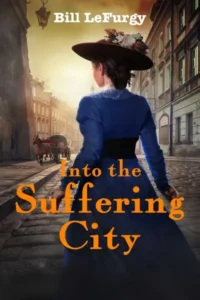
Into the Suffering City: A Novel of Baltimore
Into the Suffering City takes its title from Dante. “Through me the way into the suffering city,” reads the inscription over the gate of the Inferno, “through me the way that runs among the lost.”
The city in question here is 1909 Baltimore, and the lost are easy enough to find: a nineteen-year-old showgirl dead in a boardinghouse bed, a bullet near her heart, and a pistol on the floor engraved with the name of the man everyone has already decided did it.
Unravelling the murder will require a deep dive into the city’s seedy underbelly of hoodlums, dope fiends, and women known euphemistically as “soiled doves.”
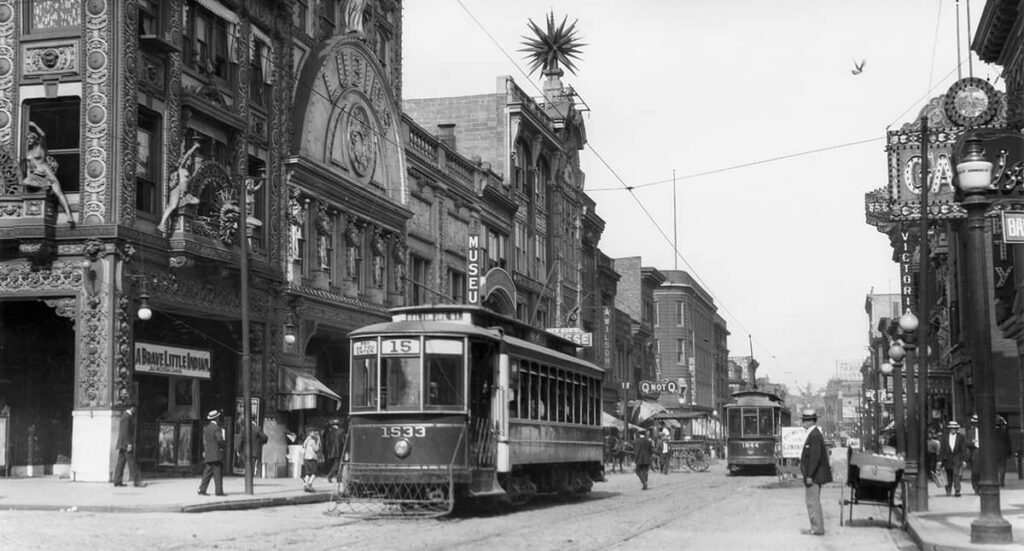
Baltimore, 1909
 The Baltimore of this novel is a real place, reconstructed from the record. Electric light is still a novelty and the morgue still uses ice to keep bodies. Ragtime piano music is all the rage. Any woman out unescorted after dark is considered a prostitute.
A bible-thumping police commissioner is running for mayor against a “million-dollar socialist” reformer.
Below the campaign speeches sits the Baltimore that the reformers kept writing reports about and then declining to publish—the saloons, the boarding houses, and the enormous, thoroughly documented sex trade that the city’s respectable men funded and denied in the same breath.
The showgirl at the center of the case lived in that world. So does almost everyone who knows anything useful about her death. Getting them to talk will require threats and bribes, but that only goes so far with people who have secrets worth killing to keep.
A Doctor Nobody Wanted in the Room
Dr. Sarah Kennecott has just received her degree from the Johns Hopkins School of Medicine with a specialty in pathology, which in 1909 makes her one of a very small number of women practicing medicine at all. She is also autistic, at a time when the word did not exist and the condition had no name—only a set of behaviors that got a person called difficult, or worse. She notices what other people miss and says so at exactly the wrong moment.
I have written elsewhere about what it meant to be autistic before anyone had a term for it, and Sarah is where that research went.
Her partner in the case is Jack Harden, a private detective carrying what a later century would call post-traumatic stress and what his own called nothing at all. She works the drawing rooms; he works the waterfront. Neither of them is welcome anywhere.
The Salome Story Informs My Historical Mystery Novel
While researching the period, I found many archival photographs of barefoot women (and some men) performing on stage, wearing jewel-encrusted bras and little else. The performers present a Salome story, based on the young woman credited with a famous dance in the Bible. Odd and unexpected, these pictures. The women are depicted as sensual and seductive, as well as powerful and dangerous—in other words, completely at odds with prevailing notions about respectable femininity at the time.
I explore the changing roles and experiences of early-20th-century women in my fiction. My main character, Dr. Sarah Kennecott, struggles in a male-dominated world that has little use for an assertive professional woman. Sarah is at the forefront of change happening slowly but inexorably across society.
Looking into the Salome phenomenon, I found a goldmine of evidence about the period. I came across so much information—and so many pictures—that I decided to put them together in a book of their own, Sex, Art, and Salome.
The First Pages
The book opens in the body chamber of the Baltimore city morgue.
Dr. Sarah Kennecott scanned the dead girl’s naked body. The corpse had a small bullet wound near the heart. The right side of the forehead had a one-inch gash over a swollen, purplish bruise, and dark material clustered under fingernails of the right hand. A shallow quarter-inch cut marked the top knuckle of the left index finger. The upper lip had a slight bulge.
Sarah knew exactly how to proceed with the postmortem examination—if she were in charge. Which she most definitely was not.
With difficulty, she broadened her awareness to include the three men also standing around the autopsy table. Do make eye contact, she told herself as her pulse sprinted. Do control the tics. Do not offend the men. Stay out of trouble.
Bare electric bulbs lit the body chamber of the Baltimore city morgue with brutal efficiency. The dead girl’s blue-black lips contrasted with the bright white autopsy table, which had rust spots from where tools had chipped the enameled surface down to the iron base. Saws, drills, chisels, and knives lay ready on a scratched steel counter below shelves of organs floating in murky glass jars. A harsh chemical stink mixed with the odor of the dead hung in the dank air. None of the sights or smells disturbed Sarah’s focus.
About the Book
328 pages. Kirkus Reviews called it a multilayered, entertaining mystery; BlueInk Review gave it a starred review for its intricate plotting; and it was recognized by the Booklife Prize. It is the first of the Sarah Kennecott and Jack Harden mysteries, followed by Murder in the Haunted Chamber. Readers who enjoy detective stories with uncanny elements may also like my list of ten supernatural thrillers with strong detective plots.
Into the Suffering City: A Novel of Baltimore is available from Amazon in paperback and for Kindle.
Readers drawn to the period may also want Ziegfeld Girls and the Birth of Hollywood Glamour, which follows fifty-three women who made the jump from the Broadway stage to the movies — the world Lizzie Sullivan was trying to reach. More about my work is on the biography page.