
L’Ange des projections lumineuses: Lantern Slides and the Coming of Cinema in Rural France
L’Ange des projections lumineuses (The Angel of Luminous Projections) was an illustrated French monthly publication devoted to teaching the Catholic faith with magic-lantern slides. These slides were made of glass and were projected using devices with lenses and an intense light source—an oil or alcohol lamp, acetylene, limelight or an electric arc.
The value of the publication goes beyond the religious: it is a month-by-month record of a working network for circulating projected images through rural France, in the years when cinema was becoming an industry but had yet to become a settled presence outside the cities. By September 1903 that same network was advertising moving pictures alongside the slides.
The first issue of the publication appeared on 15 October 1902. The Bibliothèque nationale de France volume holds ten issues from the journal’s first year: numbers 1 to 9, and number 12.
This page gathers what can be established about the publication as well as my assessment of its significance; it also provides access to the original content as searchable text.
Who Was Behind the Publication
The journal was initiated and directed by a village priest, working through a society and its clerical network. The curé of Champtercier—a small parish in the mountains near Digne, in what was then the department of Basses-Alpes—ran it as part of a society he had established there, the Œuvre des projections catéchistiques.
The priest was Georges Aillaud, identified as the Œuvre’s directeur-fondateur. An œuvre, in ordinary French Catholic usage, is a voluntary association founded by an individual and sustained by subscriptions, donations and fees for its services. This one was clerically led and carried a diocesan imprimatur, but it was not a department of the diocese.
Aillaud is not unknown: Isabelle Saint-Martin cites a handbook he published in 1899 in Faith in a Beam of Light (2022), quoting his argument that Protestant churches in America had been giving Bible lessons by projection for years “and the results are marvellous.” Beyond that he has received little attention in the English-language scholarship I have been able to find.
What Was in the Publication
The opening editorial, “Notre raison d’être,” sets out an intent to cover “everything that can contribute to teaching by luminous projection.” The aim was to supply religiously themed projection shows that would fill a perceived void left by secular magic lantern shows. The presumed reader is the village priest, who would find in it “a very real point of contact with his parishioners.”
Each issue covered four main topics: news of the sponsoring organization (the Œuvre), including letters from members; instructions for the operators of the projection shows; a technical section reviewing projection equipment; and the lantern-lecture scripts themselves, written to be read aloud during a slide series. The January 1903 issue, for example, carries Jésus Enfant!, a life of the child Christ in “eight scenes and twenty-three tableaux.”
The reprinted letters detail how the projection technology was put to use in parishes. One contributor describes monthly catechism courses drawing an average of eighty listeners, and is candid about the competition: “Projections make our task easier and draw everyone in. They all find it more worthwhile and more agreeable to come to us than to go to the tavern.” The correspondent undertook the enterprise, he explains, because “I am always fighting alcoholism and its henchmen.”
“Encouraging Examples” of How Slides Were Used
A recurring column reported what parish clergy were actually doing with their lanterns. One account describes a priest in one of the poorer districts of the Charente who had acquired the seventy plates of the Bonne-Presse picture catechism, a life of Joan of Arc in thirty slides, and “a few humorous subjects”:
You may perhaps suppose that from time to time my curé gathers a few children, or a few grown people carefully picked out, to let them admire his treasure platonically? Not in the least. On Sunday evenings he carries it out into the quarters of his parish, or into the villages, wherever he has managed to find a room large enough to hold one or several hundred people. His parish bulletin has announced in advance that on such a day, at such an hour, he will be in such a place.
That scenario of a projected mass medium is strikingly similar to the arrival of cinema in France. The Lumière brothers held their first paying screening in December 1895, and travelling exhibitors were carrying films to provincial fairs and towns within a year or two—but access outside the cities stayed intermittent, and purpose-built cinemas did not become common until after 1906.
The journal cannot tell us when films were first shown in those villages. What it shows is that projected performance was already a settled local habit there, with an audience, a venue and a schedule, before moving pictures became a regular presence.
Where the Slides Came From
The publication provides details about the Œuvre’s slide library. It circulated two kinds of image, both on glass: ordinary chromolithographic views, and the more expensive “vitrified” Tol-Sim views, promoted as more durable. The journal’s technical column describes the images as “usually positives on glass, photographic views or reproductions of paintings by the masters.”
Slides belonging to the main series carried a white label; supplementary ones, “of simple curiosity or amusement” and slipped in where possible, carried a red label. The idea, presumably, was to “liven up” audiences with an occasional non-religious image during a presentation.
The images had a mixed origin. Some were bought in from commercial houses, above all the Maison de la Bonne Presse, whose seventy-plate picture catechism and thirty-view life of Joan of Arc both turn up in parish reports. Bonne Presse’s imagery department had published Le Grand Catéchisme as eighty chromolithographs in 1894, and its projection service turned seventy of those images into glass slides. By 1903 its catalogue ran to some twelve thousand slides in black and white and color. Some slides were produced locally; and some were donated: the Œuvre repeatedly asked readers to send in useful images.
What Was New
The magic lantern was some two and a half centuries old by 1902. What had changed by then was that projection technology had evolved (and was still evolving, as the publication makes clear) to the point where small organizations could own and operate their own equipment.
In some of the rural communities this clerical network reached, regular lantern lectures may well have preceded any regular film exhibition — though the journal cannot settle that for any particular village. What it does show is a working system of projected performance already in place when moving pictures began to spread.
The Lantern and the Coming of Cinema
L’Ange des projections lumineuses began publishing in October 1902, the year Georges Méliès released Le Voyage dans la Lune. The organization issuing the publication was building projection audiences in precisely the years when cinema was turning itself into an industry, and it was doing so in places where film exhibition was still occasional and itinerant.
Film historians know the industry side of 1902–03 well and the provincial audience side much less well. The publication is a working record of how projected images actually reached a rural department in those years: apparatus hired by post, slides circulated on fixed terms, a printed script supplied with each series, and a lecturer standing beside the screen to explain it.
Every one of those elements reappears in early film exhibition, and here they are already running inside an established lantern network. In September 1903 the same society added cinématographe to the same standing offer, in the same advertisement, to the same customers; the advertisements run through the September 1903 issue. The journal therefore shows, at village level, cinema entering a distribution system that already existed rather than building one of its own.
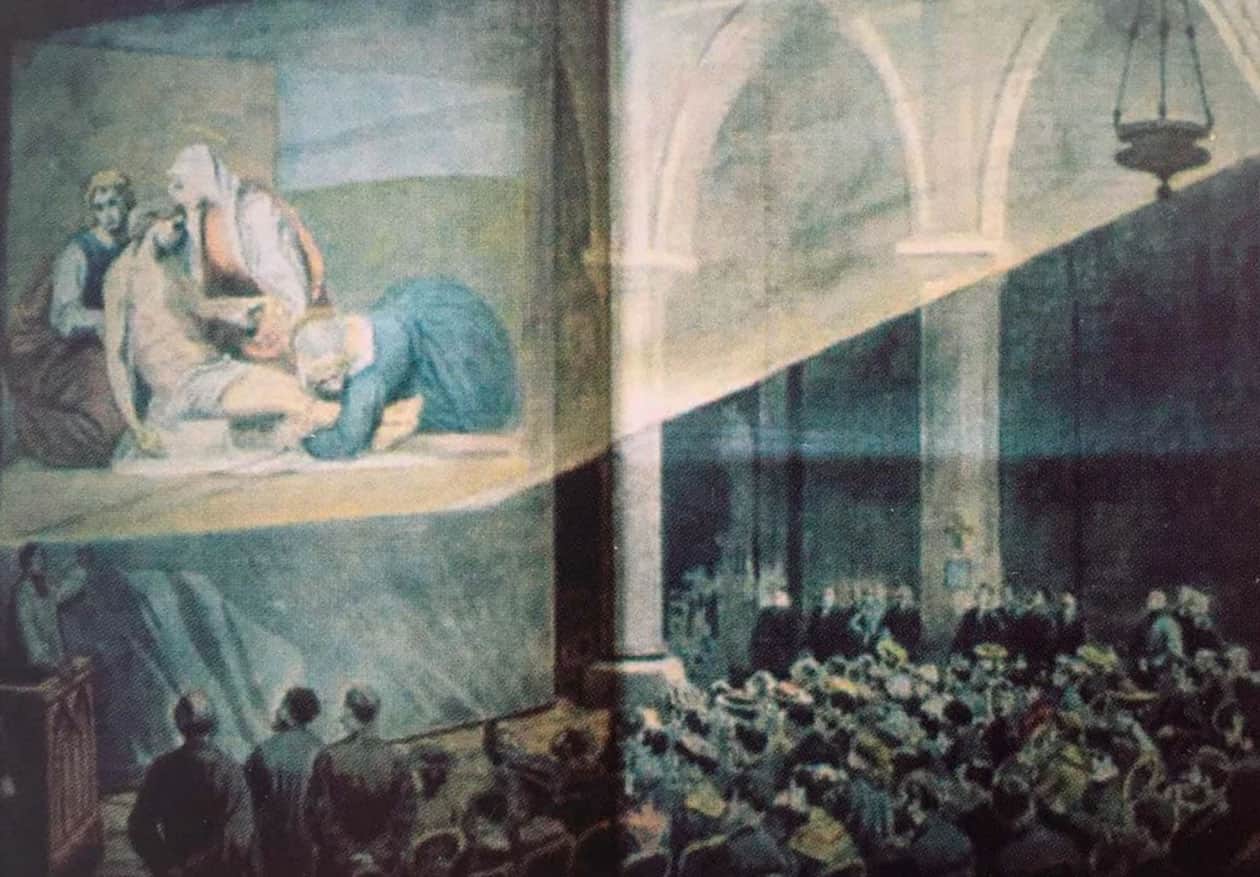
The image at the head of this page is instructive. A church nave has been rearranged into an auditorium: rows of chairs facing forward, a shaft of light crossing the dark, and a magnified image on a screen (or a wall serving as a screen). Strip out the Gothic arches and that is the physical arrangement of a cinema, several years before most French towns had one. The figure at the lectern matters as much as the beam. Early film exhibition also relied on a lecturer who stood beside the screen and told the audience what they were seeing, and the practice did not arrive with cinema—it was inherited from the lantern, where it was already a settled craft with its own manuals and conventions.
What Survives
Ten issues have been digitized, from a single copy held by the Bibliothèque nationale de France under the shelfmark D-72088 (BIS). They are numbers 1 to 9 of the first year, plus number 12.
The gap is not a digitization failure. The BnF’s holdings statement for the volume records it as running only as far as 15 September 1903 and as lacking numbers 10 and 11 — the July and August issues, which the library never had. Whether a second year was ever published is unknown; the catalogue records the run as beginning in 1902 and ending at an undetermined date. The September 1903 number is markedly longer than the others — 52 pages against the usual 16 — which may point to a combined or final issue, though that is speculation.
The Surviving Issues
Each link opens the issue in Gallica.
- 15 October 1902 — year I, no. 1
- 15 November 1902 — year I, no. 2
- 15 December 1902 — year I, no. 3
- 15 January 1903 — year I, no. 4
- 15 February 1903 — year I, no. 5
- 15 March 1903 — year I, no. 6
- 15 April 1903 — year I, no. 7
- 15 May 1903 — year I, no. 8
- 15 June 1903 — year I, no. 9
- 15 September 1903 — year I, no. 12
A machine-assisted transcription of all ten surviving issues is on a separate page: L’Ange des projections lumineuses, 1902-1903: Complete French Transcription — 198 pages, with the printed pagination marked throughout so any passage can be cited. A searchable PDF of the page images is in preparation and will be linked here.
Source, Credit and Reuse
The journal is in the public domain. The page images reproduced here come from the BnF’s digitization and are used under its terms for non-commercial reuse, which require the credit line: Source gallica.bnf.fr / Bibliothèque nationale de France. Catalogue record: BnF cb326930724. ISSN 2273-6220.
The transcription was generated from the page images by a vision-language model, independently of the BnF OCR, then compared word by word against the BnF’s own OCR for the 150 pages where a text layer exists. Candidate errors from that comparison were checked selectively against the page images; the February, March and April issues have no BnF text layer and rest on a single reading. It has not been proofread cover to cover. The full method, the conventions followed and the record of corrections are set out in the note on the transcription.
The transcription is also deposited with Zenodo, where it carries a permanent DOI along with the editorial note, the per-page source files, the apparatus of unresolved readings and the full correction log. Please cite the deposit rather than this page: Œuvre des projections catéchistiques, and Bill LeFurgy (ed.), L’Ange des projections lumineuses: Transcription of the Ten Issues Held by the Bibliothèque nationale de France, 1902–1903, version 1.0 (Zenodo, 2026), https://doi.org/10.5281/zenodo.22713669.
Sources and Further Reading
Much of the useful work on Catholic projection is in French, and a good deal of it is free to read.
Primary Sources
- L’Ange des projections lumineuses (Champtercier, printed at Lyon, 1902–03) — the ten issues held by the BnF, on Gallica. BnF shelfmark D-72088 (BIS); ISSN 2273-6220. A facsimile of all 198 pages is on this site as a single PDF (20 MB), journal content only.
- Le Fascinateur (Maison de la Bonne Presse, Paris, from January 1903) — the Bonne Presse’s own projection monthly, begun three months after L’Ange and edited by Georges-Michel Coissac. It ran until 1938, over which period the Bonne Presse expanded from lantern-slide work into film exhibition and distribution. Not digitized, as far as I can find.
- G.-Michel Coissac, Histoire du cinématographe de ses origines à nos jours (Paris, 1925) — on Gallica. One of the first histories of cinema, written by the man who ran the Bonne Presse’s projection service until 1919 — which is why it treats lantern and cinema as a single story.
In English
- Sabine Lenk and Natalija Majsova, eds, Faith in a Beam of Light: Magic Lantern and Belief in Western Europe, 1860–1940 (Turnhout: Brepols, 2022) — open access. The essential modern volume. See especially Isabelle Saint-Martin on Christian pedagogy and the lantern (which cites Aillaud), Pierre Véronneau on Le Fascinateur and the Bonne Presse, Bart G. Moens on the Bonne Presse’s Service des Projections, and Frank Kessler and Sabine Lenk on lantern performances by the clergy.
- Frank Kessler and Sabine Lenk, “Projecting Faith: French and Belgian Catholics and the Magic Lantern Before the First World War,” Material Religion 16, no. 1 (2020).
- Frank Kessler and Sabine Lenk, “Fighting the Enemy with the Lantern: How French and Belgian Catholic Priests Lectured Against Their Common Laic Enemies Before 1914,” Early Popular Visual Culture (2019).
- Karen Boyle and colleagues, “Casting Shadows: Women’s Work at the Projection Department of Maison de la Bonne Presse (1895–1920),” Women Film Pioneers Project — on the women who actually made and colored the slides.
In French
- Pierre Véronneau, “Le Fascinateur et la Bonne Presse : des médias catholiques pour publics francophones,” 1895. Revue d’histoire du cinéma.
- Isabelle Saint-Martin, Voir, savoir, croire : catéchismes et pédagogie par l’image au XIXe siècle, préface de Ségolène Le Men (Paris: Honoré Champion, 2003) — the standard work on teaching the faith by pictures.
- Sébastien Fevry and Philippe Marion, “Récit et projection lumineuse : regard épistémologique sur la narrativité de la lanterne,” Cahiers de Narratologie 41 (2022).
- Dimitri Vezyroglou, “Les catholiques, le cinéma et la conquête des masses : le tournant de la fin des années 1920,” Revue d’histoire moderne et contemporaine (2004).
- Histoire des projections lumineuses — a long-running French resource on lantern history, useful on the Bonne Presse and on apparatus.