
Salomania, Feminism and Erotic Dance: Cecily Devereux’s Book, Reviewed
I reviewed Cecily Devereux’s Salomania and the Representation of Race and Gender in Modern Erotic Dance (Wilfrid Laurier University Press, 2023) for the journal Dance Chronicle; the version of record is available at Dance Chronicle (Taylor & Francis).
Devereux’s book considers feminism in relation to Salomania, America’s Salome dance craze, analyzing the early twentieth-century phenomenon that runs through so much of the material I explore across this site — from the Salome story itself and the stage dance that scandalized audiences to Strauss’s opera. I’m posting my assessment here for readers who want a scholarly perspective on how historians are interpreting Salomania today. My full review follows.
Salome, From Dutiful Child to Erotic Temptress
 One of the most widely discussed and reimagined dances in history is that of Salome. First alluded to in the Bible, she is described as the daughter of Herodias and the stepdaughter of Herod, King of Judea. Although the biblical text does not name her, the historian Flavius Josephus identified her as Salome around 93–94 CE. She danced before the king and, at her mother’s urging, demanded John the Baptist’s head on a platter as a reward. For centuries, Western paintings typically presented Salome as the child of a morally corrupt mother rather than as an erotic figure. The dance, where depicted, shows her as restrained and fully clothed.
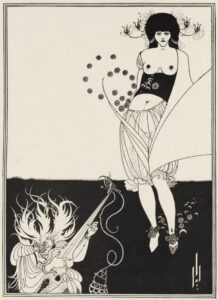
All that changed during the nineteenth century with artists reimagining Salome as someone purposefully using her body and beauty to get what she wants. Oscar Wilde took this to an extreme in his play Salome, where the title character is presented as sexually obsessed, vengeful, and dangerous. Wilde wrote the play in French in 1891, and it first appeared in an English translation with Aubrey Beardsley’s iconic illustrations in 1894. Beardsley envisioned Salome as hypnotically erotic, displaying her sinuous body without a trace of shame and set against a background of moral transgression.
Wilde’s play was performed to acclaim (and controversy) in Berlin. Inspired by the play, Richard Strauss composed Salome the opera, which premiered in 1905 Dresden. Maud Allan, a Canadian studying in Germany, also drew inspiration from the Salome story, and in 1906 danced her “Vision of Salome” in Vienna, set to music. Allan received little notice until she performed the dance in 1908 London, where she scored a huge hit. A major reason for this success was her flesh-baring costume, which was meant to evoke Western ideas of the mysterious and sensuous “Orient.” Popular obsession—dubbed Salomania—fueled innumerable Salome dance acts through the 1920s featuring women moving to music on stage while wearing skimpy, beaded costumes.
Devereux on Salomania, Feminism, and Erotic Dance
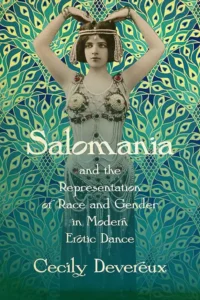
Cecily Devereux’s Salomania and the Representation of Race and Gender in Modern Erotic Dance offers a detailed feminist and postcolonial critique of the Salome dance phenomenon. Devereux claims that Maud Allan’s Vision of Salome was a game-changer for erotic dance as an economic and ideological enterprise. Whereas women had been performing in various states of undress for decades beforehand, Allan’s Vision amplified the patriarchal, capitalist, and imperialist commodification of female bodies. According to Devereux, these forces used the dance as a tool to: (1) promote white women as the preferred breeding stock for white men across imperial territories, (2) control the boundaries of female sexuality and agency, and (3) make money.
In Chapter 1, “Erotic dance and the culture of imperial motherhood,” Devereux discusses how the forces of conquest turned erotic performers into commodities within a system reliant on the ideology of “imperial motherhood,” a term introduced by historian Nancy M. Theriot in the 1990s. Imperial motherhood refers to the ideological construction of motherhood as a means of shaping women as gender-conforming, morally disciplined, and reproductively-oriented citizens, typically in service to broader national or imperial aims. Devereux uses this concept to explain why eroticized versions of Salome’s dance gained traction at particular historical moments. Chapter 2, “‘Salomé, c’est moi’: male artists and the image of the dancer,” analyzes how male artists (including Wilde) appropriated Salome as a figure of subversive—and anxiety-provoking—female desire.
Chapter 3, “Enter Herodias: the phallic mother and the reproductive fetish,” and Chapter 4, “On not seeing Salome in Sunset Boulevard,” shifts the focus to Freudian-inflected symbolism and Billy Wilder’s 1950 film, respectively. While these sections aim to build on Devereux’s core arguments about gender and patriarchy, they move into different conceptual territory, engaging primarily with film criticism and psychoanalytic theory rather than directly addressing Salomania, erotic dance, or the forms of social control emphasized in earlier chapters.
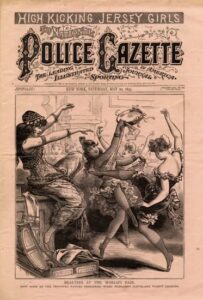
Chapter 5, “The fetish and the reproduction of whiteness from the Salome corpus to Salome, Where She Danced,” considers how a range of Salome-themed narratives—from nineteenth-century texts to Hollywood films—worked to construct and reproduce ideologies of white femininity. Chapter 6, “‘Pathmakers for Salome’: the danse du ventre, the hootchie kootch, and ‘Little Egypt,’” discusses the performative context of pre-Salomania erotic dance. Chapter 7, “Oscar Wilde, Loie Fuller, and Maud Allan,” returns to themes discussed in the book’s early chapters. Chapter 8, “Salomania and the memetic moment,” discusses how and why Salomania spread across media and culture. “Epilogue: Salomania’s legacies” connects Devereux’s theories about the rise of Salomania and today’s erotica.
Salomania, Whiteness, and Reproductive Fetishism
Devereux demonstrates broad knowledge of the subject and uses an eclectic array of sources to develop her argument: Salomania helped legitimize erotic dance just as “the ideology of white motherhood” (p. 123) emerged across the Western imperial powers. As she writes, by the end of the nineteenth century, “women are defined in metonymic relation to their genitals as patriarchal property and space, and are valued according to reproduction as their primary labour” (p. 26). According to Devereux, representations of Salome reveal a “cultural logic” that focuses on “reproductive fetishism” and is “comprehensible as capitalist and imperial patriarchy’s neurotic and pathologizing response to its own constitution” (p. 26).
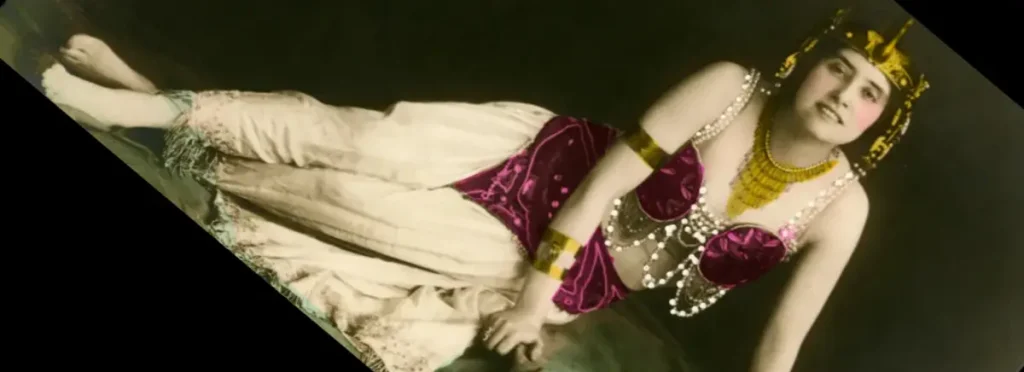
Although Devereux acknowledges the Salome phenomenon as a force for female empowerment, she regards whatever freedom performers obtained as constrained by the patriarchy. Even though Salomania led to an “expansion of the business of erotic dance that is evident in the massive growth of the business and in its current ubiquitous visibility across so many cultural registers,” Devereux views these opportunities as always imbricated in “Euro-imperial ideologies of race, gender, and power” (pp. 172–174).
Other authors have explored different perspectives on performances by Maud Allan: Judith Walkowitz notes that Allan’s Salome dance “introduced a set of codes for female bodily expression that disrupted the Victorian conventional dichotomies of female virtue and female vice and pushed beyond such dualisms.” Petra Dierkes-Thrun describes Allan as “protofeminist and gender-transgressive,” adding that her dancing produced “art [that] crossed established boundaries of art, morality, and gender, challenging social, cultural, and political conventions.”
Was Salomania Controlled by the Patriarchy?
Even when Devereux looks beyond stage presentations of the Salome dance to consider how it moved into the wider culture, she keeps a tight focus on evidence of patriarchal control. This differs from research by Mary Simonson, who uses the concept of intermediality—exchanges between various forms of expression—to view Salomania as, in part, organically fueled by female performers and their audiences. This broader consideration suggests that Salomania was not entirely dominated by the patriarchy but gave women the opportunity to drive cultural change.
As the continuing fascination with Salome makes clear, she is a figure who inspires multiple and, at times, conflicting interpretations. Devereux contributes meaningfully to this ongoing conversation. A rich vein of writing on Salome traces how she has evolved into one of the most potent cultural signifiers of gender, erotic agency, power, transgression, and artistic freedom. This body of work also reflects Salome’s enduring grip on the creative imagination and the way her image dances fluidly between high and popular culture. In many ways, Salome embodies the dense—and often contradictory—tensions, fears, and fantasies that define modernity.
For Further Reading
Judith R. Walkowitz, “The ‘Vision of Salome’: Cosmopolitanism and Erotic Dancing in Central London, 1908–1918,” The American Historical Review 108, no. 2 (April 2003).
Petra Dierkes-Thrun, Salome’s Modernity: Oscar Wilde and the Aesthetics of Transgression (Ann Arbor: University of Michigan Press, 2011).
Mary Simonson, Body Knowledge: Performance, Intermediality, and American Entertainment at the Turn of the Twentieth Century (Oxford: Oxford University Press, 2013).
Bill LeFurgy, Sex, Art, and Salome: Historical Photographs of a Princess, Dancer, Stripper, and Feminist Inspiration.