
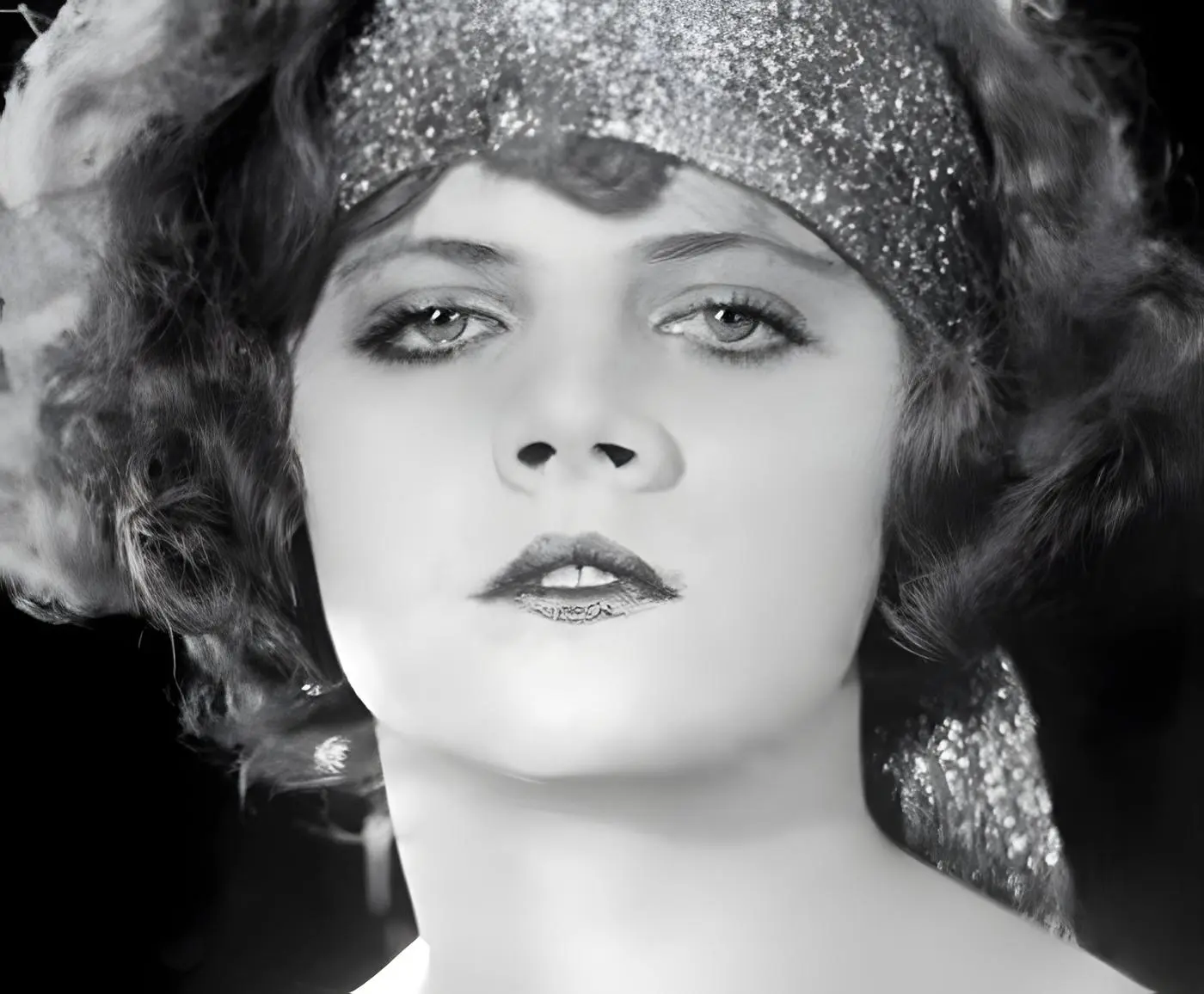
Hilda Ferguson Ziegfeld Follies Shimmy Queen and Blonde Darling of the Underworld
Hilda Ferguson was one of the most talked-about showgirls of the 1920s Jazz Age: a Ziegfeld Follies revue star whose fame rested as much on scandal as on her famous shimmy dance—the era’s emblem of the flapper in motion.
She kept company with bootleggers and gangsters, was questioned again and again about the unsolved murder of a close friend, and drank herself into an early grave. She was dead at thirty and buried in an unmarked plot.
From Baltimore to Broadway
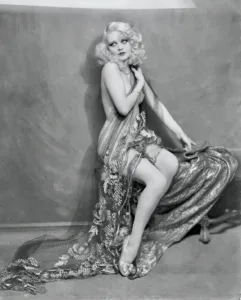
Ferguson was born Hildegarde Gibbons on January 16, 1903, in the Hamilton section of Baltimore, the youngest of six children of a sign painter. At sixteen she married Robert Ugarte, a dental student from Honduras, and the couple soon had a daughter, Yolanda Emily. Ferguson and her husband split around 1921. She later claimed in an interview with the Baltimore Sun that he beat her and “locked up all her clothes” to keep her at home.
She moved to New York City and got into show business, making her first known appearance as Hilda Ferguson on June 23, 1922, in the Bathing Beach Revue at Murray’s Cabaret.
Success came quickly; she joined Irving Berlin’s Music Box Revue on Broadway that same year. She was let go from that show in 1923 after her connection with a murder (see below), but landed on her feet when Florenz Ziegfeld cast her in the Ziegfeld Follies, where she appeared in the editions of 1923, 1924, and 1925.
The Shimmy Queen
Ferguson became a Follies star on the strength of a specialty: the shimmy. She was billed as “the immortal shimmy dancer” and “the shimmy queen,” and admirers gave her a blunter nickname: “The Body.”
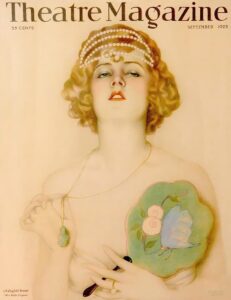
The shimmy was a deceptively simple dance: the dancer held her body still and shook her shoulders rapidly back and forth, setting the chest and torso trembling while her feet barely moved.
Popularized on the cabaret and vaudeville stage in the late 1910s by performers such as Gilda Gray and Bee Palmer, it became a Jazz Age craze: riveting to watch and just scandalous enough to be denounced as obscene, which only fed its popularity. (Gray is one of the performers profiled in 16 Forgotten Silent Film Stars.)
Ferguson’s shimmy drew crowds. Will Rogers noted in 1925: “In the Follies, we have a very beautiful girl who does a specialty dance. Well, they call it a dance, but you could put both of her feet in a vice from the knees down, and it would not interfere with the dance at all.” Despite her immobile feet, “A dish of Jello on a rolling ship is stationary compared to Hilda.”
Her fame bred the kind of gossip-column legend reserved for the biggest stars. One 1924 item in the Washington Daily News reported that, because the New Amsterdam Theatre had neglected to install a shower on the women’s side backstage, the “haughty beauty” had taken to slipping into the men’s shower and, “behind locked doors,” reveling in “the damp delights of a lukewarm sprinkling.”
Alfred Cheney Johnston, noted photographer of the Ziegfeld beauties, took photographs of her.
Her taste for luxury was retailed just as widely. A syndicated 1934 feature on a Fifth Avenue jeweler recalled that Ferguson’s “small but exquisite gem collection was the envy and despair of her sister chorines,” and told how she once bought one of speakeasy queen Texas Guinan‘s $25,000 rings for the sole purpose of flaunting it in the face of her much-married rival, Peggy Hopkins Joyce.
That celebrity made her a fixture of Manhattan’s glittering, dangerous world of chorus girls, gamblers, and “sugar daddies” that would soon produce two of the decade’s most sensational unsolved murders. Ferguson knew both victims.
The First Butterfly: The Murder of Dot King
Ferguson’s closest brush with the underworld came through Dorothy “Dot” King, the model and party girl the tabloids dubbed the “Broadway Butterfly.” Born Anna Marie Keenan, she had been Ferguson’s roommate.
Contemporary coverage left no doubt about the connection: a photo feature in the Washington Times just weeks after the murder identified Ferguson as “the pretty actress who shared Dorothy King’s apartment” and called the two “a strikingly pretty pair.” That same feature described the tangled double life investigators were unraveling—how King juggled her wealthy protector “Mr. Marshall” and her “Porto Rican” lover, even hiring a detective to shadow one from the other.
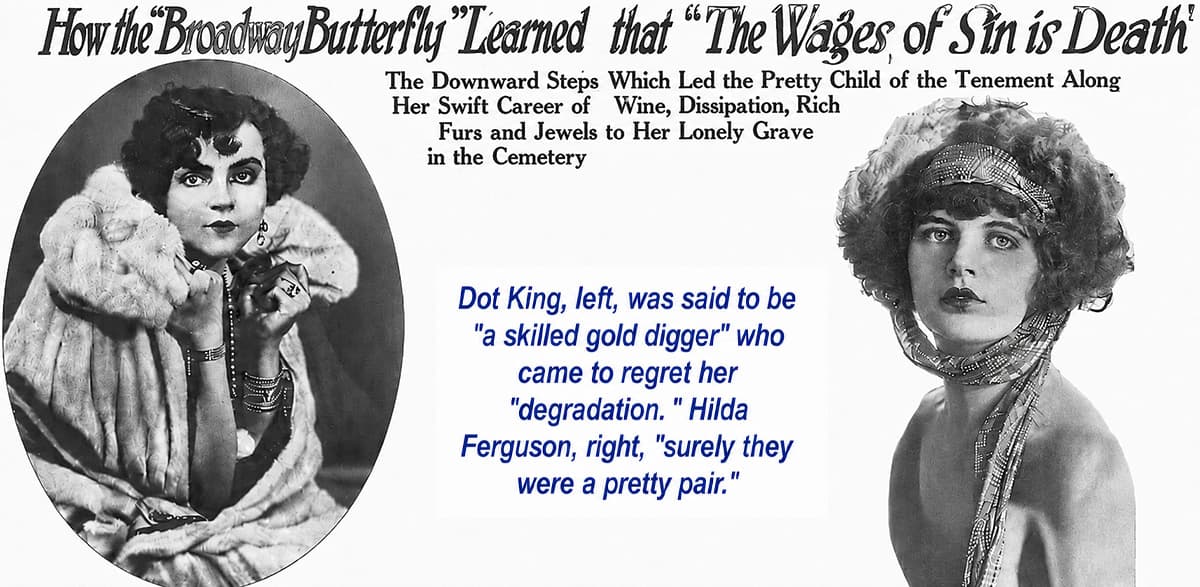
On the morning of March 15, 1923, King’s maid found her dead in the bedroom of her fourth-floor apartment in Manhattan. A bottle of chloroform lay in the bedclothes, and bruising on her neck told investigators she had been forcibly subdued; the medical examiner ruled out suicide. Roughly $15,000 in jewelry was missing, along with a bundle of love letters.
Suspicion fell on two men in particular: King’s abusive lover, Alberto Guimares, who produced an alibi, and her wealthy married benefactor, the Philadelphia millionaire J. Kearsley Mitchell, who had courted her under the alias “Mr. Marshall” and had dined with her hours before her death. No one was ever charged. The press had a field day with the story, and the glare of publicity led to Ferguson getting fired from the Music Box Revue.
Just how deeply Ferguson was entangled is a matter of some dispute. Because she had been King’s roommate and reportedly had a falling-out with her not long before the murder, some accounts describe her as a police suspect. More detailed reconstructions of the case, however, cast her as a witness rather than a suspect—questioned by police numerous times but never charged. What the sources agree on is her silence: to the day she died, Ferguson reportedly never breathed a word of what she knew about Dot King’s death. The case remains unsolved a century later.
A Second Butterfly: Louise Lawson
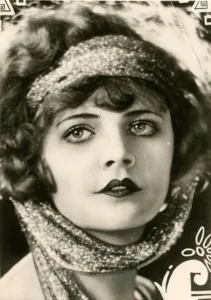
King’s murder was not the only “Broadway Butterfly” killing in Ferguson’s circle, and the two cases are easy to confuse—so it is worth keeping them apart. The second victim was Louise Lawson, a Texas-born model and showgirl who had come to New York chasing the stage. About a year after Dot King’s death, Lawson was found bound, gagged, and suffocated, with some $15,000–$20,000 in jewelry gone.
The methods and locations differed, but the pattern of a bejeweled showgirl robbed and killed was unmistakable, and it fed newspaper theories about a ring of “Wolves of Broadway” preying on women who took gifts from rich admirers.
Ferguson knew Lawson too. An unnamed “girl from the Follies” told detectives that Ferguson was pals with Louise and had “chummed with gentlemen friends” at cabarets around town.
Gangsters, Gin, and Decline
Scandal shadowed Ferguson well beyond the Butterfly cases. After her last Broadway show, in 1927, she announced an engagement to Aaron Benesch, a millionaire and owner of a large country estate, and some thirty years her senior. When questioned about living outside the city she was enthusiastic.
I love the country and the glorious sunshine—nature, lovely nature! There one gets the true values of life, the really worth-while things. City life is artificial, hard, depressing. I have seen all of it and don’t want to repeat. I am tired of theatres, of nightclubs, of hurly burly. As a professional beauty I had my pleasures, but I’ve had enough forever.
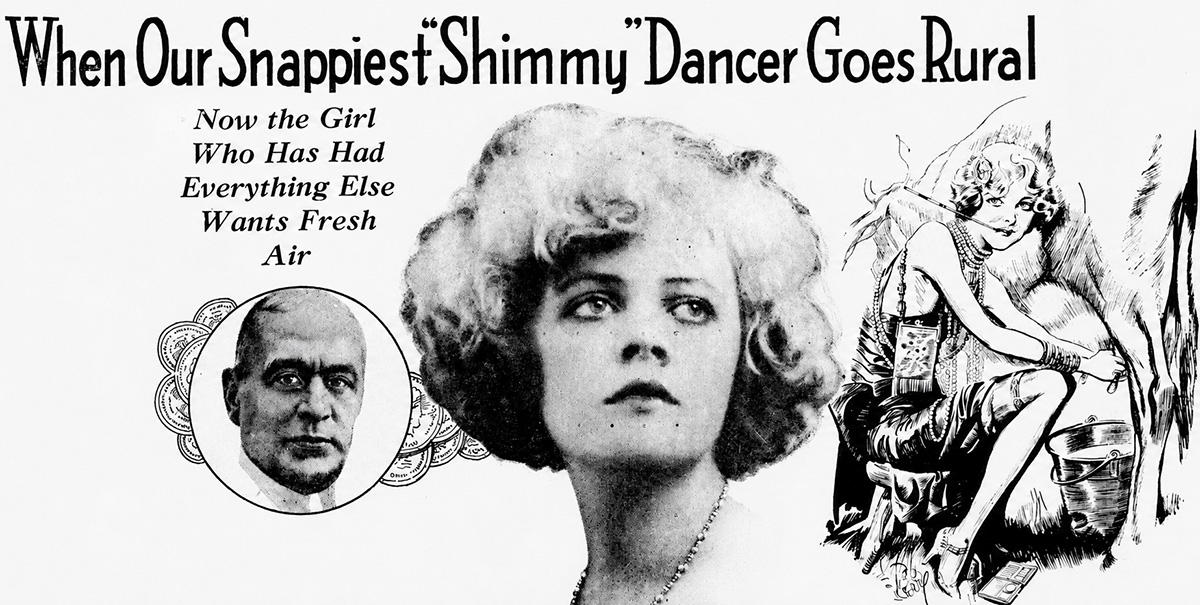
The press mocked her purported desire for the country life. She and Benesch did not marry.
She kept company with many other prominent and notorious men—actor George Raft, composer Arthur Gershwin, and Atlantic City political boss and bootlegger Enoch “Nucky” Johnson. In 1931 she was again swept into a criminal case. After her lover, the gangster “Tough Willie” McCabe—an associate of the murdered gambling czar Arnold Rothstein—was knifed in a night-club brawl, Ferguson was held on $5,000 bail as a material witness in General Sessions. Pressed by the judge about the stabbing, she offered a memorably breezy non-answer: “My dear, I really don’t know anything about it.”
Alcohol became a major part of her life. One writer memorably called her “the blonde darling of the underworld who could pour an incredible amount of straight gin through her pert rosebud lips.” By 1932 the money and the offers had dried up, and the former Follies headliner was reduced to working in a hat store.
“Broke and Broken”: The Death of Hilda Ferguson
By 1933 Ferguson was, in the phrase that has clung to her, “broke and broken.” That year she was found seriously ill and collapsed near a rundown speakeasy. She was hospitalized and died on October 3, 1933, at the age of thirty.
The wire-service notice that ran the next day was blunt about who she had been and evasive about how she died. The Washington Daily News reported that “Hilda Ferguson, former ‘Follies’ beauty, and a roommate of the murdered Dot King, died here last night from an ailment said to have been peritonitis.”
Ferguson’s alcoholism was no secret, and the kind of peritonitis that kills a thirty-year-old often follows years of hard drinking. The tidy medical wording was often used to cover for a death driven by the bottle.
Her end was bleak. According to one account of her final days, none of her show-business friends came to the funeral. Hilda Ferguson—once a dazzling star—was buried in an unmarked grave at Loudon Park Cemetery in Baltimore, the place she had left a decade earlier.