Henri Regnault's painting Salomé (1870): a young woman seated with a golden platter and a knife across her lap
| |

What Is the Story of Salome?

Salome is the young woman who, in the Gospels of Mark and Matthew, dances for King Herod and—prompted by her mother, Herodias—demands the head of John the Baptist on a platter. Unnamed in the Bible and later called Salome by the historian Josephus, she has been reinvented over two thousand years as a seductress, a symbol of female power, and an enduring cultural obsession.

In the oldest version of the story she is a nameless girl who dances at a party and, prompted by her mother, asks for a man’s head.

Dancer Maud Allan posing in an elaborate jeweled Salome costume
Maud Allan as Salome

She became an opera’s tormented heroine, a silent-film vamp, a symbol of feminist revolt, and the patron saint of a dance craze that scandalized America. The remarkable thing is that all of these are the same story. Salome keeps changing to fit the culture that inherits her, and the culture keeps finding her impossible to put down.

I came to Salome sideways. Not through scripture, but through the archive. Years of working with photographs at the Library of Congress and other collections kept turning up the same startling images: photograph after photograph of barefoot women (and a few men) performing on stage in jewel-encrusted bras and little else, all under the respectable banner of a two-thousand-year-old Bible story. That research became my book, Sex, Art, and Salome, and I later reviewed Cecily Devereux’s scholarly history Salomania for the journal Dance Chronicle.

That collision of the sacred and the sensational is the whole history of Salome in miniature. Let’s look at the whole story.

The Ancient Story of Salome: Girl Without A Name

Ninth-century Évangéliaire de Chartres manuscript showing Salome's dance and the beheading of Saint John the Baptist (BnF, Latin 9386)
From Evangeliaires de Chartres

The story begins in Mark and Matthew, written in the first century. The account in Mark (6:21–29) is the fuller one. Herod Antipas, the tetrarch (king) of Galilee, throws a birthday banquet. The daughter of his wife Herodias dances for the assembled guests and pleases Herod so much that he swears to give her anything she asks, “up to half my kingdom.”

She turns to her mother for guidance, and Herodias—who nurses a grudge against the prophet John the Baptist for condemning her marriage—tells her to demand John’s head. While the mother is asking metaphorically for John to be killed, the daughter takes the instruction literally and asks for the head on a platter.

What is striking about the original account is what it leaves out. The dancing girl is never named. She has no motive of her own, no desire, no dialogue beyond relaying her mother’s wish (in childishly literal terms). She is an instrument. The real antagonist is Herodias; the daughter is simply a tool.

The first known representation of the dancing girl dates to the 9th century and comes from the Evangéliaire de Chartres illuminated manuscript. 

The name by which we now know the dancing girl comes from a source other than the Bible. The first-century Roman-Jewish historian Flavius Josephus records a daughter of Herodias named Salome. Josephus never connects her to the beheading—he mentions the execution of John and the existence of Salome separately—but later readers stitched the two together.

Salome Paintings

In the Renaissance period, representations of Salome lived almost entirely in the visual arts rather than in literature. Artists could not resist her, because she gave them two irresistible things to depict: a beautiful young woman in motion, and the grisly drama of the head on the platter.

The images were also useful as a moral lesson: here was the seductive power of the flesh and the terrible price of a King’s foolish promise. Salome was a warning label as much as a subject.

The Renaissance gave her glamour and more focus. One of the first and most influential Renaissance masterworks was Fra Filippo Lippi’s Herod’s Banquet (c. 1452–1465). The image depicts Salome as graceful and attractive, giving her a central role in all three panels of the action; she is beginning to be seen as provocative and dangerous.

Fra Filippo Lippi, Herod's Banquet (c. 1460-64): Salome dances before Herod's guests
Fra Filippo Lippi, Herod’s Banquet

Other masters, including Andrea Solario, Lucas Cranach the Elder, and later the Baroque painter Caravaggio, all painted Salome. They typically gave Salome a dramatic close-up with the gruesome severed head on a platter. Despite this visual spotlight, Salome structurally remains a supporting player in a morality tale, acting without any personal motivation beyond her mother’s scriptural command.

Aubrey Beardsley's illustration 'The Climax' (1893) for Oscar Wilde's Salome, showing Salome lifting John the Baptist's severed head
Aubrey Beardsley, “The Climax” (1893), from the English edition of Wilde’s Salome

In 1870, Henri Regnault introduced a sensual, active Salome poised for violence (see image at top). The transformation was well underway: Salome was no longer just a dancing girl; she was now the supreme femme fatale. 

Artists that followed pictured Salome as an otherworldly symbol of erotic obsession and female power. Aubrey Beardsley’s unforgettable illustrations for Oscar Wilde’s English edition of Salome stripped away realism in favor of stark black-and-white imagery, portraying the princess as a supernatural temptress whose kiss of the severed head became one of the defining images of Decadent art.

Lovis Corinth emphasized her psychological fixation on the severed head, while Franz von Stuck portrayed her in ecstatic, near-demonic triumph. By the time Klimt painted Judith II, audiences so closely identified Judith with Salome that the two figures had effectively merged, reflecting Salome’s dominance as the era’s ultimate symbol of dangerous female sexuality.

I offer my opinion on the most famous Salome painting and discuss ten more in my post Salome Painting: From Mother’s Helper to Dangerous Seductress

Literature and Salome 2.0

Beginning in the Nineteenth century, Salome underwent a critical transformation in her long career. Writers and artists of the fin de siècle—fascinated by decadence, danger, and the figure they called the femme fatale—looked at the passive girl of the Gospels and reimagined her as a young woman of overwhelming and destructive sexual will. Call it Salome 2.0. In this version she no longer asks for the head because her mother tells her to. She asks for it because she wants it, for herself.

Gustave Moreau, The Apparition (1876): Salome points at the glowing severed head of John the Baptist
Gustave Moreau, The Apparition

The groundwork was both literary and painterly. The German poet Heinrich Heine had already imagined Herodias kissing John’s severed head out of thwarted love. Gustave Flaubert gave the tale a lavish retelling in his story Hérodias.

But the pivotal figure was the French painter Gustave Moreau, whose shimmering, jewel-encrusted canvases of Salome dancing before Herod—especially The Apparition, exhibited in 1876, in which the Baptist’s glowing head hovers in midair before her—turned the princess into an icon of hypnotic, decadent menace.

When the novelist Joris-Karl Huysmans devoted rapturous pages to Moreau’s Salome in his 1884 novel À rebours (among other vivid descriptions he called her “goddess of immortal Hysteria”), the image detonated across European culture. 

Oscar Wilde’s one-act play Salome, written in French in 1891 and soon issued in an English edition with Aubrey Beardsley’s notorious black-and-white illustrations, completed the reinvention. Wilde’s Salome is a teenager consumed by lust for John the Baptist, but he spurns her.

She demands his head not to please her mother but out of passion and revenge. In the play’s shocking climax she kisses the dead mouth she could not kiss in life. Wilde also invented, in a single stage direction, the detail that would define her forever: “Salome dances the dance of the seven veils.” He never described the dance. He left a blank space, and the twentieth century would rush to fill it.

Salome Oscar Wilde Book coverWilde gave Salome something she had never had in nearly two thousand years: desire, agency, and contradiction. He made her simultaneously virginal and lewd, an overwhelmed girl and a monstrous adult, powerful enough to destroy a prophet yet doomed for destruction. That bundle of contradictions is precisely what made her endlessly reusable. A character who can be read a dozen ways can be remade at least as many times.

The British establishment understood the threat immediately. When Wilde and Sarah Bernhardt planned to stage the play Salome in London in 1892, the Lord Chamberlain banned it because it was “too inappropriate and immoral for the public.”

The censorship only drew more attention to Wilde’s story of Salome.

What Is the Dance of the Seven Veils?

Theda Bara as Salome stylized in a jeweled costume and sheer veils against a slate-blue backgroundThe most famous part of the Salome story is not in the Bible at all. Scripture simply says the girl “danced.”

The seven veils were Oscar Wilde’s invention, conjured in that single 1891 stage direction and never actually described. That deliberate blank became one of the most productive blank spaces in modern performing art—an invitation that every choreographer, composer, and performer after him rushed to fill.

That fusion of high art and calculated striptease is exactly what lit the fuse for the craze that followed.

Salome on the Opera Stage

Contemporary staging of Salome: a woman in a bloodstained white dress lifts the severed head of John the Baptist to her lips
Palm Beach Opera, Salome; Courtesy Photo

Wilde’s Salome found its most powerful amplifier in Richard Strauss, whose opera Salome premiered in Dresden in 1905. Setting a German translation of Wilde’s play to music of lush orchestration and almost unbearable psychological intensity, Strauss transformed an already notorious drama into one of the most provocative works of the early twentieth century. Audiences were shocked, critics argued, and opera houses quickly recognized that controversy sold tickets. After its triumphant premiere, Salome spread rapidly across Europe, where major companies performed it regularly; it was perhaps the most talked-about opera of the era.

At the center of the work stood the Dance of the Seven Veils. Strauss devoted an extended orchestral sequence to the dance, making it the dramatic and musical climax of the opera. Although neither Strauss nor Wilde specified exactly how much clothing Salome should remove, the very premise of shedding seven veils encouraged increasingly daring interpretations. Directors and dancers discovered that the scene provided an entirely respectable, “artistic” justification for pushing the limits of stage modesty, while impresarios recognized that rumors of provocative performances were priceless publicity.

The opera’s American premiere proved just as sensational. The Metropolitan Opera presented Salome in January 1907, but the spectacle of a princess consumed by erotic desire for the severed head of John the Baptist horrified many of New York’s social elite. According to the familiar story, J. P. Morgan’s daughter was among those demanding action, and the production was withdrawn after a single performance. Salome would not return to the Metropolitan Opera stage until 1934.

I explore this remarkable show in greater detail in a dedicated post: Salome Opera: How Richard Strauss Built on Scandal.

Salomania: When Salome Conquered America

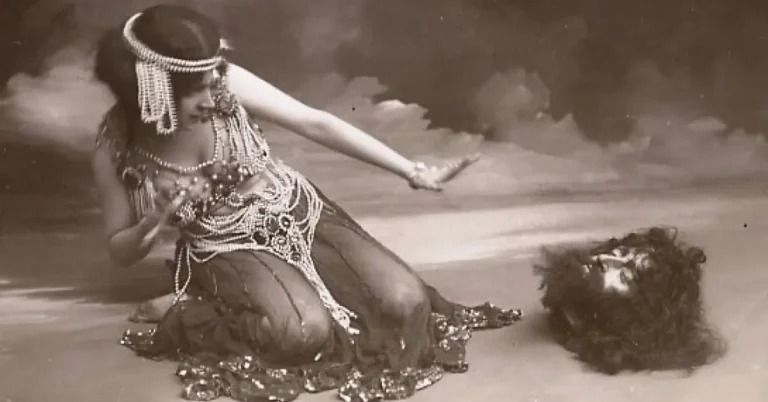
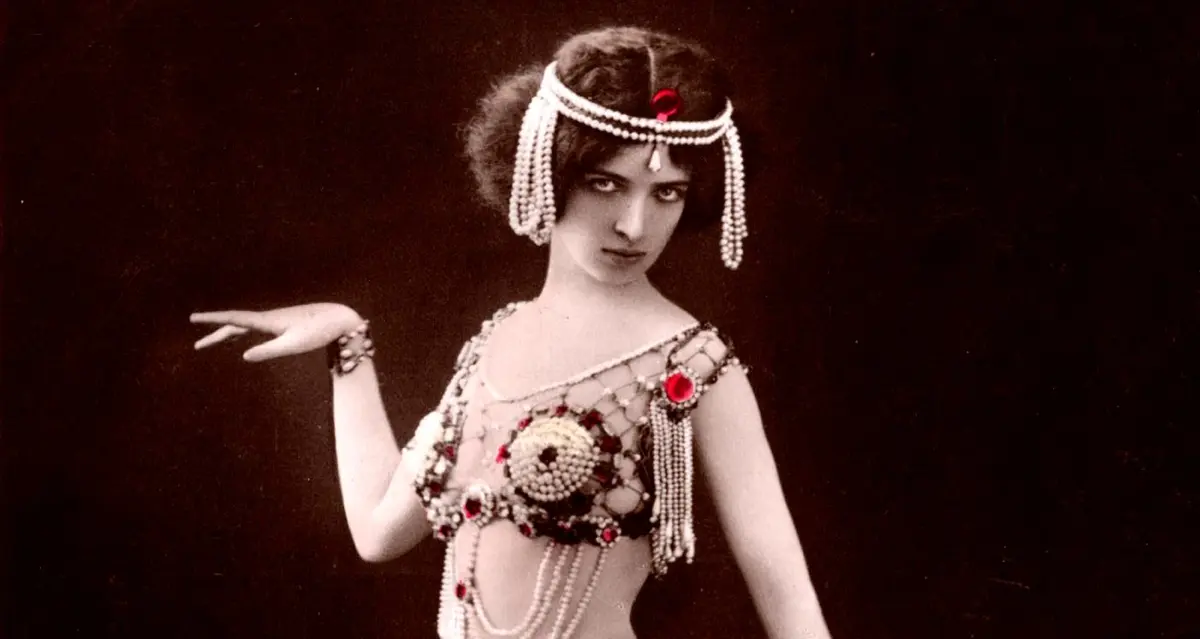
If Wilde and Strauss made Salome dangerous, the years around 1908 made her a mania. Once the dance appeared—and once audiences knew it involved a beautiful woman shedding veils—performers everywhere realized it was a license to appear on stage in less clothing than had ever been permitted, all under the respectable cover of “art.” The result was the craze contemporaries called Salomania.

Americans had been primed for the shock. At the 1893 World’s Columbian Exposition in Chicago, sideshow dancers billed as Egyptian or Syrian had already introduced “abdominal” dancing featuring bare midriffs exposed to enormous crowds.

When Salome arrived fifteen years later, she gave that spectacle a respectable, biblical name.

Gertrude Hoffmann as Salome

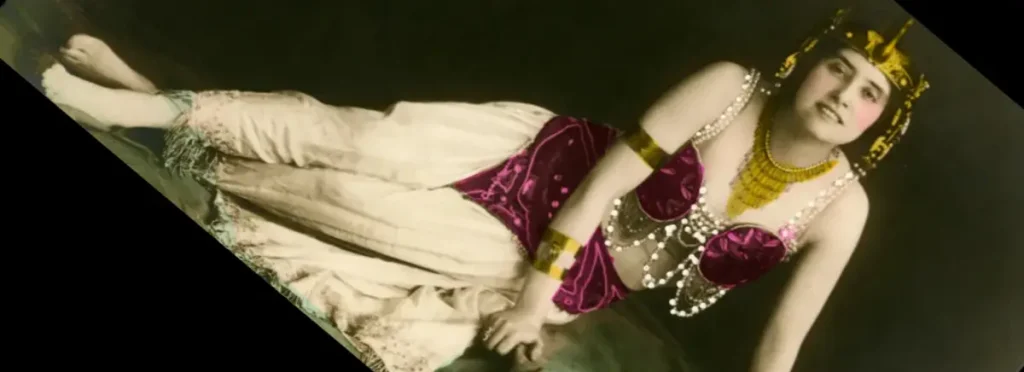
The spark was the dancer Maud Allan, whose “Vision of Salome” became the talk of London in 1908. Within months, imitators multiplied across Europe and America and Salomania was well under way. The vaudeville dancer Gertrude Hoffmann built a hit “skin Salome” act modeled directly on Allan’s and was arrested more than once for it. Eva Tanguay, the “Queen of Vaudeville,” boasted she could fit her entire costume in a closed fist.

A dancer called Mademoiselle Dazie reportedly opened a “school for Salome” that launched an estimated 150 new Salomes onto the vaudeville circuit every month. The exotic dancer Mata Hari was so associated with the role that she petitioned Strauss himself for the chance to play it.

Self-proclaimed defenders of public morality were horrified. One Boston morals society fumed that “the advent of Salome has been the debauching agent,” blaming her for a “flood of unnatural indecency” on the American stage.

Some scholars have recently looked into Salomania from a feminist perspective. See my review of one such work, Cecily Devereux’s Salomania and the Representation of Race and Gender in Modern Erotic Dance.

What the reformers missed was that Salomania was also, quietly, a revolt. These were women taking charge of their own acts, courting their own publicity, and earning independent livings by performing autonomy in the most public way imaginable. As one historian nicely puts it, modern dance didn’t argue that women should be free agents in public life—it was free women in public life, demonstratively and even outrageously. Salome was their vehicle.

I’ve written companion pieces that go deep on this era: Salome Dance: Scandalous and High Minded

Salome the Vamp: On the Silent Screen

Alla Nazimova as Salome in her 1923 avant-garde silent film
All Nazimova as Salome

The craze naturally leapt to the new medium of film. Salome reached film almost as soon as film existed: in 1908 Vitagraph cast Florence Lawrence, America’s first true movie star, in a one-reel Salome.

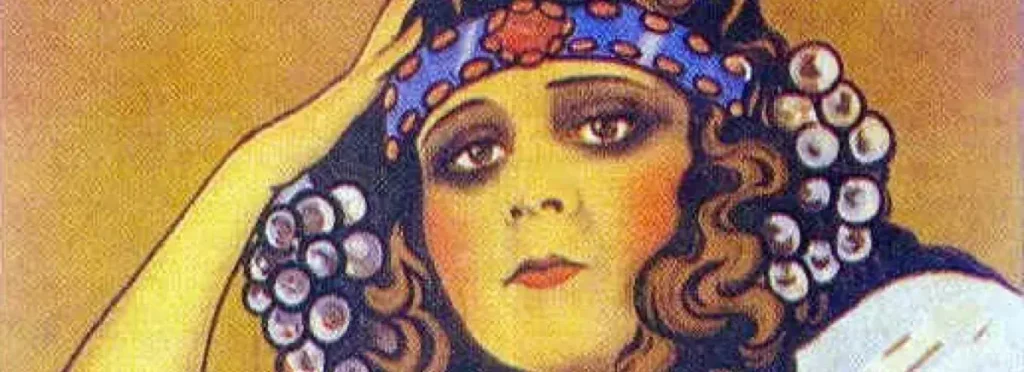
Within a decade the femme fatale had hardened into the vamp, and in 1918 Theda Bara headlined a lavish, scandalous version that made headlines for its eroticism. Critics denounced her as “underclad and over-bold,” but that only contributed to the packed houses that greeted the film around the country.

Alla Nazimova produced an avant-garde Salome film in 1923 with sets and costumes modeled on Aubrey Beardsley’s illustrations for Wilde’s play. Critics dismissed it on release; later generations reclaimed it as a silent-era landmark.

I explore these and a number of other Salome films in a companion post, Salome Movie: Seductive Silent Film Vamps and Goddesses

Salome Today: Still Changing to Fit the Culture

Salomania faded by the late 1920s, but Salome did not. She had lodged herself permanently in cultural memory, and each new generation has remade her in its own image.

Scene from the Metropolitan Opera's 2025 Claus Guth production of Salome: Salome kneels as a figure raises a severed head on a stark grey set
Salome at the Met, 2025; Photo courtesy Metropolitan Opera

The opera never left the repertory, and directors keep finding fresh meaning in it. In the spring of 2025, the Metropolitan Opera unveiled a radical new production by director Claus Guth, conducted by music director Yannick Nézet-Séguin, with Elza van den Heever in the title role. Guth reframed the story as one of childhood trauma, staging Salome as a woman haunted by earlier versions of herself and shaped by abuse—less a monster than a survivor. Critics called it harrowing and unsettling, a Salome for an age preoccupied with the roots of damage.

The screen keeps claiming her too. Al Pacino spent years obsessed with Wilde’s play, producing a film version, Salomé (2013), starring Jessica Chastain in the title role—a chilling meditation, one critic wrote, on “lust, power, reprisal and decadence.” She has turned up as a two-thousand-year-old vampire named Salome in the television series True Blood (2012), and as the subject of boundary-pushing stage revivals: Yaël Farber’s Salomé at London’s National Theatre in 2017, billed as a feminist revision that recast the princess as a symbol of revolution, and a gender-fluid Royal Shakespeare Company production the same year.

The pattern here is unmistakable. The Victorians made Salome a warning about dangerous female sexuality. The Edwardians made her a vehicle for women’s autonomy. Hollywood made her a vamp. Our own moment makes her a study in trauma, feminist power, and fluid identity.

Why the Story Endures

The story of Salome persists because of its durable frame: a young woman, a dance, a fatal desire, a man’s head on a platter—flexible enough to carry whatever a culture most fears and most wants to talk about. Sex, power, art, faith, gender, spectacle: Salome holds them all in tension without resolving any of them, and that irresolution is her secret. You can draw a straight line from Wilde’s teenage seductress to the modern performers such as Madonna, Lady Gaga, Beyoncé who built careers on transgressive spectacle and the calculated shock of the new.

Salome changes to fit the culture. The story remains compelling. And after two thousand years, she shows no sign of dancing off the stage.

This post draws on my book, Sex, Art, and Salome, a fully illustrated history of Salomania and the making of the modern femme fatale. If you’d like the whole story—hundreds of images and the performers, painters, and provocateurs who built the legend—you can read more in my book, Sex, Art, and Salome.

Similar Posts