

The Ziegfeld Follies: Broadway’s Great Revue, 1907–1931
The Ziegfeld Follies changed American entertainment in a big way. When Florenz Ziegfeld, Jr., introduced the Follies of 1907 at the New York Theatre on Broadway, he took spectacle to a whole new level.

This article is about the Broadway revue that Florenz Ziegfeld, Jr. produced from 1907 to 1931 — not the 1945 MGM musical of the same name.
It started as an uncertain experiment. It grew into an entertainment empire that ran until 1931 (with periodic revivals after Ziegfeld’s death in 1932). Along the way, the shows influenced everything from Broadway musicals to Hollywood films.
The Follies were more than entertainment. They were cultural events that changed how people thought about romance, beauty, and propriety. Even today, when people hear “Ziegfeld Follies 1920s,” they imagine a stage filled with the Ziegfeld Girls—the real Broadway showgirls—in grand costumes complete with elaborate feathered headdresses.
Ziegfeld Follies History: From the 1907 Debut to the Last Edition
Florenz Ziegfeld Jr. launched the Ziegfeld Follies on Broadway in 1907 as an American version of the lavish Parisian revue. Built around comedy, music, dance, stars, and elaborately staged showgirls, it became Broadway’s biggest show and one of the most influential popular entertainments of the early twentieth century.
The original Follies ran through 1931, changing with American tastes while helping create modern celebrity publicity, theatrical spectacle, and the image of the Ziegfeld Girl. It joined those elements into a blockbuster Broadway brand. Later revivals and films kept the name alive, but the historic Broadway series belongs to the period from 1907 to 1931.
From Vaudeville to High-Class Spectacle
Before Ziegfeld, vaudeville variety shows were loose collections of singing, dancing, comedy, and pretty girls, often thrown together with widely varying talent. They were fun, but they lacked polish and prestige.

Vaudeville was regarded as middlebrow entertainment, something that didn’t offend but also didn’t aspire to much beyond a few laughs. The shows were also modest, with limited stage sets and costumes that were interesting but not awesome.
Ziegfeld changed all that. He knew that audiences wanted more—more star-power, more extravaganza, more class. And, of course, beautiful women; lots of beautiful women.
People also wanted something modern. Early twentieth-century New York City was pulsing with change—cars, electricity, skyscrapers were all new. There was talk of the “new woman,” women who dared to think of a life outside the home. The time was ripe for a show with a current take on all the innovation that was upending decades of convention.
Ziegfeld put on a show with first-class comedy, music, dance, amazing sets, and a procession of gorgeous women. People saw his Follies as more sophisticated than vaudeville, with a greater sense of style and modernity.
London and Paris, then New York
While in London in 1896, Ziegfeld saw how much audiences loved musical comedies with beautiful women dressed in fancy, immodest costumes. Anna Held was one such performer, and her act was charming and filled with sexual innuendo. Ziegfeld wanted to bring that kind of style to America. He convinced Held to come back to New York with him.
Ziegfeld made her a star, claiming that she took a milk bath every day to make her skin supple and creamy. He even staged a confrontation with a milkman in front of reporters, claiming a delivery was sour. The free publicity put Held in the spotlight and helped propel her to musical comedy stardom. But then Held suggested a variety-style revue like the Folies Bergère in Paris.
When the first Follies launched in 1907, Ziegfeld was so uncertain of its success that he left his name off the title. But as soon as it became a hit, that changed. The show grew into the risque Ziegfeld Follies that was hugely popular in its own time and remains lodged in the popular imagination.
A Star-Making Machine
The Follies launched many performers from obscurity to stardom. W.C. Fields went from vaudeville juggler to hugely popular comedian. Will Rogers was a “cowboy performer” who became a nationally beloved storyteller. Eddie Cantor began as a singing waiter and became a Broadway and movie headliner. Bert Williams started as a minstrel performer and became one of the first Black entertainment stars.
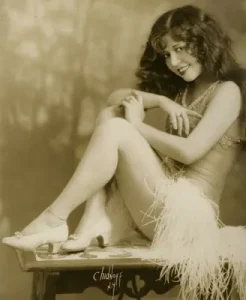
Even among these famous men, it was the women who stood out in the Follies. To name just a few: Fanny Brice was a world-renowned comedian; Ann Pennington was the most talented dancer on Broadway; Ruth Etting had over sixty hit records; Ina Claire starred in over twenty Broadway productions and a dozen films; Marilyn Miller was Broadway’s brightest musical star; Louise Brooks went on to become a legendary actress and writer.
By the time of his death, Ziegfeld was revered as a star-maker, someone who could work a special magic.
He was “a double-doored institution,” wrote the Oakland Post-Enquirer in his obituary. “Through the back entrance swarmed a horde of waitresses, telephone operators, stenographers, obscure vaudeville artists, factory girls, co-eds. They emerged [from the front door] with names spelled in electric bulbs.”
The Ziegfeld Girls
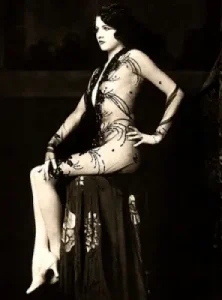
No part of the Follies did more to define it than the women Ziegfeld put on stage. He selected a special few as showgirls—so striking and self-assured that audiences couldn’t look away—dressed them in fantastical costumes, and drilled them in the slow, deliberate “Ziegfeld Walk” built to show them off. They became cultural icons in their own right.
That story is big enough to stand on its own. I tell it in full—the media legend, the beauty politics, and the ambivalence beneath the glamour—in the Ziegfeld Girls: staging provocative beauty.
For one of them in particular, see Hilda Ferguson, the Follies’ shimmy queen. Another was Helen Lee Worthing, whose silent-film career and later struggles with alcohol and prescription drugs are examined in my survey of actresses whose lives and deaths intersected with substance use.
Ziegfeld, the Master of Hype
Ziegfeld was a marketing mastermind. As a young sideshow operator, he once sold tickets to see an empty water tank, claiming it contained invisible fish. He also used spectacle and illusion shaped the Follies.
He fabricated stories to make his Follies stars seem even more interesting. Ziegfeld claimed the star of the first Follies, Nora Bayes, lived on nothing but lollipops to keep her figure trim. Although Fanny Brice was already an established vaudeville performer before the Follies, Ziegfeld claimed he discovered her “hawking newspapers beneath the Brooklyn Bridge.” He also told the press he insured showgirl Hilda Ferguson’s limbs for $100,000.
Every year, he promised bigger, flashier productions than the last. He turned glamour photography into a publicity machine, hiring photographers — above all Alfred Cheney Johnston — to take carefully posed, risqué portraits of his performers. These images were widely published, fueling the fantasy that Follies Girls were the most beautiful women in the world.
A Visionary Producer, Tastemaker, and Moral Influence
Ziegfeld knew how to mix comedy, dance, and spectacle. And music. Irving Berlin, Victor Herbert, and George Gershwin wrote for the Follies, giving the shows the latest sounds: blues, ragtime, and Tin Pan Alley. Jazz appeared early in the shows, helping bring it into the mainstream.
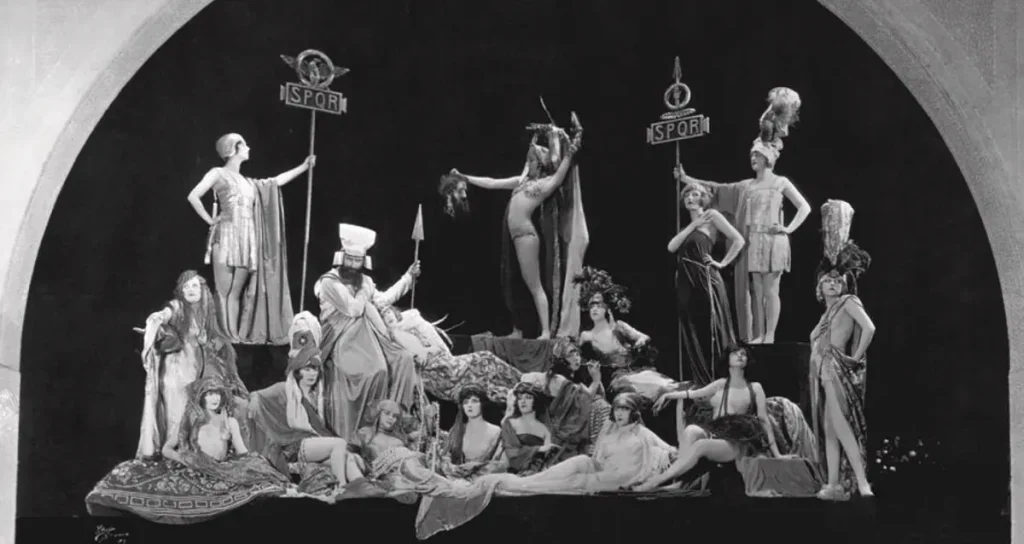
He also revolutionized stage design, hiring Viennese architect Joseph Urban in 1915. Urban’s lavish, color-rich set designs transformed the Follies into visual masterpieces. One critic later said that “Urban did more than any other man to revolutionize American stage design, revitalizing Broadway and influencing everything from architecture to industrial design.”
Labeling Ziegfeld “an institution” and “the greatest moral influence in the city,” The New Yorker in 1925 went on to say that “New Yorkers [don’t] go to the Follies to be entertained . . . They go there to worship—and to discover where the exact limit of propriety has moved.”
Pioneering the Nightclub Experience
The Follies shows typically ended around mid-evening. Ziegfeld guessed that audiences wanted the entertainment to last. He was right. In 1915, he launched the Ziegfeld Midnight Frolic on the rooftop of the New Amsterdam Theatre. It was an instant success.

The show launched the modern nightclub experience, with acts that were bawdier than regular shows. The women performers were dressed even more provocatively. Some stood on a glass runway above the audience, allowing those below to look up under their costumes, adding to the show’s erotic appeal.
Also new was having performers interact with the audience. Early Frolics featured “Balloon Girls” who wore inflated balloons as part of their costumes. The performers would venture into the crowd, and men were encouraged to pop the balloons with their lighted cigars.
The Frolic ran past midnight, which was rare at the time. The audience was often made up of high-society types, who were seen as sophisticated and “in the know” for attending an exclusive event and staying up late.
The Follies Go Hollywood
Hollywood saw Ziegfeld’s success and wanted a piece of it. By the late 1910s, film studios began signing Follies headliners.
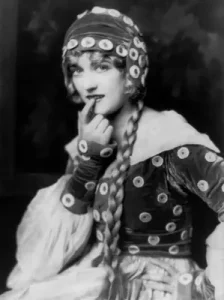
W.C. Fields, Will Rogers, and Eddie Cantor became major film stars. But it was the Ziegfeld Girls whom Hollywood desired most. Many became silver screen icons, including Barbara Stanwyck, Louise Brooks, Marion Davies, and Olive Thomas. Sixteen of these women — household names then, nearly forgotten now — are profiled in 16 Forgotten Silent Film Stars.
Olive Thomas’s 1920 film The Flapper also helped recast the flapper from a schoolgirl into the adult Jazz Age figure remembered today.
More than just stealing talent, Hollywood borrowed Ziegfeld’s marketing techniques. His carefully crafted “Glorified Girls” and “American Venuses” laid the foundation for the Hollywood star system, where actresses were styled and marketed as idealized celebrities.
Why the Ziegfeld Follies Were Important
The Broadway musical as we know it began with Ziegfeld. He demonstrated that big, lavish productions with high-quality singing and dancing would draw big box office. The Follies also laid the groundwork for celebrity culture, with performers receiving huge amounts of publicity and public attention.
The Ziegfeld Follies left a legacy beyond entertainment. The shows launched celebrity culture by encouraging people to idolize glamorized performers. Ziegfeld Girls were held up to the public as the feminine ideal: how women should look, what they should wear, and how they should behave. In this way the Follies blurred the line between advertising, consumer culture, and gender role models.
The Ziegfeld Girl ideal offered a dual idea of perfection. On one hand, it was all about appearance, with the showgirl setting the (perhaps impossible) standard. On the other, the Ziegfeld Girl was an example of an independent woman, someone with her own identity and earning power.
The Follies are long gone, but their influence on entertainment, celebrity culture, and beauty standards remains.
Ziegfeld Follies vs. Modern Broadway
The Ziegfeld Follies was a revue: a sequence of songs, dances, comedy sketches, star appearances, and visual spectacles. Unlike most modern Broadway musicals, it did not depend on one continuing plot or on songs that advanced a single story.
Broadway showgirls in Ziegfeld’s era were often organized as a visual chorus and promoted collectively as a beauty ideal. Modern Broadway ensembles are more likely to serve character and narrative, while performers are generally presented as individual artists rather than interchangeable symbols of glamour.
What can modern Broadway learn from the Ziegfeld Follies? Ziegfeld understood the power of visual identity, star publicity, and making a production feel like a cultural event. Those lessons remain useful, even as the Follies’ treatment of women as a branded beauty ideal deserves critical scrutiny.
A Note on the Spelling
The producer’s name is Florenz Ziegfeld Jr. — Z-i-e-g-f-e-l-d. It is among the more reliably mangled names in American theatrical history. Ziegfield is the most common variant, followed by Zeigfeld, Zigfeld, and Zigfield. The name is also routinely confused with the Germanic Siegfried, and turns up as Ziegfried — neither of which has any connection to the Follies. The revue itself is occasionally rendered Follie or Folly. All of these still appear in search queries today; if you arrived by one of them, you are in the right place.
The Follies in Their Own Words
What Earthly Use Is a Show Girl? — a syndicated newspaper feature of March 1915, in which Ziegfeld is called in as the expert witness on whether the show girl is worth her keep.
Behind the Scenes in Beauty Land — by Florenz Ziegfeld, Jr. — his ten-part series of 1921 on where the chorus beauties came from, how they were chosen, and where they went.
Ziegfeld on Beauty: The Complete 1923 Newspaper Series — five syndicated articles of 1923 in which he turns from the stage door to the reader, telling ordinary women how to acquire the standard the Follies put on display.
The Real Life Follies of “Bubbles” Wilson — the 1941 memoir of Imogene Wilson, the Follies dancer who became the film actress Mary Nolan, serialised in full.
The performers in this piece are the subject of Ziegfeld Girls and the Birth of Hollywood Glamour, a photographic tribute to fifty-three Follies women who went on to careers in the movies.
Further reading: Most of the surviving photographs of these performers were made by one man; my peer-reviewed Alfred Cheney Johnston article in Afterimage looks closely at how he worked and why he was forgotten.