
Alfred Cheney Johnston’s 1928 Beauty Advice for Women
For six days in the autumn of 1928, Alfred Cheney
Johnston — the photographer whose studio portraits defined the look of the Ziegfeld Follies —
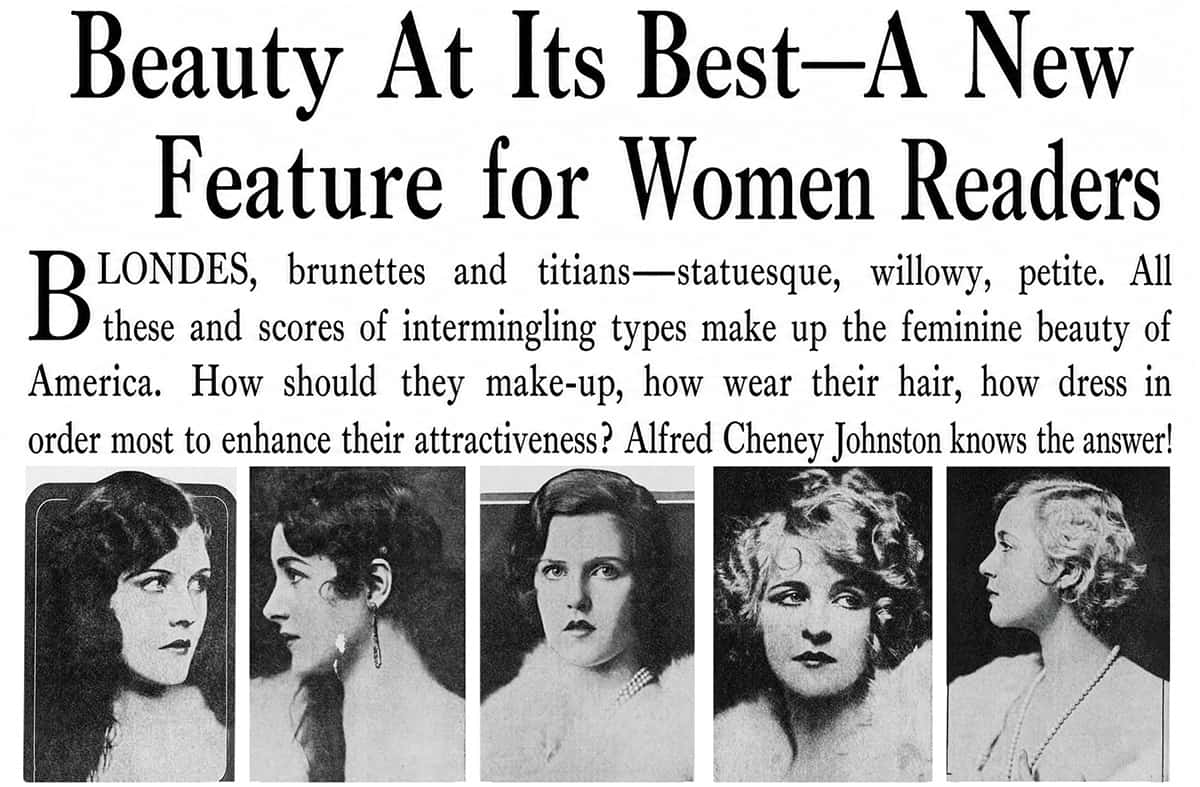
wrote a daily newspaper column sorting American women into beauty types named after Old Master painters.
The complete series is transcribed below for the first time.
Johnston is best remembered for his portraits of performers associated with Florenz Ziegfeld and
the Ziegfeld girls, and for the
nude studies he made alongside that commercial work.
This series shows a third side of him: Johnston presenting women’s appearance as a system of distinct
“types,” each with its own prescribed colours, coiffure and cosmetics. He illustrated it with
his own models — one of whom, Marion Benda, he notes had “graced many of the Ziegfeld
revues.” Nothing in the series indicates it was produced for or authorised by the Follies.
1. Delicate Blonde Must Use Extra Care in Make-Up
Thursday, September 27, 1928 · Myrna Darby, the “Gainsborough Girl”
BEAUTY AT ITS BEST
DELICATE BLONDE MUST USE EXTRA CARE IN MAKE-UP
This is the first of a series of articles written for The Times and NEA Service by Alfred Cheney Johnston, one of the foremost artists among American photographers. Each day he discusses a type of feminine beauty, explains how it best can be enhanced by make-up and coiffure, tells which color schemes and styles of gowns he considers most effective.
By Alfred Cheney Johnston
Illustration captions. Myrna Darby . . . the “Gainsborough Girl.” — [NEA credit mark at foot of halftone] Johnston — [portrait of the author, inset in column 2]
Transcription notes
- “dissimiliar” is the paper’s own misspelling and is marked [sic]. It is the Indianapolis compositor’s, not NEA’s: the same NEA release in The Herald News (Fall River, Mass.), Tue 4 Dec 1928, p. 11 — https://www.newspapers.com/image/1308219733/ — sets “dissimilar” correctly.
- The piece is internally inconsistent on the compound: the headline and the editor’s note set “make-up,” the body text sets “makeup” twice. Both are transcribed as printed.
- “wilfully” is a period-acceptable variant and is left unmarked.
- The article occupies a single column beneath a two-column headline and halftone; it runs unbroken and ends above “TAX HEARING OCT. 5.” No column joins to verify.
2. Chestnut Blonde Is Given Largest Choice of Colors
Friday, September 28, 1928 · Naomi Johnson, the “Greuze model”
BEAUTY AT ITS BEST
CHESTNUT BLONDE IS GIVEN LARGEST CHOICE OF COLORS
This is the second of a series of articles written for The Times and NEA Service by Alfred Cheney Johnston, one of the foremost artists among American photographers. Each day he discusses a type of feminine beauty, explains how it best can be enhanced by make-up and coiffure, tells which color schemes and style of gowns he considers most effective.
By Alfred Cheney Johnston
Illustration captions. Naomi Johnson . . . the “Greuze model.” — [NEA credit mark on the rule at foot of halftone] Johnston — [portrait of the author, inset at the head of the text column]
Transcription notes
- “cloffure” is the paper’s own mangling of “coiffure” and is marked [sic]; the second letter is an undotted “l,” not an “i.” The error is the Indianapolis composing room’s: the same NEA release in The Herald News (Fall River, Mass.), Thu 6 Dec 1928, p. 15 — https://www.newspapers.com/image/1308219882/ — sets “coiffure.”
- “lively features” is what the paper sets, and is transcribed as printed; the Fall River printing sets “lovely,” which is plainly NEA’s word, so this too is an Indianapolis slip.
- The piece is internally inconsistent on the color word: “soft grey eyes” in one paragraph, “gray and beige” in another. Both are transcribed as printed.
- The editor’s note here reads “style of gowns” where installment 1 sets “styles of gowns”; the singular is as printed.
- The installment carries no cross-heads; the text runs unbroken beneath the two-column headline and halftone and ends above “Approves $167,000 Bond Issue.”
3. Madonna Type of Brunette Beauty Should Wear Red
Monday, October 1, 1928 · Marjorie Mulhall, the “Madonna type”
BEAUTY AT ITS BEST
MADONNA TYPE OF BRUNETTE BEAUTY SHOULD WEAR RED
This is the third of a series of articles written for The Times and NEA Service by Alfred Cheney Johnston, one of the foremost artists among American photographers. Each day he discusses a type of feminine beauty, explains how it best can be enhanced by makeup and coiffure, tells which color schemes and styles of gowns he considers most effective.
By Alfred Cheney Johnston
Illustration captions. Marjorie Mulhall, Johnston’s “Madonna type” of brunet. — [NEA credit roundel at foot of halftone] Johnston — [portrait of the author, inset in the left-hand body column]
Transcription notes
- The body is set in two columns beneath the two-column halftone and caption. The left column runs unbroken from the byline to “…at the nape of the neck.”; the right column, cut short by the Kay Jewelry advertisement below it, carries the last three paragraphs, beginning “Burgundy reds…”. The order is confirmed by a second printing of the same NEA release — The Herald News (Fall River, Mass.), Fri 7 Dec 1928, p. 16, https://www.newspapers.com/image/1308219997/ — which runs the identical sequence.
- That Fall River printing carries two sentences that The Times does not: “Her dusky hair, rich skin, soft eyes and pomegranate mouth are attractive either way.” after “…quietly in its stead.”, and “Earrings are always attractive on this type.” after “…nape of the neck.” Both are absent from the Indianapolis setting, which was trimmed to fit above the advertisement.
- No [sic] marks were needed. Two apparent misprints proved on inspection to be inking flaws, not press errors: the “a” of “beautiful” (“very beau-/tiful”) is filled in and reads as “n” at low magnification, and an ink smear crosses “carry” in “the ochre powder should carry a tinge of rose.”
- The paper is inconsistent between “BRUNETTE” in the headline and “brunet” in the caption and twice in the body; all are transcribed as printed. The inconsistency is local, not NEA’s: Fall River wrote its own headline (“MADONNA TYPE OF BEAUTY”) and likewise sets “brunet” in the caption and body, so “brunet” is the wire copy and “BRUNETTE” the Indianapolis copy-desk’s word.
- “grey” and “ochre” are the British-style spellings actually set, and are left unmarked. The editor’s note sets “makeup” as one word here, where the first installment’s note set “make-up.”
4. Titian Type of Beauty Requires Little Makeup
Tuesday, October 2, 1928 · Ann Smith, the “Romney type”
BEAUTY AT ITS BEST
TITIAN TYPE OF BEAUTY REQUIRES LITTLE MAKEUP
This is the fourth of a series of articles written for The Times and NEA Service by Alfred Cheney Johnston, one of the foremost artists among American photographers. Each day he discusses a type of feminine beauty, explains how it best can be enhanced by makeup and coiffure, tells which color schemes and styles of gowns he considers most effective.
By Alfred Cheney Johnston
Illustration captions. Ann Smith . . . the “Romney type.” — [NEA credit mark at foot of halftone]
Transcription notes
- Three of the paper’s own misspellings are marked [sic]: “creal” for “real”, “organe-tinted” for “orange tinted”, and “brililant” for “brilliant”. All three are the Indianapolis composing room’s, not NEA’s: the same release in The Herald News (Fall River, Mass.), Sat 8 Dec 1928, p. 11 — https://www.newspapers.com/image/1308220096/ — sets “real blue eyes”, “orange tinted rouges” and “brilliant” correctly.
- In “opalescent” the “l” is filled with ink and effectively lost in the impression; the reading is secure from the surrounding letters, is confirmed by the Fall River printing, and is given unbracketed. That printing also has “countless lores”, which is therefore NEA’s wording and not a slip.
- The tearing along the left margin of this scan is confined to column 1 (the Roosevelt report and the VerWilKo advertisement). No part of this article is affected.
- “the stately, auburn-haired lady, with blue eyes should include” — the comma after “lady” and the absence of one after “eyes” are as printed.
5. Ruffles, Ribbons Become Blonde Butterfly Type
Wednesday, October 3, 1928 · Carol Bergman, a “Fragonarde blonde”
BEAUTY AT ITS BEST
RUFFLES, RIBBONS BECOME BLONDE BUTTERFLY TYPE
This is the fifth of a series of articles written for The Times and Nea service by Alfred Cheney Johnston, one of the foremost artists among American photographers. Each day he discusses a type of feminine beauty, explains how it best can be enhanced by make-up and coiffure, tells which color schemes and styles of gown he considers most effective.
By Alfred Cheney Johnston
Illustration captions. Carol Bergman, a “Fragonarde blonde.” — [NEA credit mark at foot of halftone]
Transcription notes
- “Fragonarde,” for the painter Fragonard, is NEA’s own form, not an Indianapolis slip: it is set that way in the caption and twice in the body here, the same way in The Herald News (Fall River, Mass.), Tue 11 Dec 1928, p. 11 — https://www.newspapers.com/image/1308220242/ — and in some sixty other 1928 printings of the release across five states. It is marked [sic] at its first appearance in the article text only, and left unmarked thereafter.
- The editor’s note here sets “Nea service” in upper-and-lower case, where the first installment of the series sets “NEA Service.” Both are transcribed as printed.
- The first column ends “Her eyes are blue—a gray blue,” with the final mark blotted against the column rule; the comma is confirmed by the Fall River printing, which sets “a gray blue, and her lashes long and darker than her hair.”
- The paper is inconsistent on the compound, setting “lip rouge” open in one paragraph and “lip-rouge” hyphenated in the next; it also sets “beige black and white” with no comma after “beige.” All are transcribed as printed.
6. Typical Girl of U. S. Blends All Styles of Beauty
Thursday, October 4, 1928 · Marion Benda — Circe, Salome, Psyche, Carmencita
BEAUTY AT ITS BEST
TYPICAL GIRL OF U. S. BLENDS ALL STYLES OF BEAUTY
This is the last of a series of articles written for The Times and NEA Service by Alfred Cheney Johnston, one of the foremost artists among American photographers.
By Alfred Cheney Johnston
Illustration captions. Marion Benda . . . Circe, Salome, Psyche, Carmencita. — [NEA credit mark at foot of halftone]
Transcription notes
- “apled” is the paper’s own misspelling of “applied” and is marked [sic]. It is the Indianapolis composing room’s: the same NEA release in The Herald News (Fall River, Mass.), Wed 12 Dec 1928, p. 11 — https://www.newspapers.com/image/1308220340/ — sets “applied.”
- The stray “beauty” is a displaced word, not a substitution. The Fall River printing reads “…rose, American beauty and certain shades with purple as a base. Blue grays and certain shades with yellowish beiges are not at their best…”: the colour is American beauty, and the Indianapolis compositor dropped “beauty and certain shades with” from the first sentence and carried “beauty and” into the second. Both sentences are transcribed as printed and the stray word is marked [sic].
- No full point follows “young woman” before “She is a trifle above the average height”; the omission is flagged with [sic] after “woman.” Fall River sets the point, so the loss is Indianapolis’s.
- In “her skin [a] warm ivory” the word is obliterated by a narrow ink blot; Fall River gives “and her skin a warm ivory,” which fits the blot and settles the reading.
- “beiges” ends the line tight against the column rule; the faint trailing mark is a final “s,” as the Fall River printing’s “yellowish beiges” confirms.
Related reading
- Alfred Cheney Johnston: The Photographer Who Glorified the Ziegfeld
Girl — the life and studio behind this byline. - Alfred Cheney Johnston: Why the Surprising Nude
Photographs? — the private work he made alongside the commercial portraits, and what it was for. - Ziegfeld Follies Girls: Staging Provocative Beauty
— the women Johnston photographed, and what the standard cost them. - Ziegfeld on Beauty: The Complete 1923 Newspaper Series —
the impresario’s own beauty advice, five years earlier and far more prescriptive. - Behind the Scenes in Beauty Land — Ziegfeld’s
ten-part series of 1921 on how the chorus was recruited, trained and kept.
Cite This Transcription
This transcription is deposited with Zenodo and carries a permanent DOI. If you need a citation that will outlast this website, cite the DOI rather than the page address.
The deposit holds HTML and PDF editions of the text as it stands here. The source text is in the public domain; this transcription and its editorial apparatus are released under CC BY 4.0.
Part of a collection. This transcription is one of a growing set of Jazz Age primary sources, transcribed in full — memoirs and articles from the silent-film and Ziegfeld world, each taken from the original printing and deposited with a DOI.
Further reading: Johnston explaining beauty in his own words sits alongside my peer-reviewed Alfred Cheney Johnston article in Afterimage, which reads the photographs themselves.