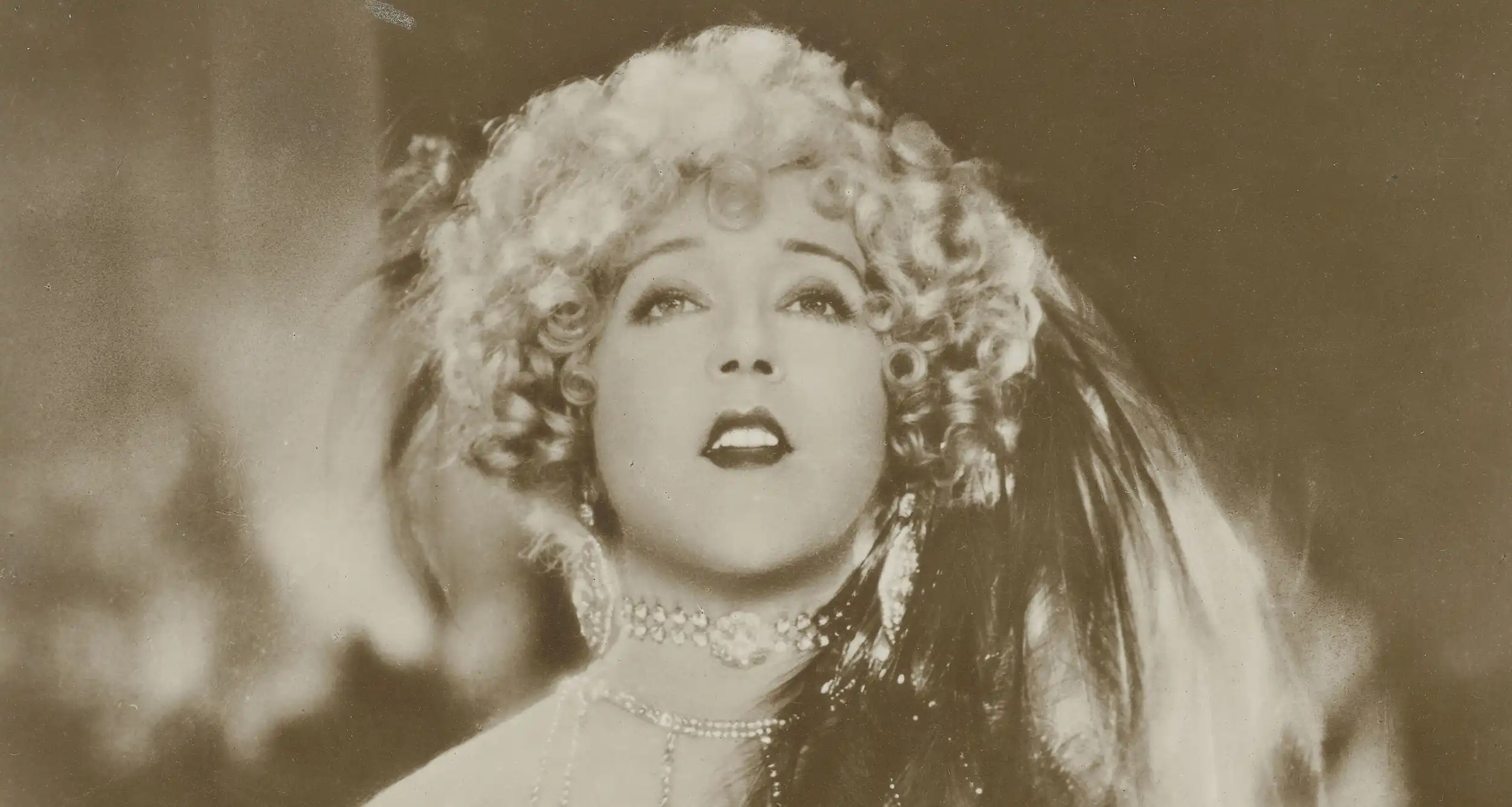
Mae Murray’s First Film: To Have and to Hold, 1916
Mae Murray’s first film was To Have and to Hold, a costume drama released by Paramount on March 5, 1916. Made by the Jesse L. Lasky Feature Play Company and directed by George Melford, it co-starred Wallace Reid.
Mae Murray Deserts Stage for Screen
In mid-December 1915, newspapers across the country carried the headline: “Beautiful Mae Murray Deserts Stage for Screen.” The famous Broadway dancer, a star of the Ziegfeld Follies of 1915, was going to Hollywood.
Murray’s move was a gamble. She was hailed on Broadway for her graceful dancing and dynamic stage personality, but had little experience as a dramatic actress. Stage talent did not automatically translate into screen appeal: famous actresses such as Blanche Ring and Lillian Russell had already appeared in movies without establishing themselves as film stars. Murray was a dancer.
Why she made the move is a compelling story; what happened during the making of her first film, To Have and to Hold, is even more so.
From Broadway Chorus to Follies Star
Born Marie Adrienne Koenig in 1885 (some sources say 1889), Mae Murray developed a love for dancing as a child.
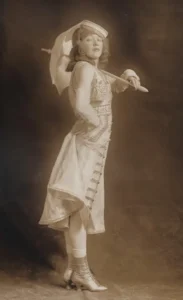
Her Broadway debut came in 1906, in the musical comedy About Town. She joined the chorus of the Ziegfeld Follies of 1908 as one of the early Ziegfeld Girls, and for the next several years moved from the chorus line to featured musical-comedy roles.
She also became a well-known cabaret dancer and refined a famously graceful, sensuous style.
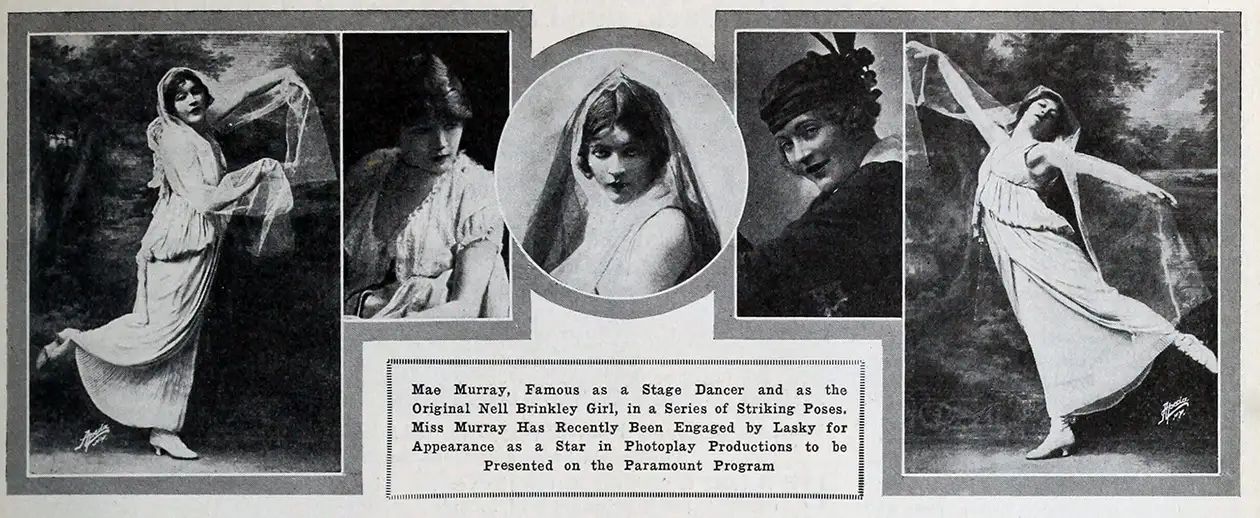
Murray drew attention for her looks, becoming known as the “Nell Brinkley Girl.” Illustrator Nell Brinkley drew pictures of beautiful romantic young women who were modern and spirited; they often had curly hair, expressive eyes, and a pronounced pout.
In 1915, she returned to the Ziegfeld Follies stage as a headline performer and a top Broadway dance star. “Probably no American girl of the generation has gained the fame which has come to Miss Murray since she made her debut on Broadway,” declared the Sunday Gazette (Atlantic City, NJ) in December 1915.
Hollywood Offers an Opportunity
Murray attracted Hollywood’s attention through what amounted to an impromptu screen test. One of the hits of the Ziegfeld Follies of 1915 was a comedy sketch in which Murray appeared as “Merry Pickum” in a short film parodying “how motion pictures are made.”
Murray was said to photograph so well that motion-picture executives hurried to sign her. Her contract with Ziegfeld was a problem until Samuel Goldfish (later Samuel Goldwyn) purchased her release on behalf of the Jesse L. Lasky Feature Play Company. Goldfish later said that the Lasky company prevailed over more lucrative offers because he promised Murray the title role in Sweet Kitty Bellairs, a popular stage comedy to which the company held the screen rights. Murray admired the story, believing the lively, flirtatious heroine suited her vivacious personality.
Murray gave a different account in her 1942 memoir. She named Adolph Zukor—then president of the Famous Players Film Company, which had not yet merged with the Lasky organization—as the man who offered her a Hollywood contract. According to Murray, Zukor proposed welcoming her with a red carpet and brass band, but she initially declined, saying she loved dancing on Broadway too much to leave.
In Murray’s telling, she spent a single sleepless night mulling over the offer; she chose to go to Hollywood partly to escape a persistent suitor, Jay O’Brien. If so, the escape failed: she married O’Brien on December 18, 1916.
“You’re Not in the Follies Now”: Making the Picture
Her arrival in Hollywood was, according to her memoir, a disappointment. No red carpet, no brass band.
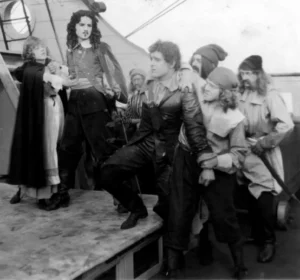
More difficulties followed, including being cast in a five-reel costume drama, To Have and to Hold, as her first picture instead of Sweet Kitty Bellairs.
The film was based on Mary Johnston’s 1900 novel, set in the early seventeenth century. Lady Jocelyn Leigh (Murray) flees England, and marriage to the unbearable Lord Carnal (Tom Forman), for the Jamestown colony. Despite some doubts, Jocelyn marries Captain Ralph Percy (Wallace Reid), but Lord Carnal comes after her. After some conflict, Carnal gives up and Jocelyn devotes herself to her husband.
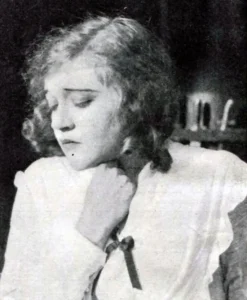
Murray found the transition to film difficult. George Melford was the director, and Murray portrayed him as harsh, constantly reminding her, “You’re not in the Follies now!” Watching the daily rushes, she recalled “saying over and over, ‘I don’t like me!’”
She had several reasons to dislike the situation: Melford’s dictatorial manner, the demands of dramatic acting rather than comedy, and a series of mishaps whose details remain uncertain—and may have been planted for publicity. One account had her “lost in the dunes” during filming; she was reportedly found “near hysterics.”
Another incident supposedly happened when the cast and crew went by boat to Catalina Island to shoot scenes. When threatening weather caused the company to leave the island, Murray was somehow left behind on a rock.
According to contemporary accounts, heavy seas prevented a rescue party from reaching her immediately. “After passing most of the night, exposed to wind and rain,” wrote The Moving Picture World, “she was rescued the next morning through a heavy sea.” Photoplay noted that “another report states that she was lost for a half hour. Perhaps it just seemed like 12 hours.” Motography quipped that Murray was now called “Mae Rooned.”
A “Stupendous Introduction” for Mae Murray
The studio worked hard to promote Murray and the film before release. A story appearing in many newspapers across the country in February 1916 likely originated with a Hollywood press agent. “Never in the history of the motion picture industry was a more elaborate and stupendous introduction prepared for any single star,” reported the Galena Weekly Republican of Galena, Kansas, “and it is said without fear of contradiction that the anticipation of her film debut will in no measure be greater than its realization.”
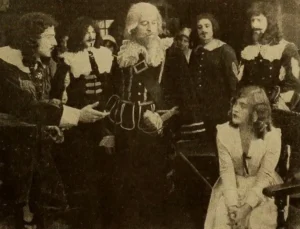
To Have and to Hold was released on March 5, 1916. Critics generally loved the film but were split on Murray. Motion Picture News praised her as “a star and a real one.” The Washington Post wrote that “the motion picture public may prepare to accept a new idol of the silent drama,” praising Murray’s “beauty, naturalness and ability.”
Other outlets were less charmed. The New-York Tribune flatly declared, “she is not an actress, and it is unlikely that twice her present salary will make her one.” The New York Dramatic Mirror said Murray “was pleasing in a negative manner . . . no actress can ever hope for success in this field who has only one facial expression and uses it upon every occasion.”
Some reviews pointed to what they saw as Murray’s preference for the theatrical rather than the dramatic. Variety praised director Melford for working within “the limitations of his star”; he “handled her so that her histrionic ability is not over taxed.” The New York Times wrote, “she has yet to remember that she is not dancing—in this picture she is ceaselessly fluttering—but she will learn repose, no doubt.”
Sadly, the film is lost, so modern audiences cannot judge the production or Murray’s performance for themselves. Murray did get to play Sweet Kitty Bellairs later in 1916, but that film is lost, too.
Mae Murray Moves Past Her First Film to Movie Stardom
Murray, of course, never did “learn repose.”
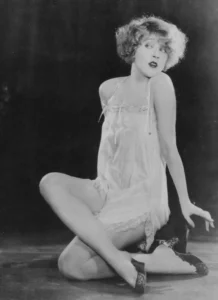
As she ascended to stardom during the late 1910s and early 1920s, she became known as “The Girl with the Bee-Stung Lips” and “The Gardenia of the Screen.”
The nicknames suggested more than Murray’s physical appearance; they also captured the extravagant quality of her screen personality. As the Women Film Pioneers Project notes, “Murray’s presence can be considered excessive and baroque . . . a force of nature is not necessarily natural, and Murray’s fans reveled in her colorful performances.”
The Lasky studio may have recognized from the beginning that Murray’s theatrical energy needed to be adjusted for the camera. Casting her in a costume drama under a strict director gave her little opportunity to rely on the dancing and dynamic stage presence that had made her famous.
Murray may not have liked herself in the role, but she persevered and went on to play memorably flamboyant characters in surviving films such as Jazzmania (1923) and The Merry Widow (1925). Her later years were far less glamorous; I tell that part of her story in my post on forgotten silent film stars.
This post is part of the Silent Movie Day Blogathon, hosted by Silentology and The Everyday Cinephile in celebration of Silent Movie Day on September 29. Be sure to check out the other entries!
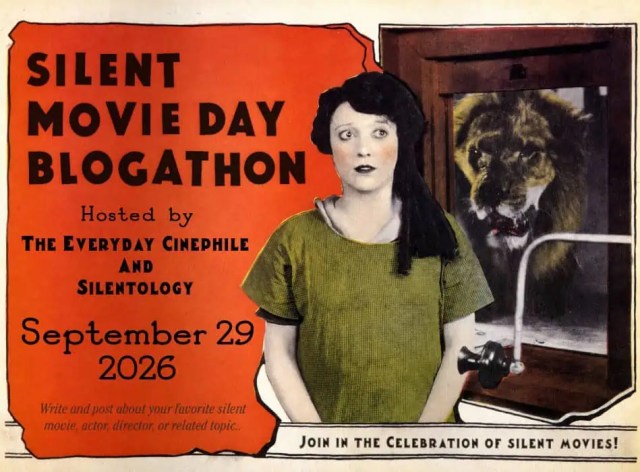
Silent Movie Day is an annual celebration of silent film in which anyone can participate. In the organizers’ words: “We believe that silent film is a vital, beautiful, and often overlooked part of film history. Our goal is to advocate for its presentation and preservation.” For more, see the Silent Movie Day website.