
What Was Salomania? America’s Salome Dance Craze
Salomania was the craze for “Salome dancing” that filled American and European stages between 1907 and the mid-1920s. The peak was in 1908. That year, hundreds of performers — vaudeville headliners, opera divas, circus sideshow acts, chorus girls, and even some men — put on jewel-encrusted bras and gauzy skirts, danced barefoot with a papier-mâché severed head, and made a biblical teenager into a scandalous, but very profitable, show business act.
This page explains what Salomania was, who drove it, why it provoked such alarm, and what it left behind.
Also explore Salome in painting and Salome on the silent screen.

Salomania “Rages Through the World Like an Epidemic”
During the summer of 1908, American newspapers breathlessly reported on the Salomania craze. One account declared:
An epidemic of “Salomes” has struck the world. Almost as naked as truth, and concealing principally by gauze and ropes of jewels, extremes which in days gone by were never considered permissible for stage display, a host of great dancers are going through sinuous movements to show the daughter of Herodias in her extreme moment of ecstacy. Seldom has a fad, and especially so questionable a one, spread with such amazing rapidity.
This passage indicates the mix of amusement, confusion, and scandal that greeted the explosion of stage acts that incorporated a scantily dressed Salome performing a provocative dance.
What Salomania Was, and When
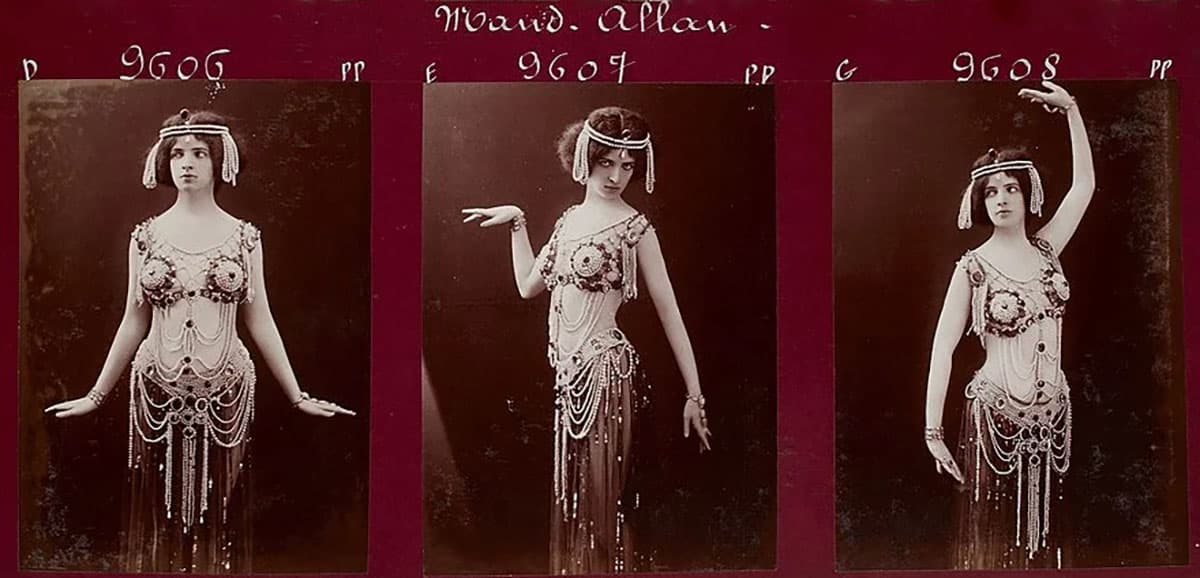
![Newspaper headline: 'As to "Salomania": The Crazo [sic] for Stage Dancing and the Merits of the Respective Styles—Isadora Duncan vs. Numerous Salomes'](https://billlefurgy.com/wp-content/uploads/2026/08/as-to-salomania-300x187.jpg) The craze had a clear shape. It began with two shocks in quick succession: one was the Metropolitan Opera’s notorious 1907 production of Richard Strauss’s Salome, shut down after a single performance. The other was Maud Allan’s Vision of Salome, which conquered London the following year.
The craze had a clear shape. It began with two shocks in quick succession: one was the Metropolitan Opera’s notorious 1907 production of Richard Strauss’s Salome, shut down after a single performance. The other was Maud Allan’s Vision of Salome, which conquered London the following year.
By 1908 the imitators were everywhere, and they remained for the better part of two decades. What made it a mania was both the ease of performance and the sheer number of people doing it. All a performer needed was a headdress, a beaded bra, bare feet, and a fake head on a platter. The barrier to entry was almost nonexistent, and the publicity was free, because everyone was talking about it with some mix of wonder and moral outrage.
Some of the more art-conscious observers recognized elements of dancer Isadora Duncan’s style, including the bare feet, classical costume, and interpretive movements. But while Duncan was then emerging as a pioneering force in what became known as modern dance, most stage Salomes had no claim to artistry.
The newspapers themselves made the scale of the craze part of the joke. A syndicated item titled “As to ‘Salomania,’” published on September 3, 1908, noted that one theater was advertising its “Newest Salome,” even though “there is a newest Salome blossoming out every few minutes.” The report also described an actress’s campaign for regulations to suppress the multiplying Salomes—and predicted that the craze might even become an issue in the fall presidential campaign. (Punxsutawney Spirit, September 3, 1908.)
Moral Guardians Sound the Alarm
In 1909, the New England Watch and Ward Society, an organization devoted to protecting public morals, issued a stern warning in its annual report:
The advent of Salome has been the debauching agent. It has meant the introduction of a new element of indecency on the stage — the uncovered feet and limbs — and has created a vogue of risqué dances which have tended to deprave public taste. The barriers against the Oriental muscle dances with their bodily contortions and appeal to the baser instincts, have been swept away in a flood of unnatural indecency. Dances hitherto suffered under limitations at our cheaper show houses under a vulgar name have been adopted into polite society under the appellation “Salome Dance.”
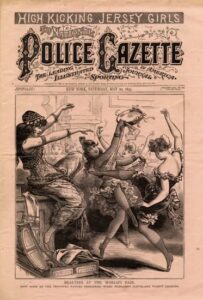
The Society understood the problem was long-standing. “For 17 years this dance has gone over this country as vaudeville and sideshow to a circus, but now it has risen from its contempt to grand opera.” (The 17 years refers to the appearance of “belly dancing” at the 1893 Chicago World’s Fair).
The reformers were alarmed at both the spread of the dance and its association with high art. Awful as it was that Salome’s bare midriff was flaunted in the dime museum, it was somehow worse that it was on display at the opera house.
Much to the dismay of self-appointed guardians of public morals, much, much more Salome-induced indecency was in store.
Gertrude Hoffmann and the “Skin Salome”
One of most scandalous (and popular) performers was Gertrude Hoffmann, who rose to fame in 1908 with a salacious “skin Salome” act. Police arrested her in New York in July 1909 for offending public decency, and censors and local authorities interfered with her act in other cities.
Hoffmann, who based her act on Maud Allan’s Vision of Salome, was a sly performer. According to the historian Susan Glenn, Hoffmann used Salome “to enlighten, confound, and satirize the phenomenon of Oriental dancing and her own role in it.” Publicity was essential to the enterprise. “Welcoming press coverage that emphasized the orgasmic violence and lust of her performances, Hoffmann was only too happy to see her dances discussed in terms usually reserved for lurid crime reportage.”
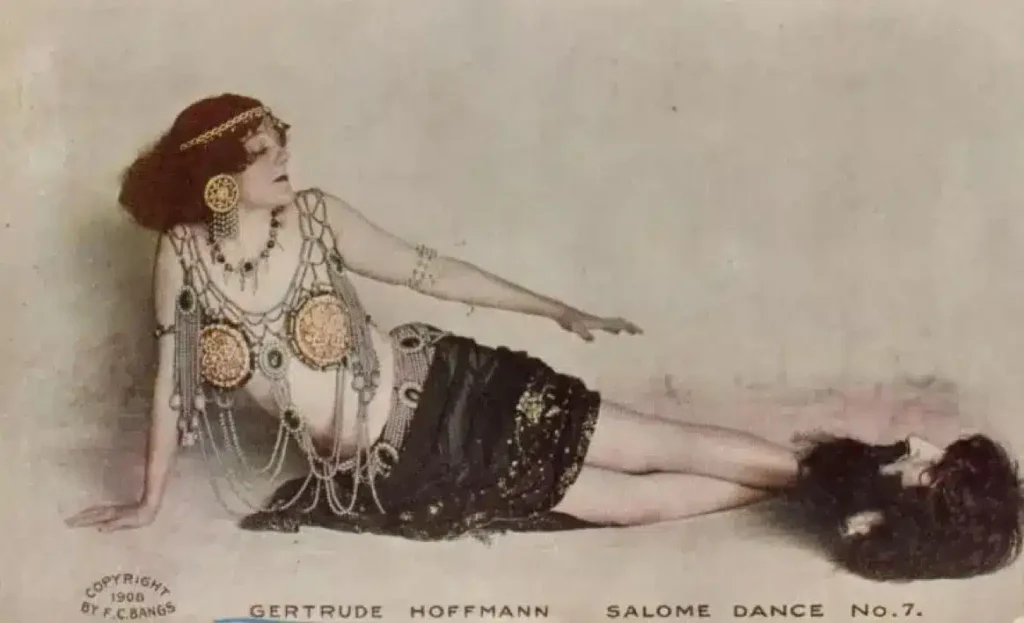
For added effect, she proclaimed theatrical indignation when censors intervened. “What kind of a town is this?” she blustered in 1909 to a Kansas City reporter after a judge clamped down on her act. “I have given my dances all over the . . . the United States. I played in the leading cities of New England, where the Puritans came from and where their descendants live and thrive and still preach purity.”
This was all part of the act. Hoffmann grasped early what every performer in this story eventually learned: a controversial Salome sold more tickets than a tame one.
Eva Tanguay, the Queen of Vaudeville
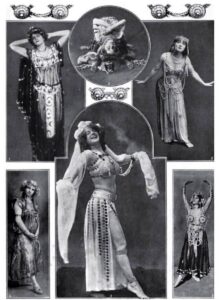
Hoffmann was not alone in serving up the outrageous Jewish princess on stages across the country. In 1908, The Sketch magazine printed a composite photograph showing “A Few of the Multitude of Salomes Now Dancing in America.”
Of these, perhaps the most famous was Eva Tanguay, known as “the Queen of Vaudeville” and “the Cyclonic Comedienne.” Tanguay astutely sought headlines, good and bad.
One much-repeated story has her stabbing a stagehand with a hat pin when he blocked her path; as the man writhed in pain, she supposedly declared, “Now, maybe you’ll know how to get along with a lady!” Her documented run-ins with stagehands were real enough—a court fined her $50 for throwing one down a flight of stairs.
Tanguay played Salome with extreme audacity, boasting that she was the “real deal” and that everyone else’s act was a pale imitation. She flaunted her racy outfit, claiming, “I can fit the entire costume in my closed fist.” Her Salome act involved camp sexuality while letting the audience in on the joke.
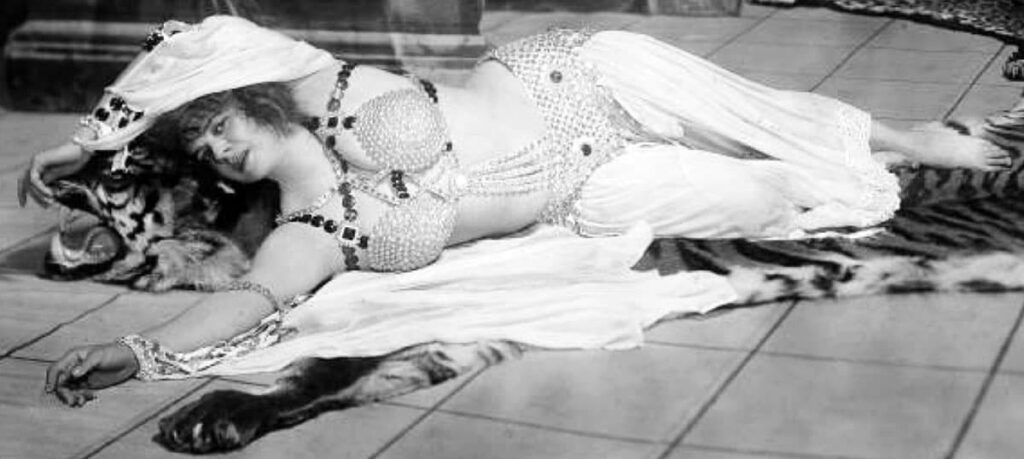
Two other performers were known for their physical daring. La Sylphe (Edith Lambelle Langerfeld) was notable as a very flexible Salome, and her dance routine included a variety of contortions. Lotta Faust also made for a notable Salome, drawing attention with her semi-nudity and provocative movements. “Her undulation becomes more riotous as the dance continues,” observed the Chicago Tribune.
Aida Overton Walker’s Artistic Salome
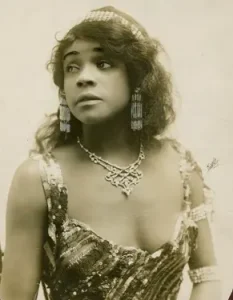
In 1908, Aida Overton Walker, a versatile singer, dancer, and choreographer, and one of the leading Black performers on the American musical stage, performed a Salome dance during the Bandanna Land revue’s run at New York’s Grand Opera House. She reprised the performance in 1912 on Broadway at the Victoria Theatre.
Walker’s approach cut deliberately against the prevailing style. As Susan Glenn writes, “Rather than hype the sexual prurience of the dance, [Walker] characterized her black Salome as more artistic than erotic, more spiritual than sensational.”
Reviewers concurred, with one observing that Walker “was clothed more than several of the other local Salomes” and “relied on the grace of her dancing for effectiveness.” For a Black performer navigating a white theatrical establishment that leaned into racial stereotypes, the choice to be covered and classical was strategic as much as aesthetic.
Mlle. Dazie’s School for Salome
Mademoiselle Dazie (Daisy Ann Peterkin) was one of the first in America to dance as Salome, appearing in Florenz Ziegfeld’s Follies of 1907, before Maud Allan took London by storm. The Salome interpretation was one part of Dazie’s act, which also included “The Jiu-jitsu Waltz” and “The Living Doll Dance.”
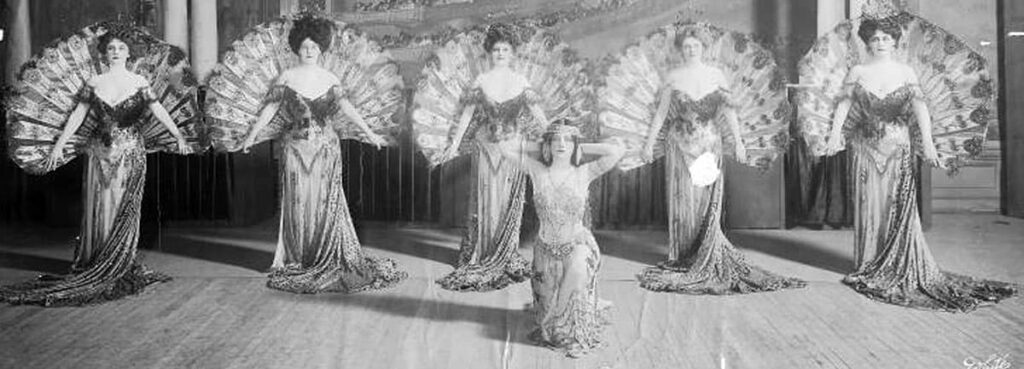
Her next big contribution was educational. According to Glenn, Dazie opened a “school for Salome” that, by the summer of 1908, launched “an estimated 150 newly minted Salomes . . . upon the vaudeville circuit every month.”
That figure is telling: 150 a month, from one school, in one summer. Salomania was not a handful of famous women being scandalous; it was an industry of scandal, if you will.
Mata Hari
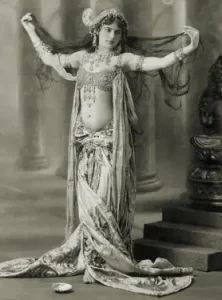
The Dutchwoman Margaretha Zelle achieved spectacular success in 1905 Paris billing herself as a Javanese princess named Mata Hari. She wore a very skimpy costume while supposedly performing “sacred Hindu dances.”
Mata Hari was commonly associated with Salome, so much so that she felt entitled to dance in a production of the Strauss opera, claiming “Only I will be able to interpret the real thoughts of Salome.” She was unsuccessful in convincing Strauss (by most accounts, she was not an especially talented dancer), but her fame soared as she performed with fewer and fewer clothes. She originally began wearing a flesh-colored body stocking under her costume but eventually showed expansive amounts of her own skin.
With her star fading during World War I, Mata Hari became entangled in an absurd espionage plot, and was arrested. A French firing squad executed her in 1917 based on the flimsiest of evidence. Tragic though her death was, it ensured her enduring fame as the personification of the seductive femme fatale.
The Salome Dancers
The success of Maud Allan and Mata Hari led to a profusion of “Salome dancers,” a generic term that lumped together women who performed in vaguely Eastern headdresses, jewel-encrusted bras, bare midriffs, and flowing skirts and scarves. A few deserve rescuing from the category.
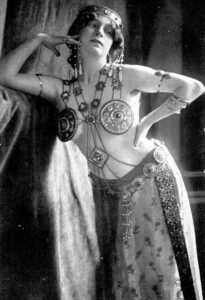
The Baltimore-based Zallah, formerly known for her “Bathing Suit Dance,” quickly jumped on the Salome bandwagon in 1908. That year, she was “Queen of All Dancers,” performing “Invasion of Salome” in Detroit. As time passed, she variously offered a “sensational version of Salome” and a Salome dance “within the bounds of propriety” — the two settings on the Salomania dial, depending on the town.
One of the most photographed exotic dancers in Europe around 1910 was known as “Mlle. Hero” (or sometimes simply as “Herito”). The Bystander magazine described her in 1909 as “A dancer before various Herods who has outstripped many in the race for kingly favour,” noting that she had performed “before the Kaiser, the Emperor of Austria, and the Kings of Spain and Belgium.”
Odette Valery danced at the Folies Bergère, where she specialized in barefoot “Greek dancing,” including roles as Salome and Cleopatra. She performed across Europe and shocked audiences in 1908 New York with a dance that included a live snake. Nicknamed “the bogey-woman of Paris wives,” Valery lived in high style. The Oakland Tribune reported in 1909 that she danced “the Salome houchee-kouchee” at a New York party with the playboy playwright Wilson Mizner. The fun ended in 1912, when she was found ill and penniless in a cheap London rooming house, cared for by her seven-year-old son.
Henrietta Sahary-Djeli, “The Mysterious,” was a Paris dance-hall favorite known for her extreme flexibility. In 1912 she performed as Salome in La Danse Prohibée. A critic said her act had elements of “the mysterious Orient . . . [and] the age-old grandeur of biblical visions.” Her arms drew special praise for mimicking “a series of waves from the shoulder to die along the fingers . . . They give the impression of those ‘charmed serpents’ of which Baudelaire speaks.”
Men Danced As Salome, Too
The craze was not confined to women, and some of the most admired Salomes of the period were men.
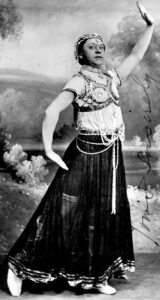
The vaudeville star Julian Eltinge (William Julian Dalton), a female impersonator, put on a Salome parody around 1908. One critic declared that Eltinge “gives a more photographic interpretation of femininity than the average woman” and delivers “a better ‘Dance of the Seven Veils’ than any woman has yet presented on Broadway.”
The Englishman Malcolm Scott won great reviews on both sides of the Atlantic for his portrayal of the Jewish princess. In 1909, The New York Dramatic Mirror raved about Scott’s act, which substituted a bottle of whiskey for the severed head:
Creeping upon it as stealthily as the usual Salome approaches the head of John the Baptist, Scott . . . breaks forth into a mad, whirling dance of joy, throwing himself upon the object of his affection and hopping ecstatically about. Nothing funnier than this moment has been seen in a New York vaudeville theatre.
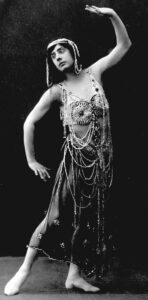
Nikolai Fedorovich Barabanov, who performed under the stage name Ikar, was one of the more obscure men to have staged a Salome dance. An Isadora Duncan performance impressed Barabanov to the point where he obsessively copied her dance moves for many weeks. He did this work in private until about 1908, when he began performing at a Saint Petersburg cabaret known as the Crooked Mirror — a hotspot of the avant-garde in pre-revolutionary Russia that counted members of the Ballets Russes among its audience.
Barabanov did parodies of the leading art dancers, including Maud Allan’s Salome. He became “the in-house ballerina,” and his act was a sensation. As Mark Konecny writes, “His parody was as much homage as imitation . . . Ikar carefully choreographed his dance with comedic elements; his keen eye for absurdity was vital to the success of his dance — for instance — mixing a dancer’s jumps with a ballerina’s flourish, giving both an air of sentimentality and the right note of parody to undercut his completely serious rendition.”
Parody: How You Know Salomania Had Won
Salomania inspired many parodies, which is the surest evidence of how thoroughly it had saturated popular culture. La Belle Leonora presented “Sal-Oh-My” in 1908 London. Another London show offered tiny “Maud Allans” in a child chorus parody.
Fanny Brice scored her first hit in 1909 doing a Salome dance parody while singing Edgar Leslie’s and Irving Berlin’s “Sadie Salome, Go Home.” The lyrics include:
Don’t do that dance, I tell you Sadie
That’s not a bus’ness for a lady!
‘Most ev’rybody knows . . .
Where is your clothes?
Oy! such a sad disgrace
No one looks in your face
A joke only works if the audience already knows the reference. By 1909, everyone did.
Why Salomania Mattered
It would be easy to file all this under novelty. That would be a mistake.
Salome’s thematic malleability allowed her to serve as a vehicle for challenging traditional ideas about sex. Openly displayed female sexual desire is undeniably at the center of the Salome story. After seeing that desire played out countless times on stage and screen, audiences had little choice but to rethink what went on in the bedroom — and perhaps what could and should go on there.
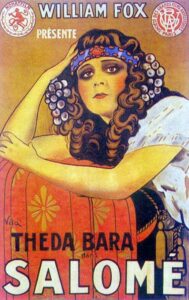
The performances also drew attention to changing gender roles and promoted the idea of women as individuals equal to men. Practically speaking, many Salome performers took charge of their acts and earned an independent living — in 1908, when American women could not vote nationally and prevailing ideology held them to be naturally weaker and subordinate.
Salomania centered on seeing women in a dramatic new way. This heightened stereotypes and sexual objectification but also contributed to disruption of the status quo. “Incarnating as Salome,” writes Toni Bentley, “women gained a very particular forum for liberation . . . by appearing to act in accordance with a misogynistic point of view. In accepting the premise, they subverted it.”
The subversion was in plain sight. As Edward Ross Dickinson puts it: “Modern dance didn’t argue that women should be autonomous participants in the public sphere; it was autonomous women in the public sphere — demonstratively, even outrageously.”
Salome performers played a key role in directing cultural attention toward modernity and the shock of the new. The women (and men) portraying Salome also led the way in embracing performance as transgressive spectacle, with artists breaking the rules of expected behavior as a calculated part of the act. Audiences were given a vicarious sense of excitement, liberation, and even a bit of danger. Salome performers pushed the limit on societal and moral standards, audiences loved it, and the culture changed.
In that sense, there is a direct line from Salome to more recent performers such as Beyoncé, Lady Gaga, Madonna, and David Bowie. The artistry of early twentieth-century Salome performers — coupled with the irresistible lure of bare flesh and sexual suggestion — helped shape the rules, expectations, and shared meanings that make up modern culture.
Where to Go Next
This page is an overview of the Salomania craze. I have written about several other aspects of Salome on this site:
- The Salome dance as an art form, including Maud Allan’s Vision of Salome, the performance that set the craze in motion.
- The 1907 Metropolitan Opera scandal that pulled Strauss’s Salome after a single New York performance.
- The story of Salome herself — from an unnamed dancing girl in the Gospel of Mark to the femme fatale of Wilde and Strauss.
- My review of Cecily Devereux’s book Salomania and the Representation of Race and Gender in Modern Erotic Dance (Wilfrid Laurier University Press, 2023).
- The dancer Nyota Inyoka, whose career from the late 1910s onward belongs to the wave of “exotic” performance that Salomania left in its wake.
- The scandalous career of Adorée Villany, prosecuted for indecency in Munich in 1911 and acquitted on an artistic-merit defense.
About This Account
I spent many years working with historical documents at the Library of Congress and other cultural heritage institutions, and I wrote Sex, Art, and Salome, a pictorial history of the phenomenon drawn from period newspapers, magazines, photographs, and archival collections. Much of the material above is adapted from that book, which reproduces more than a hundred images of the performers described here.