
The First Flapper Was a Schoolgirl—Until Hollywood Grew Her Up
A flapper was a young woman of the 1920s who cut her hair short, raised her hemline, and refused the manners her mother was raised on. That definition holds for the later 1920s. It is not what the word meant when Americans first took it up: in 1916 a flapper was a schoolgirl, roughly twelve to sixteen years old.
Today, the word “flapper” conjures a picture of a woman in her twenties with a cocktail, cigarette holder, and sleek bob haircut, ready for sophisticated adult adventure.
That is most definitely not how the flapper first came into public awareness. In the 1910s, and still in many uses well into the early 1920s, a flapper was a school-age girl, often in her early or middle teens, still wearing clothes bought by her mother.
The grown-up flapper of the current imagination owes much to Hollywood. Studios seized on a flapper craze, and repeatedly put the label on glamorous adult performers. Casting and film publicity helped move the flapper from schoolgirl to a bold young woman reveling in the Jazz Age experience.
Why Were They Called Flappers?
Not because girls wore their galoshes unbuckled so they flapped while walking. That fad was American and post World War I, while “flapper” was already British slang for a young girl in the 1890s. The word crossed the Atlantic with that meaning intact, while the galoshes explanation circulated during the 1920s.
Where the word actually came from is less settled. The explanation offered most often, including by the American writers who introduced it here, is the fledgling: a young wild duck or partridge, flapping as it learns to fly and not yet able to rise. Others have proposed a northern English dialect word for an unsteady young woman. Some meant something plainer still—a girl wore her hair in a plait down her back, flapping as she walked, because she was not yet old enough to put it up.
What the surviving explanations have in common is worth noticing. Every one of them describes a child: a bird that cannot yet fly, a girl who cannot yet pin up her hair. Only the galoshes story dresses her in the fashion of a grown woman, and that is the one that was invented.
What Did “Flapper” Originally Mean?
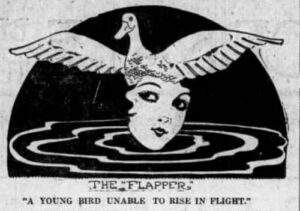
The term flapper arrived in America sometime after 1900.
By the end of 1916, syndicated columnist Winona Wilcox described her as “a young bird unable to rise in flight,” who was “an honest, talkative, critical and very active girl, 15 or 16 years old.”
Wilcox obviously had no clue as to how usage of the word would morph in just a few years. “The term is almost exactly descriptive of the delightfully innocent little girl, who is properly, a flapper,” she wrote. “It is a pity that the genus is so rare in America. When a young girl begins to rouge, she ceases to be a flapper—she has learned how to fly!”
Flapper as a Marketing Term for “That Hard to Fit Age”
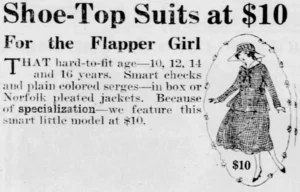
March 31, 1916, p. 25.
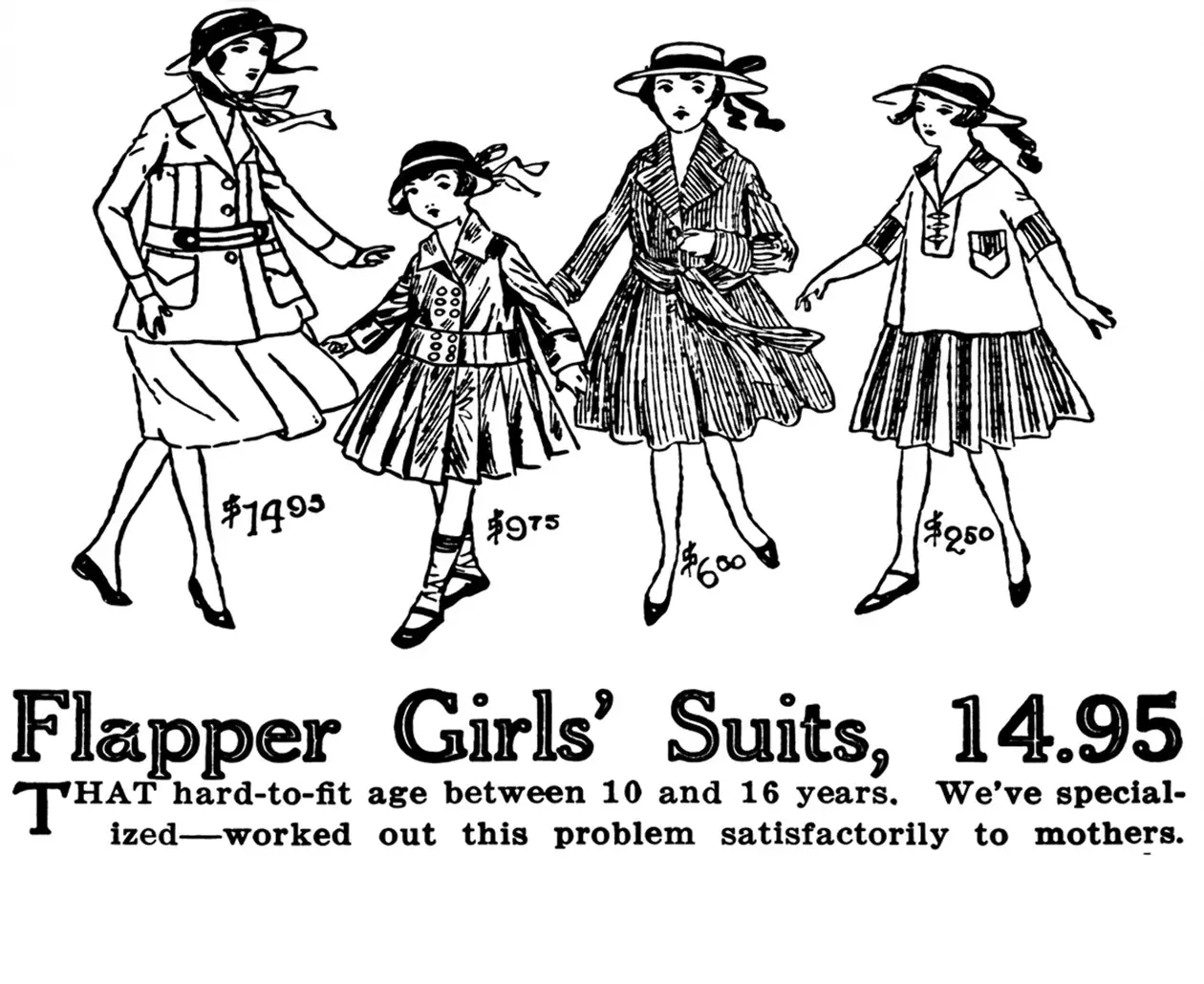
Wilcox was absolutely correct in pointing to the word as effective in describing young girls. Advertisers began using it to pitch adult shoppers looking for girls’ clothing for the age after childhood but before adulthood.
The Pittsburgh Press (see image) dropped the potential flapper age to as low as 10 in its ad for “Shoe Top Suits.” (Curiously, the hemlines for young girls, and even some women, stopped well above the shoe top at the time).
On December 22, 1918, the Omaha World-Herald ran an ad noting that “the girl of awkward age—the ‘flapper’—is a problem that every mother of a young daughter has to face.” The flapper here is quite young: “From 11 to about 14 the average girl seems to be all legs and arms. Angles have replaced the soft curves of babyhood, and she has not yet arrived at the assured grace of sweet sixteen.”
How Old Was a Flapper?
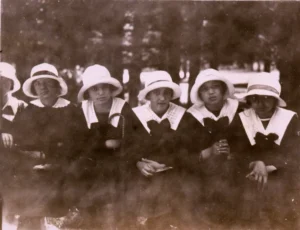
In his June 1922 Atlantic Monthly essay, “Flapper Americana Novissima,” psychologist G. Stanley Hall went looking for a representative flapper and selected a schoolgirl “approaching sweet sixteen.” His focus remains on the schoolgirl “fledgling, yet in the nest, and vainly attempting to fly.”
“’Sweet sixteen and never been kissed,’ that is what the girls of grandma’s day boasted,” wrote the January 16, 1922 Nowata [Oklahoma] Daily Star. “But the modern Nowata flapper denies that she hasn’t been kissed when she admits her sixteenth birthday.”
The February 26, 1922 Atlantic City Sunday Press and the Sunday Gazette wrote under the headline “Who Wouldn’t Be A Flapper And Have A Silk Cape?” that “Little girls of all ages from six to flapper years are going to wear the most fetching silk cape and hat sets this spring.”
Who Was the First Flapper in an American Film?
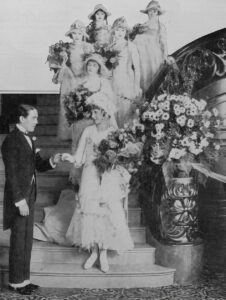
On screen, the flapper was an older figure almost from the start. The earliest American film character I have found explicitly identified as a flapper appears in His Majesty, Bunker Bean (Paramount, 1918), where she is the boss’s daughter whom the hero courts and marries; she is played by the twenty-two-year-old Louise Huff.
The label was central enough to the part that the character is identified not by a given name but simply as “The Flapper.”
Tellingly, the studio’s own publicity called her “the engaging young Flapper” even as it cast a grown woman. The novelty was the casting, which put a woman of twenty-two under a word that had been reserved for schoolgirls.
That was the start of Hollywood’s widening of the term.
By 1922, Nobody Agreed What a Flapper Was
A February 18, 1922, syndicated article in The Flint Journal (Flint, Michigan) outlined the growing fuzziness of the definition. A “noted writer and lecturer” kicked off the conversation by noting, with reference to co-eds, that “The ordinary conception is a giddy girl of 16 or thereabouts. But there is more meaning than that to the word. A ‘flapper’ is anyone without a program in life.”
The University of Chicago student newspaper declared: “The ‘flapper’ is the girl who parades the campus bareheaded, wears a huge fur coat and specializes in teahounds” (slang at the time for male flirts).
For a definitive answer, the article turned to eighteen-year-old film actress Gladys Walton “who has become nationally known as ‘America’s greatest flapper.’” Walton said, “She’s merely misunderstood by the old-timers, who have been unable to readjust their minds. She is a type of adolescent development and, don’t worry, she’ll come out all right.”
Hollywood Gives the Schoolgirl an Adult Face and Body
Walton’s films show how quickly the label spread across different kinds of roles. Risky Business (1920) cast Walton as a “madcap” younger sister; Photoplay called her “an attractive little flapper.” In High Heels (1921), Walton’s character was advertised as both a “spoiled society flapper” and a “frivolous little flapper.” In Desperate Youth (1921), a Universal melodrama of orphans and servants in the rural South, the studio’s advertising sold Walton herself as “the fascinating little flapper.”
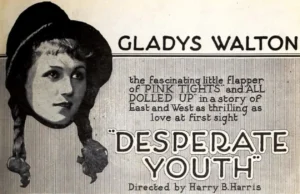 The diversity of roles is revealing. Walton moved from a younger sister to a society girl to the heroine of a rural melodrama, and the label followed her through every one. Publicity was beginning to treat “flapper” less as a precise age designation than as a reusable screen persona—plucky, high-spirited, a little mischievous—that attached to a performer rather than to a character.
The film that put the word on American marquees was The Flapper (Selznick, 1920), starring the ex-Ziegfeld Midnight Frolic star Olive Thomas, age twenty-five. Her character, Ginger King, is supposed to be sixteen; for romantic purposes she claims to be “about twenty,” and later in the film she passes herself off as a worldly “woman of experience,” sophisticated and a little wicked. A grown woman had been cast as a girl of sixteen—a girl who spends the picture pretending to be a grown woman.
What Did Fitzgerald Mean by “Flapper”?
Fiction was helping the flapper grow older, too. F. Scott Fitzgerald’s Flappers and Philosophers (1920) calls Ardita Farnam of “The Offshore Pirate” a flapper. Ardita is about nineteen: still a teenager, but also a cigarette-smoking, socially independent young woman considering marriage.
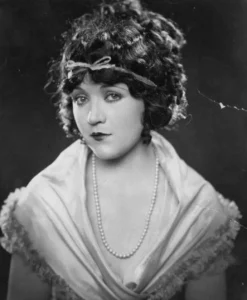
Fitzgerald’s The Beautiful and Damned (1922) supplies even stronger evidence. Gloria Gilbert is twenty-two and eventually marries. When she is twenty-eight, a studio invites her to test for a movie flapper part as the female lead’s younger sister. Fitzgerald was describing almost exactly the practice that helped change the label: Hollywood casting an adult woman as a younger flapper.
Warner Bros. then carried Fitzgerald’s adult flapper to the screen in its adaptation, also titled The Beautiful and Damned (1923). The twenty-six-year-old Marie Prevost played Gloria. Reviewing the film, the Rochester Journal and the Post Express said Fitzgerald had “immortalized the flapper” and described the story as the life of a “modern flapper.” Fitzgerald’s fiction and its film adaptations helped grow the flapper up.
But Hollywood was already moving firmly in this direction. In May 1922 Photoplay reported Norma Talmadge, twenty-seven, “playing in a flapper key.” In July 1922 it described Mae Murray—in her mid-thirties—as “a Fifth Avenue flapper with no responsibilities.”
By 1924 Picture-Play was debating “The Unsteady Screen-flapper Throne”: which adult star—Colleen Moore, Clara Bow or Constance Bennett—rightfully reigned as the screen flapper? Nobody in the contest was in high school. The films both reflected a broader usage and, through casting and publicity, made the adventuresome adult flapper vivid, repeatable and nationally familiar.
On Screen, the Flapper Played at Being More Sophisticated
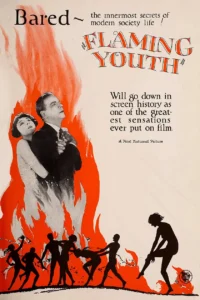 On screen, the flapper tends to be a specific type. In Flaming Youth (1923), Colleen Moore raids her older sisters’ dressing table so she can sneak into a party. One study of the performance describes her as oscillating “between attempts to assume a pose of sophistication equal to her accessories, and irrepressible outbursts of youthful enthusiasm.”
The pattern evolved. Moore’s shopgirl in Irene (1926) pretends to be a society woman; her hotel switchboard operator in Orchids and Ermine (1927) cannot manage to look “as worldly as the other women”; Clara Bow’s Betty Lou in It (1927) plays at being “an elegant and reserved woman of society.”
In each film, a working young woman plays at having savoir-faire and a high social rank. What remained of the schoolgirl flapper was not a particular age so much as a stance: youthful cheek, imperfectly mastered sophistication, and the exhilarating nerve to try on a more adult identity.
Casting drove the transformation. Thomas’s Ginger King was the early instance; by the time of Irene, Orchids and Ermine, and It, the heroines were working, courting, and contemplating marriage.
The adolescent had not simply become harder to see; Hollywood had rewritten her as a grown woman whose youthfulness was now a style and an attitude.
The Flapper Finally Grows Up
In film culture, at least, approximately 1924–1925 marks the tipping point at which the adult young woman became the flapper’s dominant public image. It is telling which actress modern cultural memory eventually settled on. Louise Brooks was not the silent era’s biggest flapper star; Colleen Moore and Clara Bow both outdrew her. Her early arrival in New York revealed plenty of adolescent awkwardness, but in her flapper roles she wears the sophistication straight. There is no pretend schoolgirl straining underneath, no joke about a girl overreaching beyond her station. Brooks is the flapper we remember, the one who no longer had to pretend.
What survived in cultural memory was the version the movies had made easiest to see: the bobbed, stylish, socially independent young woman of the Jazz Age. Hollywood did not single-handedly grow the flapper up, but it was a major force in accelerating the change and fixing her adult image in memory.
A Timeline of the Flapper’s Age
| Date | What “flapper” meant |
|---|---|
| 1890s | British slang for a young girl, generally in her early teens |
| 1916 | American newspapers describe her as a girl of about twelve to sixteen |
| 1918 | The first American film character billed simply as “The Flapper” appears in His Majesty, Bunker Bean |
| 1920 | Olive Thomas, twenty-five, plays sixteen-year-old Ginger King in The Flapper |
| 1922 | Publicity begins treating “flapper” as a reusable screen persona rather than an age |
| 1923 | Marie Prevost, twenty-six, plays Fitzgerald’s Gloria in The Beautiful and Damned |
| 1924 | Department stores still advertise “Flapper-Girl Clothes” for girls of twelve to sixteen |
| Later 1920s | The word settles on a fashionable young woman in her twenties |
Common Questions About Flappers
What Does “Flapper” Mean in Slang?
In British slang of the 1890s it meant a young girl, generally in her early teens. By the later 1920s in the United States it meant a fashionable young woman who bobbed her hair, shortened her skirts, and ignored the manners her mother was raised on. The distance between those two meanings is the subject of this article.
Why Were Girls Called Flappers?
Most likely after the fledgling, a young bird flapping as it learns to fly. A northern English dialect word for an unsteady young woman has also been proposed, as has a girl’s plait worn loose down her back. The popular story that the name came from unbuckled galoshes is false: the word is older than the fad, and came from a different country.
What Age Was a Flapper?
In 1916 American newspapers put her at about twelve to sixteen. Department stores were still selling clothes labeled “flapper” to girls of that age in 1924. By the end of the decade the word had moved up to women in their twenties, which is where popular memory left it.
Did Flappers Wear Bras?
Most wore a bandeau rather than the shaped brassiere of later decades. The fashionable line of the 1920s was flat and straight, so underwear was cut to suppress the bust rather than lift it—one more respect in which the silhouette was closer to a girl’s than a woman’s.
What Is a Flapper in a Bathroom?
A different word entirely. The rubber valve at the bottom of a toilet tank is also called a flapper, and has nothing to do with the 1920s.
A note on sources. Magazine pages are from the Internet Archive: Photoplay (1922), Picture-Play (1921–1924), Motion Picture Magazine (1924). Newspaper quotations are cited in the text by paper, date, and page; the pages were located via Newspapers.com and are in the public domain. Film details are drawn from the AFI Catalog. The reading of Colleen Moore’s and Clara Bow’s performances draws on Sara Ross, “‘Good Little Bad Girls’: Controversy and the Flapper Comedienne,” Film History 13, no. 4 (2001): 409–23. For the intellectual frame, see G. Stanley Hall and the Flapper and the full text of Flapper Americana Novissima on this site. Additional full-text material appears in Silent Film and Jazz Age Culture: Primary Sources.