
G. Stanley Hall and the Flapper: Taking the Modern Girl Seriously
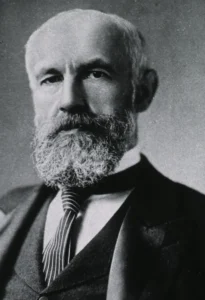
When the prominent American psychologist G. Stanley Hall died in April 1924, The New York Times remembered him days later under an unusual headline: “Dr. G. Stanley Hall Studied the Flapper’s Personality.” The article devoted substantial attention not to Hall’s place among the founders of American psychology, but to an essay of his about the “modern young girl.”
That says something about the grip the flapper had on the American imagination—and about the reach of Hall’s article “Flapper Americana Novissima,” published in the Atlantic Monthly in June 1922 and transcribed on this site in full.
Hall did not invent or fully understand the flapper, but by treating her as a serious subject of psychological and social analysis, he helped establish her as a defining figure of modern womanhood.
G. Stanley Hall and the Flapper: Uncomfortable Now, Comforting Then
Hall’s essay is a perfect example of how a modern reader cannot help but bring a modern perspective to a historical source.
Read today, the piece has some unappealing features: an element of voyeurism, a good deal of gender stereotyping, and above all a presumptive male assessment of what young women, as a monolithic group, are thinking, how they act, and what they want.
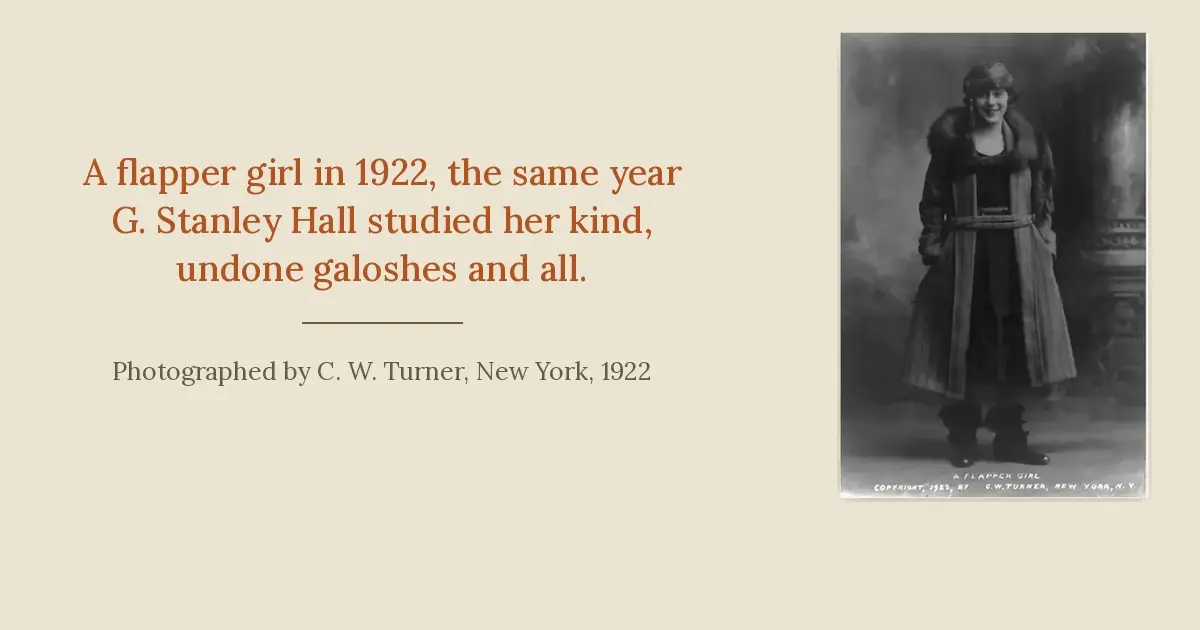
In one section, Hall recounts walking behind a girl he judged to be “approaching sweet sixteen” on her way home from school, calling her “the very specimen I sought,” and inventorying her from knitted hat to unbuckled galoshes—pausing on the one that “flapped about her trim ankle in a way that compelled attention.” Elsewhere his information comes secondhand, from teachers and other authoritative adults. His subjects function as objects of study, incapable of (or unworthy of) speaking for themselves.
When it first appeared, the piece was comforting to some for its willingness to see in a young woman reaching for more experience “the bud of a new and better womanhood.” Many appreciated his optimism, which extended to hope that the flapper might lead humanity itself toward greater freedom. “The new liberties she takes with life are contagious,” he wrote, “and make us wonder anew whether we have not all been servile to precedent, and slaves to institutions that need to be refitted to human nature.”
“The Flapper is Not Necessarily Bad”
The Miami Herald welcomed Hall’s reassuring view of modern young women. “It is refreshing, in the midst of the present clamor from pulpit and often from the press, to read the reassuring words of a man like Dr. Hall,” the paper wrote on June 27, 1922. It went on:
The flapper is not necessarily bad. She is wise beyond those of her years in a former generation. That wisdom contains elements of safety as well as elements of danger. Constant nagging will produce nothing but evil results. A sympathetic understanding on the part of those who are older will make the flapper of today into the fine, womanly leader of a new feminine dispensation. It is time to quit scolding.
Hall Is Criticized for His Views
Other critics, particularly religious leaders, made plain their disagreement with Hall. An article titled “Pastor Says Flapper Can’t Find Happiness in So-Called Freedom” in the June 19, 1922, St. Louis Globe-Democrat reported on a sermon that cast Hall as the leading voice for the view that the flapper is fundamentally sound.
The sermon discussed the other school, which can be summarized as “the flapper is misguided in not obeying her parents,” and that camp got the headline. The flapper was in this view headed for sure disaster. “Happiness cannot be found in overthrowing the moral findings of centuries,” the article reads. “Woman’s freedom is not in license, which must ever end in slavery.”
Blunter still was the reformer Wilbur F. Crafts who told a St. Louis audience that summer that the real question was whether “many girls are becoming immodest and immoral, and, if so, what the community should do about it.” The June 28, 1922, St. Louis Star and Times reported on its front page that Crafts “scored the alleged flippant tone of G. Stanley Hall.”
Flapper Americana Novissima: How Hall Studied the 1920s Flapper
Hall promoted adolescence as a subject of scientific study with an influential 1904 work, Adolescence. He was among the first to treat the years between childhood and adulthood as a distinct stage of development worthy of close study.
By 1922, he believed that culture had produced a new variety of adolescent girl. The mock-taxonomic title “Flapper Americana Novissima”—the newest American flapper—announces his intention to examine her almost as if she were a newly discovered species.
Hall gives the essay a tongue-in-cheek tone; writing about himself a few months later in The Century Magazine, he called it “a rather light skit.” The flapper in 1922 was a major social phenomenon, but also one regarded with a mix of ridicule and moral indignation. His talk of “specimens” works in two registers: funny (surely no one truly believed a young woman was equivalent to a lab rat) and deliberate (it was a scientific term).
He begins with definitions, admitting that he had to be corrected from thinking of a flapper as a loose sail at risk of capsizing a boat to a young bird attempting to leave the nest. This was not his problem alone. He states that “the world has not yet found the right designation for this unique product of civilization, the girl in the early teens, who is just now undergoing such a marvelous development.”
As noted, he follows a high-school girl who commands the center of the sidewalk, greets boys casually and wears distinctive clothing and jewelry, as well as galoshes—one entirely unbuckled, the other flapping loose. Her gait is “swagger and superior.” Hall recognizes that she is “out to see the world and, incidentally, to be seen of it.” Unable to imagine conversing in any meaningful way, he consults her teachers. Elsewhere he draws evidence from shopkeepers, a barber and the head of a city traffic squad.
This is an odd pastiche of research, involving as it does observation, anecdote, personal opinion, and gossip. What emerges is a fascinatingly dense network of attention surrounding the flapper figure. Everyone has an opinion about her because she is a newly central archetype in society representing a break with longstanding restraints, the waning influence of parents and other authority figures, newly configured relationships between the sexes, and a rush by the young to seek entertainment outside the home, in public.
Hall’s essay was widely discussed when it appeared, and it remains provocative today. It is often referenced in modern studies of how young women were perceived and represented during the 1920s. Before his death, Hall was reportedly exasperated by the range of opinions provoked. As the New York Times article cited above says, his remarks “were misquoted and he was made to say things either too strongly in favor of flappers or too much against them”—so far off the mark that he “once said he felt obliged to laugh at the stories he read about himself to avoid getting angry.”
From the New Woman to the 1920s Modern Girl
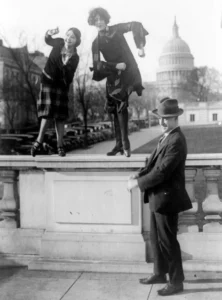
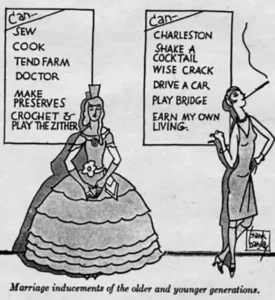
The flapper did not appear from nowhere at the start of the Jazz Age. She inherited much from the New Woman of the 1890s and 1900s: education, athleticism, public visibility, wage work and a claim to more individual freedom.
And it is critical to note that the New Woman (and later the flapper) was never a single type. She could be a reformer, student, worker, artist, or consumer, and her meaning shifted with race, class, and region.
The best-known visual version of the New Woman was Charles Dana Gibson’s poised but distant Gibson Girl. The Library of Congress describes her as independent, educated and active publicly, while noting that she helped prepare the way for the flapper. Around the turn of the century, growing numbers of young women entered the workforce, including taking jobs as telephone operators.
Around the same time the Salomania dance craze allowed women to take to the public stage, manage their own acts and earn independent livings years before American women won the vote.
Alfred Cheney Johnston’s emergence as a Ziegfeld photographer in 1917 supplies a visual bridge between the New Woman and the flapper archetypes. His painterly portraits carried an older ideal into theatrical publicity, magazines and advertising while presenting Ziegfeld Girls as modern, self-possessed individuals.
The flapper entered public space as a rule breaker: daring to dance the latest dances in public, bob her hair, and defy convention in terms of clothing and language. For a society accustomed to young women who were obedient and closely supervised, this was a startling change. Hall’s essay appeared at precisely this moment, when the flapper was becoming a recognizable type but her meaning was still unsettled.
Louise Brooks in June 1922: The Modern Girl Arrives
This shift is visible in Louise Brooks’s own early life. On June 29, 1922—the very month Hall’s essay appeared—the fifteen-year-old Brooks left Wichita by train for New York to study with the Denishawn dance company. By October she had joined the company and was touring the country.
As discussed in “Louise Brooks Arrives in New York”, the Denishawn school was her official reason for coming to New York, but she was determined to become much more than a dancer. She remade her speech, dress and manners while giving rein to an independence that later made her difficult for employers to manage. Hall could hardly have invented a more fitting illustration of the modern girl.
Brooks was precisely the kind of ambitious adolescent who was eager to explore the life possibilities offered by dance, fashion, and social boldness. And, of course, her stage and film career would eventually make her an embodiment of flapperdom itself, as a gallery of Brooks photographs makes plain.
Jazz, Dance, and the Flapper’s Modern Body
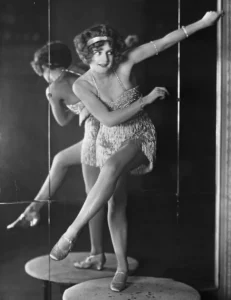
Hall observed that a key element of the flapper’s identity is motion. Yes, she looks and sounds different, but a new kind of movement is key. She moves through public spaces and dances wherever and whenever possible. On the professional stage the same appetite for motion made careers: the shimmy was the signature of Follies dancers such as Hilda Ferguson. The latest music, with its propulsive melodies and strange new tempos, is irresistible. The modern girl’s nerves, according to Hall, are “uniquely toned to jazz.”
Chani Marchiselli’s essay on the flapper and the flâneur explores how the modern young woman came to unsettle the old model of the adventuresome young man roaming the city. The vehicle for this was often dance, which allowed for public freedom and self-expression.
Movement through the city and on the dance floor was not simply display. It was a way for young women to appear in public space and act on their own terms.
These women meant to be noticed, and men certainly did, readily observing their clothing and their bodies. But the radical nature of their presentation complicated male assessment; men were often uneasy about this new mode of feminine behavior.
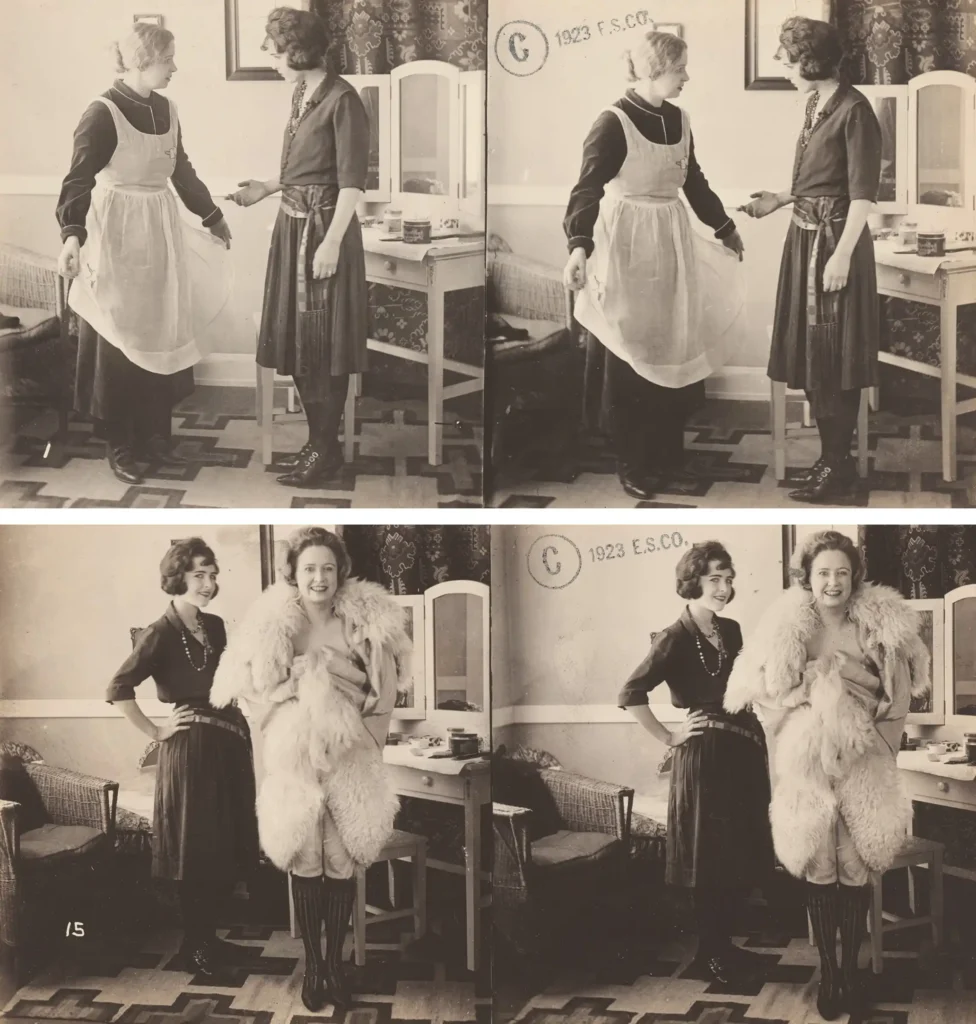
Hall draws appearance into focus through his insistence that the girl imitates, “consciously or unconsciously, her favorite movie actresses.” And it is true that a procession of actresses, often moving from the Ziegfeld Follies revue to motion pictures, were influential among young women. Stars of the mid- to late 1920s such as Louise Brooks, Mae Murray, and Mary Nolan became widely circulated ideals of beauty and helped give women confidence to appear boldly in public.
What Hall Got Wrong About the Flapper
Hall often admires the flapper, crediting her with energy, intelligence, resilience and the possibility that she might lead women toward “a new dispensation.” But he insists that, despite her new “mannish” boldness, she will eventually revert to a traditional feminine role.
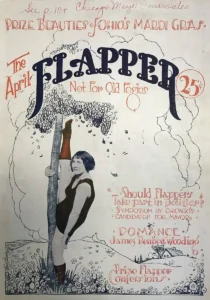 He launches a curious argument about how “the long struggle for emancipation, sometimes called the war of sex against sex”—which had produced the full women’s suffrage via the Nineteenth Amendment less than two years before the article’s publication—caused woman to lay aside “some of her most distinctive traits,” compete “with man along his own lines,” and perhaps grow “a trifle masculine.”
Hall then credits the flappers with glorying in “their sex as such” and “giving free course to its native impulses.” She “vaunts her femininity, and her exuberance gives it a new charm.” Strip away the euphemism and he is welcoming a franker sexuality in young women—display, flirtation, and above all knowledge—because he believes it clears the way for progress, which in his account requires “that women become more feminine and men more virile.”
Laura Davidow Hirshbein points out that Hall ultimately minimized the flapper’s freedom by reaffirming a strict biological distinction between women and men. She places Hall within a broader tendency to frame women’s new activities around the timeless roles of wife and mother. The flapper is a new entity celebrated for seeking a measure of freedom, but only because it promotes a beneficial, biologically prescribed femininity.
Hall’s sample is much narrower than his expansive claims suggest. The flapper of the mass media was generally imagined as white and middle-class, often a well-to-do high-school or college girl with access to leisure and consumer goods. Hall occasionally notices factory and store workers, but his universal “girl” leaves many young women outside the frame.
One of the most objectionable aspects of the essay to modern eyes is its confident assessment of young women by a male authority figure. Today we would call this “mansplaining.” It was commonplace in Hall’s time; now it is more readily recognized and criticized.
A Modern Psychologist Questions Hall’s Science
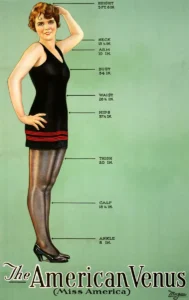
In her 1985 article The Measurement of Masculinity and Femininity: Engendering Categorical Realities, Jill G. Morawski, a social psychologist and historian of psychology, considers Hall’s flapper essay within the context of how psychologists have constructed masculinity and femininity. She places Hall among those who claimed scientific authority while moving beyond what their evidence could support.
Morawski’s discussion of Hall is brief but pointed. Hall offered little data beyond his casual observation of one girl and secondhand reports from adults about an unspecified number of others. Yet that did not stop him from offering sweeping conclusions about what the flapper represented and the type of adult she would become.
Morawski’s larger point is not simply that Hall’s method was weak. It is that psychologists, with their professional standing as scientific experts, could turn prevailing social expectations (and their own personal convictions) about men and women into seemingly objective knowledge.
Why Hall’s 1922 Flapper Mattered—and Still Does
“Flapper Americana Novissima” remains important because it captured a major social change as it unfolded. Hall perceived key elements of that change, even if he did not fully understand them. He appreciated that adolescent girls were pushing against traditional constraints and seeking greater control over their identities and lives.
Whatever qualms the essay raises today, it participated in a broader debate about greater freedom for young women and contributed to the flapper’s enduring place in the modern imagination. Hall treated her as more than a popular-media caricature mocked for frivolity and vanity. By making her the subject of serious analysis, however idiosyncratic his methods, he helped establish the flapper as a significant modern figure.
In the end, Hall offered a largely hopeful portrait of the flapper. Rather than dismissing her as evidence of moral decline, he presented her as an expression of social change and possibility. That sympathetic image—independent, energetic, and distinctly modern—has proved remarkably durable.